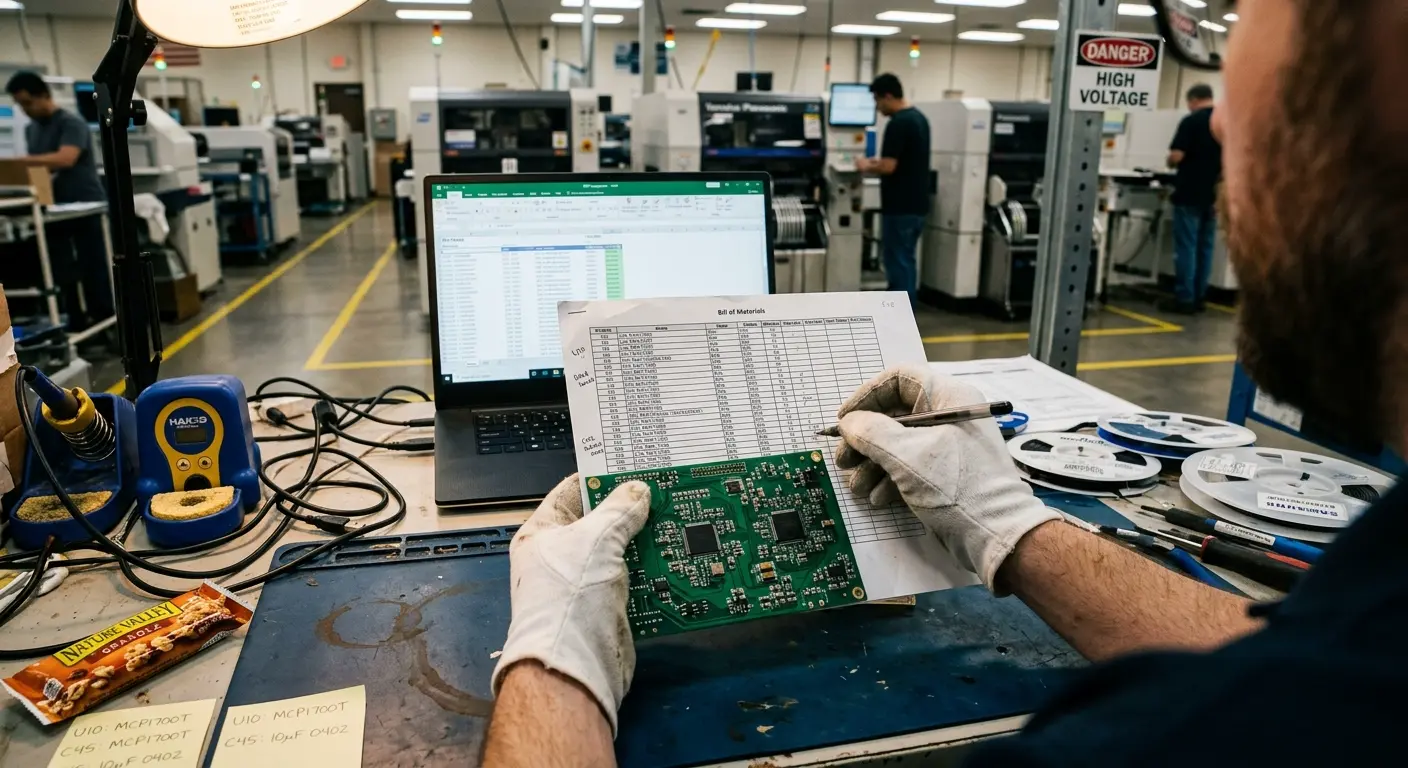
Your BOM is the single document that determines whether your AI hardware product launches on time or dies in NPI hell. Most hardware startups treat the Bill of Materials as a static shopping list — pick parts, get quotes, build boards. But in 2026's semiconductor market, where AI chip lead times stretch to 40+ weeks and passive component allocations return without warning, that approach is a recipe for missed milestones and burned runway. The startups that ship on time are the ones that design their BOMs with the same rigor they design their circuits: multi-source qualification, flexible architecture, and a built-in risk framework that flags problems months before they become production blockers.
Why BOM Strategy Is the Hidden NPI Bottleneck
Every AI hardware startup obsesses over silicon selection — NPU vs GPU vs FPGA, performance per watt, SDK maturity. But the parts surrounding that hero chip? The voltage regulators, the high-speed transceivers, the DDR5 memory, the power inductors? Those commodity decisions are where NPI timelines live or die. A single unavailable 0402 decoupling capacitor can halt an entire production run. We have seen it happen.
The 2026 semiconductor landscape compounds this risk. AI accelerator demand has absorbed foundry capacity at TSMC and Samsung, creating ripple effects across the entire component ecosystem. Power management ICs from TI and Infineon carry 26-30 week lead times. High-density memory modules from Samsung and SK Hynix are allocation-controlled. Even passive components — the parts everyone assumed were infinite — are seeing regional shortages driven by EV and data center demand.
📦 Component Availability
Design your BOM around parts that exist in volume, not just on datasheets. Multi-source qualification for every component above $0.10 is non-negotiable in 2026.
⏱️ Lead Time Management
Map every component's procurement timeline against your NPI schedule. If any part exceeds 16 weeks lead time, you need a buffer stock plan or an alternate source qualified before schematic freeze.
🔄 Flexible Architecture
Build A/B/C part flexibility into your design. The ability to swap between Texas Instruments and Monolithic Power regulators without a board spin saves weeks when allocation hits.
📊 Risk Scoring
Assign every BOM line a risk score based on sole-source dependency, supplier financial health, and geographic concentration risk. Flag anything above your threshold for mitigation before production.
The A/B/C BOM Architecture: Flexible by Design
The most resilient BOMs use a tiered qualification approach that separates components into three categories based on criticality and sourcing flexibility. This is not theoretical — this is how mature hardware companies manage procurement risk, and it works for startups too.
🏷️ The A/B/C Part Classification System
Every component on your BOM should fall into one of these three tiers:
- A Parts — Primary Source: Your first-choice component, qualified and tested. This is what you design around and what procurement targets first.
- B Parts — Approved Alternate: A drop-in or near-drop-in replacement that has been tested and validated on your board. Requires engineering sign-off but no redesign.
- C Parts — Emergency Fallback: A last-resort option that may require minor rework — paste stencil adjustment, firmware tweak, or mechanical accommodation. Qualified enough that you can activate it in under 2 weeks.
The goal: zero sole-source components in production. Every critical part should have at least a B option qualified before your first pilot run.
For AI hardware specifically, this tiered approach is most critical for power management. Your AI accelerator — whether it is an NVIDIA Orin, a Qualcomm AI Engine, or a custom ASIC — has very specific power delivery requirements. The PMICs and voltage regulators feeding that chip need to deliver tight transient response and precise sequencing. Having only one qualified source for these parts is a bet-your-company decision.
Power Delivery: Where AI Hardware BOMs Fail First
AI accelerators draw massive transient currents — 50A to 200A spikes in microseconds during inference bursts. Your power stage components (inductors, MOSFETs, bulk capacitors) must handle these transients without voltage droop that causes logic errors. The specific inductor value, DCR, and saturation current rating are not easily swapped without validating against your load profile.
This is why we recommend qualifying at least two inductor suppliers (e.g., Wurth Elektronik and Bourns) and two MOSFET sources (e.g., Infineon and onsemi) during your prototype phase. The validation cost is modest — a few hours on a bench with an oscilloscope and electronic load — but the insurance value is enormous when your primary source goes on 30-week allocation.
Component Risk Matrix for AI Hardware
Not all BOM lines carry equal risk. Use this matrix to prioritize your qualification and mitigation efforts. Score each component on three axes: sole-source risk (1-5), lead time risk (1-5), and substitution difficulty (1-5). Multiply for a composite risk score.
AI Accelerator / SoC: Typically sole-sourced from NVIDIA, Qualcomm, or custom foundry. Long lead times (30-52 weeks). Substitution requires full redesign. Mitigation: Early engagement with distributor allocation managers, long-lead procurement at prototype stage, buffer stock of 20-30% above forecast.
PMICs and Voltage Regulators: TI, Infineon, MPS lead times of 20-30 weeks. Multiple footprints available but performance varies. Mitigation: Qualify A/B sources during EVT phase, use adjustable-output regulators that cover multiple voltage rails.
High-Speed Memory — DDR5, LPDDR5, HBM: Samsung, Micron, SK Hynix supply constrained by data center demand. 18-26 week lead times. Mitigation: Standardize on commodity density/package, qualify two vendors, avoid speed-bin-locked designs.
Connectors and Cable Assemblies: Amphenol, Molex, TE typically 12-16 weeks. Many footprints are proprietary. Mitigation: Design around industry-standard footprints, stock connector families used across your product line.
Passive Components — Resistors, Capacitors: Generally available from 5+ manufacturers. Short lead times (4-8 weeks) except during allocation events. Mitigation: Use standard EIA case sizes, avoid exotic values, maintain approved vendor list of 3+ suppliers per value.
NPI Readiness: The BOM Scoring Rubric
Before you commit to production tooling, score your BOM against this readiness checklist. Every "No" answer is a risk that needs a mitigation plan — or a redesign decision you should make before spending $50K on steel tooling.
- Sole-Source Ratio Below 15%: No more than 15% of your BOM lines should have only one qualified source. Above this threshold, a single supply disruption can halt production.
- All Long-Lead Items Identified: Every component with lead time exceeding 16 weeks is documented, with buffer stock ordered or alternate source qualified.
- Passive Component AVL Complete: Every resistor, capacitor, and inductor has at least 3 approved vendors in standard case sizes with no exotic values.
- Power Stage Fully Validated: All A and B power delivery components tested under worst-case transient load, thermal validated across your operating range.
- BOM Cost Within Target at Volume: Component pricing validated at your actual production volume — not Digi-Key unit pricing, not "estimated" pricing, but quoted pricing from your CM or distributor.
- End-of-Life Check Complete: Every part verified as active and not under PDN (Product Discontinuation Notice). Check manufacturer websites and distributor EOL flags.
- Geographic Diversification: No more than 60% of BOM cost concentrated in a single country of origin, considering current trade policy risks.
- DFM Review Passed: Your CM has reviewed the BOM for assembly feasibility — component spacing, reflow profile compatibility, and test access.
Supplier Strategy by Component Category
Different component categories demand different sourcing strategies. Here is our recommended approach for AI hardware BOMs, based on what we see working across dozens of startup NPI programs at Illuminious.
🧠 AI Accelerators
Engage allocation managers at Arrow, Avnet, or Mouser 6+ months before build. Register your design with the silicon vendor's startup program for priority allocation. NVIDIA Inception and Qualcomm Advantage offer qualified startups early access.
⚡ Power Management
Qualify at least 2 PMIC/regulator vendors during EVT. TI, MPS, Infineon, Richtek all offer Webench-style tools for quick alternative validation. Use adjustable-output parts to maximize interchangeability.
💾 Memory
Standardize on commodity densities and packages. Qualify Samsung and Micron in parallel. Avoid speed-bin-locked designs — design for the widely available speed grade, not the fastest bin.
🔌 Connectors
Prioritize industry-standard footprints over proprietary ones. Molex, TE, Amphenol each have cross-reference tools. If you must use a proprietary connector, negotiate allocation commitments at PO time.
📦 Passives
Use EIA standard case sizes (0402, 0603, 0805). Maintain an AVL with Murata, Samsung Electro, Yageo, TDK, and Walsin. These five cover >95% of passive requirements and buffer against any single supplier's allocation.
🔧 Mechanicals
Heatsinks, shields, and enclosures seem simple but carry hidden lead times. Engage 2 thermal solution vendors early. CNC prototyping is fast but production stamping/die-casting tooling takes 6-10 weeks.
Managing Lead Times in the 2026 Semiconductor Market
The 2026 semiconductor cycle is unlike 2021's broad-based shortage. This time, the crunch is concentrated in AI-adjacent components — the chips, memory, and power ICs that feed the generative AI infrastructure boom. Here is how to manage it.
⚠️ 2026 Lead Time Reality Check
Based on current distributor data and OEM procurement reports:
- AI Accelerators — NVIDIA, Qualcomm, custom ASICs: 30-52 weeks. Improving from 2025 but still allocation-controlled.
- High-Bandwidth Memory — HBM3E, LPDDR5X: 22-30 weeks. Data center demand absorbing >80% of output.
- Power Management ICs: 18-28 weeks. TI and Infineon prioritizing automotive and industrial accounts.
- High-Speed SerDes and Transceivers: 16-24 weeks. Concentrated among 2-3 vendors.
- Standard Passives: 6-10 weeks. Generally stable but watch for allocation on high-capacitance MLCCs.
- Connectors: 10-16 weeks. Standard items available; custom tooling adds 6-8 weeks.
The takeaway: if your BOM contains any AI accelerator or high-speed memory, your procurement timeline drives your NPI schedule — not the other way around.
Buffer Stock Strategy for Startups
Startups cannot afford the inventory buffers that large OEMs carry, but you also cannot afford to stop a production line waiting for parts. The solution is strategic buffer stock on your highest-risk components:
- AI Accelerator — 20-30% buffer: Order above forecast at PO time. The extra cost of holding inventory is trivial compared to the cost of a stalled production run.
- Memory — 15-20% buffer: Particularly for the specific density and speed grade you designed around. Do not assume you can swap speed grades at production time.
- PMICs — 10-15% buffer: These are your most commonly delayed components after the SoC itself. A small buffer pays for itself on the first allocation event.
- Custom Mechanicals — 100% buffer on first run: Your first production run of heatsinks, shields, and brackets should always include spares. Tooling adjustments between runs are common and having buffer parts prevents downtime.
How Illuminious Helps Startups Build Resilient BOMs
At Illuminious, we work with AI hardware startups from schematic review through volume production, and BOM optimization is baked into every phase. Our approach is not theoretical — it comes from managing hundreds of NPI programs across our three manufacturing sites in Palo Alto, Shenzhen, and Batam.
Our DFM services include BOM risk analysis as a standard deliverable. Before your board goes to layout, we review every component for availability, cost optimization opportunities, and supply chain risk. We catch the sole-source PMIC that is about to go on 30-week allocation. We flag the exotic inductor value that has only one manufacturer. We suggest the standard-value alternative that saves you $2.40 per board without compromising performance.
Our NPI engineering team manages the entire procurement timeline in parallel with your design progress. Long-lead parts get ordered at EVT. Buffer stock plans get built into your production quotes. And because we maintain relationships with distributors across the US, China, and Southeast Asia, we can source from multiple channels when one region goes tight.
For early-stage startups, our Startup Bridge Program provides access to our component database, pre-negotiated distributor pricing, and BOM review services at rates designed for pre-revenue companies. We have seen too many startups fail not because their product was bad, but because they could not get parts. That is a solvable problem with the right partner.
For deeper reading on related topics, see our guides on AI hardware chip selection and our complete NPI engineering guide.
Build Your BOM Like You Build Your Product — With Intent
The AI hardware startups that will win in 2026 are not just the ones with the best algorithms or the most funding. They are the ones that can actually ship product at scale, on time, without supply chain disasters eating their runway. Your BOM strategy is the foundation of that capability.
Start your BOM risk assessment early, qualify alternate sources before you need them, and work with a manufacturing partner who treats supply chain resilience as a core competency — not an afterthought.