Sheet metal fabrication for enclosures, brackets and panels
No CAD yet? Our design team can take it from a sketch or a spec.
Walk Shenzhen factories with us, Dec 6–11. See the tour
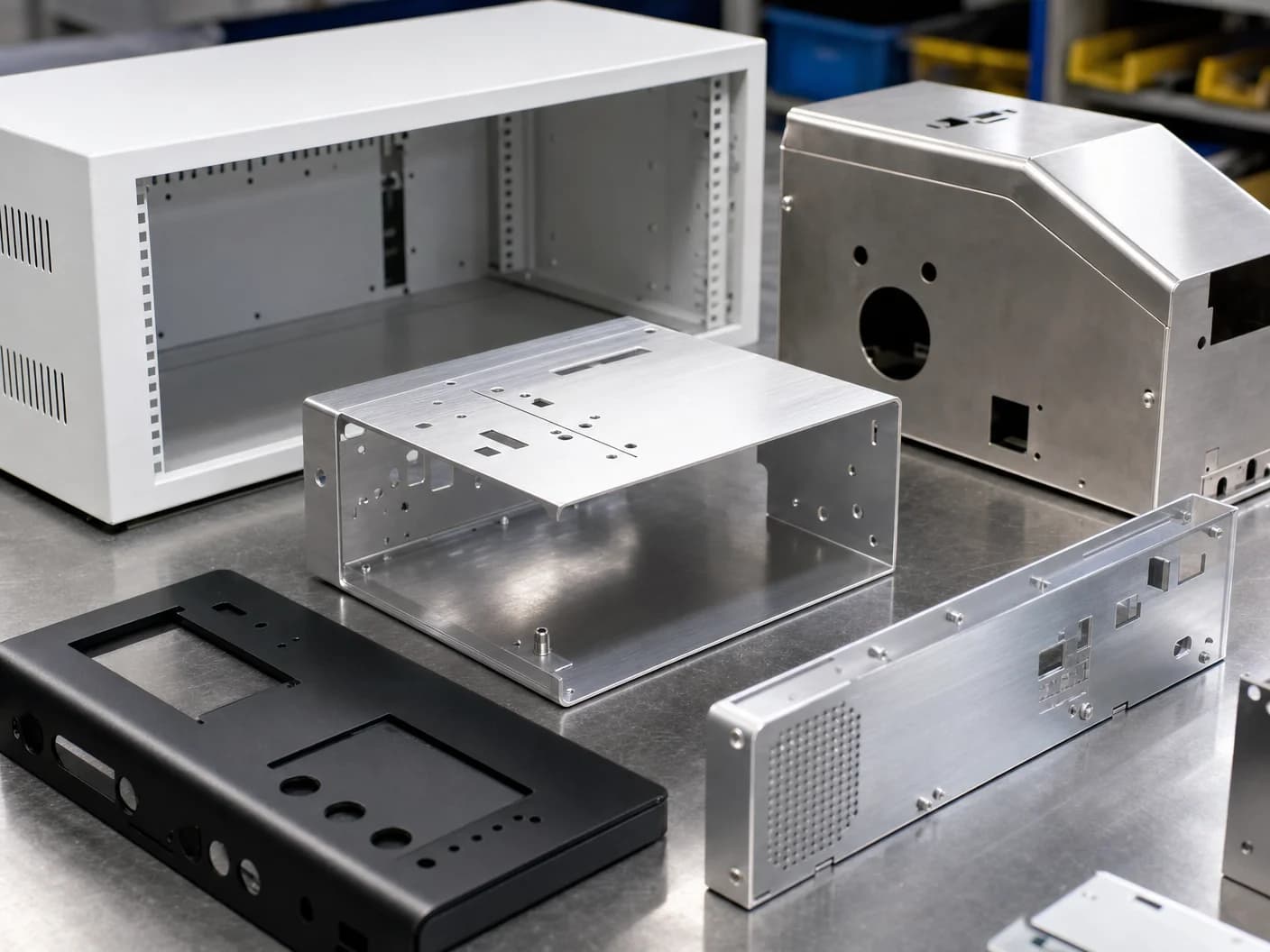
Sheet metal fabrication makes a part by cutting a flat profile from sheet stock and then forming it: bending it on a press brake, welding it and adding hardware. Because the material starts flat and keeps one thickness, a sheet metal part is lighter and cheaper than a machined one for an enclosure, a bracket or a panel. Illuminious is a U.S. NPI engineering company, and the Shenzhen factory cuts, punches, bends, welds and finishes sheet metal in-house after our engineers check each part against how it will be formed. Engineered in San Francisco. Prototype builds, DFM and mass production in our own factory in Shenzhen.
Choose it when the part's job is to contain, mount or cover something, not to be a solid body. For electronics, that means chassis, rack enclosures, brackets for boards and batteries, heat-spreading covers, and front panels. Sheet metal is one of the 12 services in the portal, and a specialist prices every order from your files.
What the factory does in sheet metal
| Capability | What it covers |
|---|---|
| Laser cutting | Flat profiles, holes and cut-outs in aluminum, mild steel, stainless and copper or brass. |
| Bending and forming | Press-brake bending, with bend allowances set by the tooling and the material. Hems and louvers declared per order. |
| Punching | Perforated patterns, louvers and repeated shapes, punched in-house. Formed parts at volume go to metal stamping. |
| Welding | Welded parts and assemblies, with dressing after the weld. |
| Hardware and features | Installed hardware and inserts, tapped holes, countersinks and counterbores, and laser marking. |
| Finishing | As fabricated and deburred, anodizing on aluminum, powder coating, brushing, plating, and silkscreen or marking. Anodizing, plating and powder coating are done in the Shenzhen factory. |
| Inspection | Standard inspection, a dimensional report, or a first-article report. |
| Box build | Sheet metal parts assembled with boards, harnesses and displays into a finished unit in the same factory. |
What design choices make a sheet metal part cheaper?
Fewer bends in fewer setups, less welding, and a part that unfolds into one flat pattern. Keep the inside bend radius at or above the material thickness. Keep holes and forms away from bends. Use tabs, clinches or fasteners where you could weld. Each choice makes the part cheaper and easier to repeat.
These are the checks the free engineering review runs on every sheet metal order. On an engineering project, our engineers apply them while the enclosure is still in CAD, as part of the DFM services for the whole product, so the board, the enclosure and the box build agree before anything is cut.
Three examples show the difference. A box with four welded corners becomes a box with tabs and slots, and the welding disappears. A bracket with a hole too close to its bend becomes one with the hole moved a few millimeters, and the hole stops distorting. A cover with two bend radii becomes one with a single radius, and the press brake needs one setup instead of two.
What does a sheet metal part cost you?
Cut length, bend count and weld length, all declared with the order. Cutting is priced by how far the beam travels, which is why a part covered in small holes costs more than its area suggests. Bending is priced per bend and per setup. Welding costs most, because it is manual and needs dressing afterward.
A design that clinches, tabs or fastens where it could have welded is the cheaper and more repeatable design. Finish and appearance grade add cost too: a cosmetic grade changes how the part is handled at every step, from the first cut to packing.
How a sheet metal part is made
Free engineering review
An engineer checks the flat pattern, the bend sequence and the features against the material and thickness.
Material
Sheet is chosen and checked for thickness and surface.
Cutting and punching
The flat pattern is laser cut or punched, with holes and cut-outs in place.
Forming
Bends are formed on the press brake in the planned order.
Welding and hardware
Welds are made and dressed; inserts and fasteners are installed.
Finishing and inspection
The finish is applied in the factory, and the part is inspected at the level you declared.
How thick a sheet can be bent, and how tight a radius?
The configurator accepts a declared sheet thickness from 0.3 to 25 mm. Formability at both ends is confirmed against your material in the free engineering review. Thin sheet bends easily and tears at a tight radius. Thick sheet needs more force and springs back more, so the bend allowance matters more as thickness rises.
Where a flat pattern already exists, declare it. The configurator has a field for it, and supplying yours removes an assumption from the price. If ours and yours differ, the review reconciles them before production, not after.
Tolerances deserve the same care. Laser-cut features hold tighter tolerances than bent ones, because every bend adds the variation of the material and the brake. Put the tight tolerance on features in one flat face where you can, and dimension bent features from the bend that locates them. Declare general, controlled or critical tolerance per order, and mark the critical dimensions on the drawing.
Which material should an enclosure be made from?
Aluminum for low weight and for anything that will be anodized. Mild steel for strength per dollar, where powder coat protects it. Stainless for wet, chemical or hygienic places, and for parts that must not be coated. Copper and brass for conductivity or appearance, not for structure. The finish is a separate decision.
The finish interacts with the material. Anodizing applies only to aluminum. Powder coat hides more than brushing does. Brushed stainless shows every handling mark made after brushing.
What does an electronics enclosure need from sheet metal?
Three things beyond fit. Seams that close tightly enough to keep electromagnetic noise in, so the product passes its emissions tests. Ventilation placed where the heat actually is. And mounting points that hold boards, batteries and connectors where the layout expects them, within the tolerance the box build needs.
Those three are where enclosure and electronics meet, and where separate suppliers lose time. When the board and the enclosure are designed and built by one team, the seam contact, the airflow and the standoffs are checked against each other in the same DFM review.
Sheet metal bounds
A specialist prices every order; a build outside a bound goes to an engineer.
Declared optionSettings available
- Product type
- Flat cut part, bent part, welded part, or sheet-metal assembly
- Material
- Aluminum, mild steel, stainless steel, copper and brass
- Sheet thickness
- 0.3 to 25 mm
- Envelope
- 1 to 3,000 mm width and height, 0 to 3,000 mm depth
- Quantity
- 1 to 100,000 parts
- Profile cut length
- 0 to 1,000,000 mm declared
- Flat-pattern area
- 0 to 90,000 cm² declared
- Bend count
- 0 to 200 bends
- Weld length
- 0 to 100,000 mm estimated
- Features
- Countersink or counterbore, tapped holes, installed hardware and inserts, hems, louvers, laser marking
- Finish
- As fabricated or deburred, anodize, powder coat, brushed, plating, silkscreen or marking
- Tolerance
- General, controlled, or critical dimensions
- Inspection
- Standard, dimensional report, or first-article report
- Required files
- STEP model plus a dimensioned drawing before production; DXF for flat-only parts
- Free engineering review
- Within 24 hours on business days after you submit
Recent work: a rack server split across three vendors
An edge computing startup had its aluminum enclosure, its HDI boards and its rack assembly at three vendors, and the units ran hot and leaked noise at the seams. In the Shenzhen factory, the enclosure, the board assembly and the box build moved onto one floor. Ventilation was matched to the heat, and gaskets were fitted at a controlled compression. Read the case study
Order sheet metal online
Sheet metal parts take one path: configure online and get an official quote from a specialist within 24 hours on business days, after the free engineering review. Start in sheet metal. For a sheet metal part inside an assembly with boards and wiring, use custom mechatronic parts and assemblies. Read the sheet metal design guide before you fix bend radii and hole positions.
Facts and questions
Do you need a flat pattern, or can you unfold my model?
Either. "Flat pattern available" is a declared toggle on the order. Supplying yours removes an assumption: bend allowance depends on the tooling and the material, so a pattern unfolded with different assumptions should be reconciled before production. The free engineering review compares the two and tells you where they differ.
Can you install hardware such as press-in inserts?
Yes. Installed hardware and inserts are one of six declared features, with countersinks and counterbores, tapped holes, hems, louvers and laser marking. Declaring them with the order puts them in the price instead of in a later revision, and the review checks their distance from bends and edges.
What finishes are available?
As fabricated and deburred, anodize, powder coat, brushed, plating, and silkscreen or marking. Anodizing, plating and powder coating are done in the Shenzhen factory, and anodizing applies to aluminum only. Appearance grade (standard, strict or cosmetic) is declared separately, because it changes how the part is handled throughout fabrication.
How large a part can you fabricate?
The configurator accepts an envelope of 1 to 3,000 mm in width and height and up to 3,000 mm in depth, with a flat-pattern area up to 90,000 cm². Larger work is priced by an engineer in the official quote. Thin or oversized parts may need extra support in handling, which the review notes.
Can sheet metal parts go into a box build with boards?
Yes. The Shenzhen factory runs sheet metal and box build in-house, so the enclosure, the board assembly and the final build can sit on one order and one floor. Use custom mechatronic parts and assemblies to declare the assembly needs: fasteners and torque, wiring, functional test and custom packing.
When does a sheet metal part need a drawing?
A model is enough to configure the order; a specialist prices it within 24 hours on business days. A dimensioned drawing is required before production wherever the part has a requirement the geometry cannot carry: a tolerance tighter than the general band, a datum scheme, a finish callout, a thread or a cosmetic surface.
How your official quote is prepared
A specialist prepares the official quote for your sheet metal parts from your files and specifications, within 24 hours on business days after you submit. An engineer reviews every order, and the review comes before payment. The official quote it publishes is the amount you pay.
- An engineer runs a free engineering review of your files, and nothing is charged when you submit.
- You see the findings first.
- We publish the official quote with an itemized total, lead time and validity window.
- You accept the official quote, and only then does payment open.