OEM manufacturing to your design
No CAD yet? Our design team can take it from a sketch or a spec.
Walk Shenzhen factories with us, Dec 6–11. See the tour
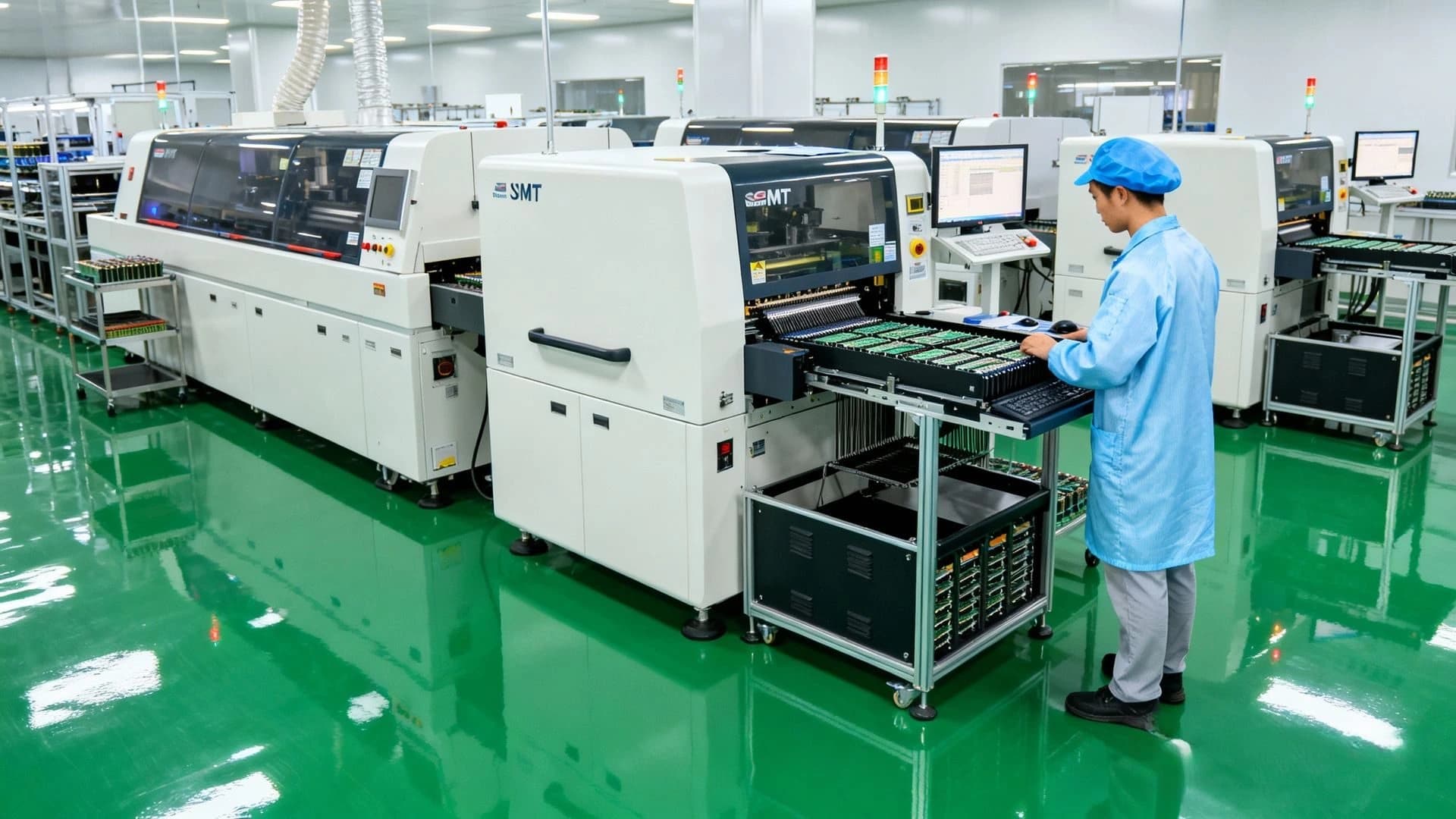
We build a product to a design you own and control. You supply the files; we supply the process, the capacity and the quality system, and we change nothing without asking. Choose OEM when the design is settled, you can own the engineering, and what you need is the same result on every unit you ship, batch after batch. Illuminious is a U.S. NPI engineering company, and OEM manufacturing is your design, built as drawn: nothing in it changes without your approval. Engineered in San Francisco. Prototype builds, DFM and mass production in our own factory in Shenzhen.
Build-to-print is enforced by fields on the order: alternates policy, production-file confirmation, traceability and revision approval. Engineering still matters on an OEM job. Our engineers read your package before the first build, and a DFM review is available when you want one. If your design is not settled yet, ODM services or DFM services fit better.
Why do engineers read a build-to-print package?
Because a package that looks complete can still stop a line. A BOM line with no stock, a footprint that does not match its part, a tolerance the drawing never states, a test point no probe can reach: each is cheaper to find in a file than on the floor. The free engineering review finds them first.
The findings come back as a list. Each item names the file, the problem and what we propose. You decide. We do not change a build-to-print design to suit ourselves; a proposal you decline stays declined, and the risk is written down so both sides know it is there.
What the Shenzhen factory does for an OEM build
| Capability | What it covers |
|---|---|
| Boards | Bare-board fabrication and SMT on 8 automated SMT lines, through-hole and mixed boards, with automated optical inspection, and X-ray on the advanced route. |
| Molded parts and tooling | Injection molding on 30+ injection molding presses. Production molds are cut after DVT closes the design, and tooling you pay for is yours. |
| Machined and sheet-metal parts | CNC machining and sheet metal in-house, with dimensional, CMM or first-article reports declared per order. |
| Box build | Boards, harnesses, displays and power go into the enclosure, then firmware is loaded and each unit is tested. |
| Test | 30+ ICT/FCT test stations. Fixtures are built before PVT and run the production test firmware. Firmware test results are kept per serial number. |
| Sourcing | Parts from our network of 350 audited suppliers, consigned by you, or a mix. |
| Certification support | Units prepared for the certification path. |
| Quality system | The factory holds ISO 9001, ISO 13485, IATF 16949, AS9100 and ISO 14001. Workmanship is judged to IPC-A-610 and rigid boards to IPC-6012. |
What changes between a prototype order and a production order?
The controls, not the care. A prototype order answers questions and may change between units. A production order builds the same unit every time, so the alternates policy, the inspection level, the test definition and traceability are fixed before the run. A design change then needs a new revision, re-measured and signed.
The first production run starts from a signed golden sample, not from a prototype that happened to work. If you have no golden sample yet, the first OEM step is a PVT run to make one. If you have one from another factory, we measure it against your drawings and our first articles before volume starts.
What does a complete build-to-print package contain?
Each service publishes its required files. A board needs a fabrication Gerber archive, plus a BOM and placement file for assembly. A machined part needs a STEP model, plus a drawing for anything the geometry cannot carry. Sheet metal needs a model and a drawing, with DXF accepted for flat parts.
The rest of the package is what files cannot express: the alternates policy, the inspection level, the marking and packing, and any regulated use. All are declared fields on their order routes. Declaring them accurately is what makes the official quote the amount you pay.
How an OEM build runs
Package review
Our engineers read your CAD, BOM, schematics and quality specification. The free engineering review returns findings before you pay.
Official quote
Tooling, unit price and one-time engineering costs are itemized, with the lead time.
Tooling and first articles
Molds, dies and fixtures are made. First-article units are measured and documented for your approval.
PVT
A run on production fixtures proves the process. Our engineers attend it in person.
Golden sample
You sign the reference unit. The record lists the design revision, BOM, firmware release, measured values and cosmetic limits.
Production
Each batch is compared with the golden sample. When a result drifts, an engineer reviews it before the next batch.
Packing and shipment
Units are packed to your specification, in anti-static packing where they carry boards, and shipped to your warehouse or fulfillment point.
How do I stop the manufacturer changing my design?
Declare that it may not, and require the production file. "No alternates without approval" is a declared setting on the mechatronic route, and production-file confirmation on board and stencil orders blocks fabrication until you approve the file that will run. Every scope change then arrives as an itemized revision you approve, question or decline.
There is no silent price increase and no silent substitution. That is what separates a build-to-print relationship from a supply one. A design change after the golden sample is re-measured against the old reference and signed again.
What evidence comes back with a production run?
Whatever you declare. On a board: electrical test as a sample or a 100% flying-probe test, AOI, X-ray on the advanced route, and programming and functional test where you define the pass. On a part: standard inspection, a dimensional report, a CMM report or a first-article report, with a material certificate on request.
Lot and material traceability is a declared toggle on the mechatronic route. Requesting it with the order puts the record-keeping into the reviewed scope, where it can be planned instead of reconstructed. Production units ship with debug ports locked.
How is quality held from batch to batch?
Against the golden sample you signed. Each batch is compared with it, using the inspection and test results the order declares: automated optical inspection, X-ray on the advanced route, and in-circuit and functional tests on fixtures built for your product. When a result drifts, an engineer reviews the drift before the next batch runs.
The first board of each run is checked against the BOM before the run continues. A design change after sign-off is re-measured against the old reference, and the golden sample is signed again. Nothing about the reference changes by default.
What to decide before the first production run
- Alternates policy. Which parts may change, and who approves a change.
- Inspection level. AOI on the standard board route; AOI with X-ray or an advanced report on the advanced route; standard, dimensional, CMM or first-article on parts.
- Test definition. What the functional test measures and what counts as a pass.
- Traceability and marking. Lot and material traceability on the mechatronic route, and board marking: an order number at a position you choose, or a 2D data-matrix code.
- Packing. Standard or custom packing, and a humidity indicator card for moisture-sensitive assemblies.
- Product class. Consumer, industrial or a regulated class, which sets the paperwork that ships with the units.
Regulated products run under the Shenzhen factory's certificates: medical devices under ISO 13485, with the FDA path run with your regulatory team; automotive and EV parts under IATF 16949; aerospace and drone parts under AS9100. Four of the six product classes send a board order to an engineer before anything is built.
The controls a build-to-print order declares
Each setting exists on the order route named in its row.
| Control | Settings available | What it prevents |
|---|---|---|
| Approved alternates (mechatronic route) | No alternates without approval; form and fit with approval; engineer may propose | A part substituted without your knowledge |
| Production-file confirmation (board and stencil routes) | Requested or not, per order | Fabrication from a file you have not seen |
| Lot and material traceability (mechatronic route) | Requested or not | A field failure that cannot be traced to a batch |
| Electrical test (standard board route) | Sample test, or 100% flying-probe test | An open or short reaching your line |
| Inspection (advanced board route) | Standard AOI; AOI with X-ray; advanced report with X-ray | Hidden joints under bottom-terminated packages nobody checked |
| Inspection (CNC route) | Standard, dimensional report, CMM report | A dimension nobody measured |
| Material certificate (CNC route) | Requested or not | An alloy you cannot prove |
| Board marking (standard board route) | None; order number at our position or yours; 2D data-matrix code | Units nobody can identify after they ship |
| Product class (standard board route) | Consumer or industrial, automotive, medical, aerospace, military or defense, other regulated | Regulated paperwork found after the build |
Who you work with
Your contract is with Illuminious LLC (Wyoming). In Shenzhen, our engineers work next to the lines that build your product, and the same engineers answer your questions from the package review to the last batch.
Recent work: one housing, one board, one partner
A smart home company had its housing, its HDI board and its box build at separate vendors on two continents, and every defect started an argument about whose part was wrong. In the Shenzhen factory, the overmolded enclosure, the multilayer HDI assembly and the final box build moved onto one program and one quality system. Read the case study
Order build-to-print work online
Board builds go through Standard PCB & PCBA, with a live supplier price where suppliers can price the build and a specialist where they cannot. Parts and assemblies go through custom mechatronic parts, CNC machining and sheet metal: configure online and get an official quote from a specialist within 24 hours on business days. Volume production, molding and box build are priced by an engineer in an official quote. Read the box build assembly guide before you write the assembly specification.
Facts and questions
What do you need to take over an existing design?
The files, the BOM, the test specification and a golden sample if one exists. Our engineers read the package, run a first-article build and compare it with your reference. Tooling you own elsewhere moves here only when it fits the factory's equipment; the review confirms that before any transfer is planned.
Which quality standards do you build to?
The Shenzhen factory runs ISO 9001, with ISO 13485, IATF 16949 and AS9100 where medical, automotive or aerospace requirements reach the build. Assemblies are judged to IPC-A-610 and rigid boards to IPC-6012. Class 3 is an acceptance level inside those standards: name it in the order and the inspection scope follows it.
Can I keep buying some components myself?
Yes. Parts supply is a declared field with three settings: Illuminious sources the parts, you consign them, or a mix. Consigning the parts you already hold while we source the rest is a normal configuration. The free engineering review confirms which lines you supply and which we buy before anything is ordered.
What quantities can I order?
Board orders in the portal take 1 to 100,000 boards on the standard route. Production quantities for molded parts and box builds are set in the official quote, from what the tooling and the line need. A small first run is normal: a PVT run is sized by what it must prove, not by a minimum.
Do you sign our NDA before we send files?
Yes. We sign your NDA before the first call, and project files live in private project storage, reached through your account. Files uploaded to the portal stay attached to the order revision they belong to, so the build runs from the version you approved and not from an email attachment.
Can units ship straight to our U.S. warehouse?
Yes. Units are packed to your specification in the Shenzhen factory and shipped to the address you name, whether that is your warehouse, a retailer's distribution center or a fulfillment point. See U.S. fulfillment for the packing, marking and delivery options that are declared with the order.
What does build-to-print change control look like?
A change is an itemized revision. The proposal names the file, the problem and the cost, and you approve, question or decline it. A declined proposal stays declined. Alternates need your approval under the declared policy. After the golden sample, a design change is re-measured against the old reference and signed again.
How your official quote is prepared
Board builds show a live supplier price where suppliers can price them; a specialist prices parts, assemblies and anything suppliers cannot, within 24 hours on business days. An engineer reviews every order before payment. The official quote is the amount you pay.
- An engineer runs a free engineering review of your files, and nothing is charged when you submit.
- You see the findings first.
- We publish the official quote with an itemized total, lead time and validity window.
- You accept the official quote, and only then does payment open.