Cable and harness assembly, from wiring list to tested harness
Settle branch lengths, connectors and the test before EVT. The review aims at a harness that fits the enclosure on the first build.
No CAD yet? Our design team can take it from a sketch or a spec.
Walk Shenzhen factories with us, Dec 6–11. See the tour
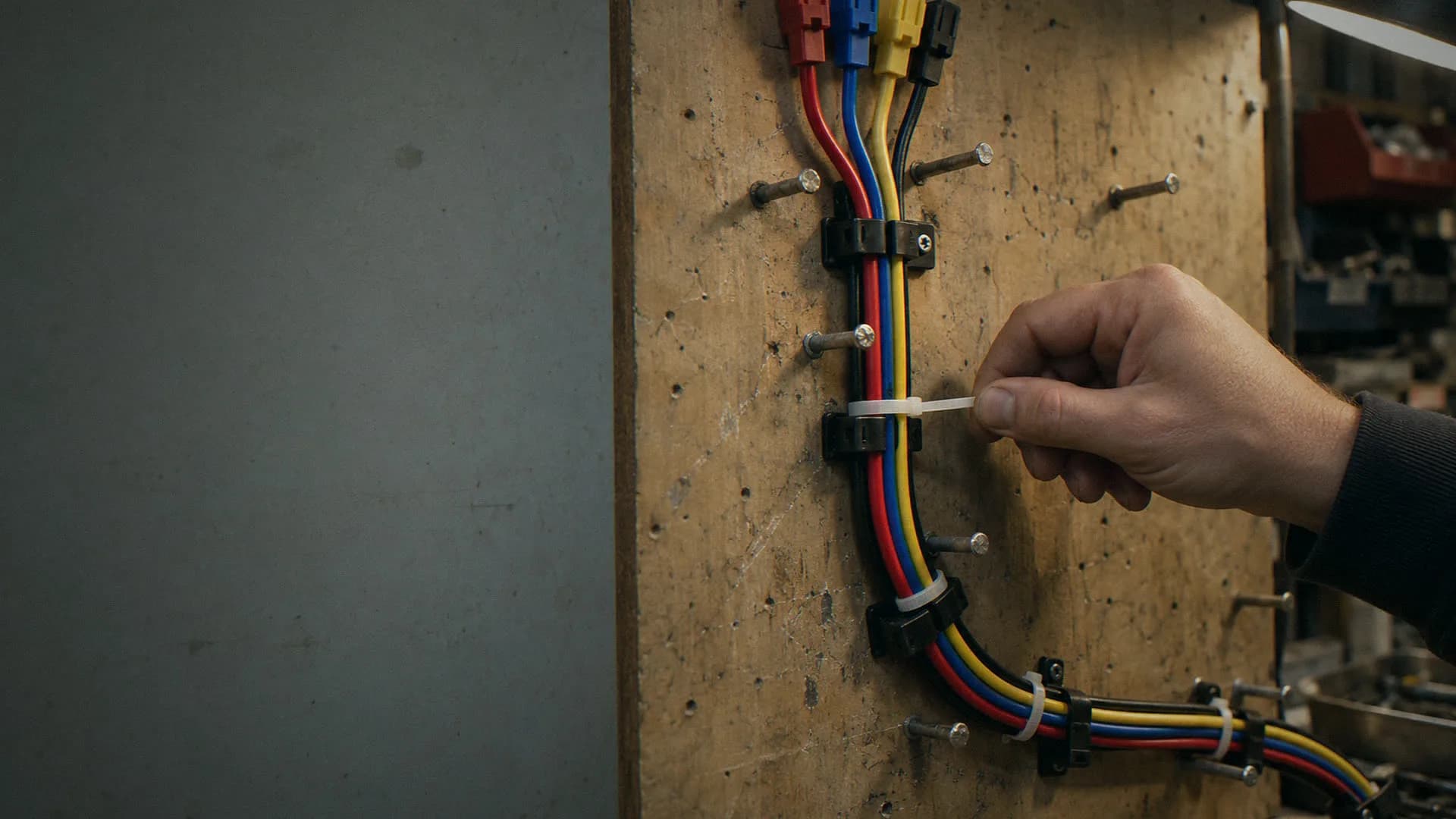
A cable harness is a set of wires cut to length, terminated, bundled and loaded into connectors. With a harness, the assembler plugs in one connector instead of routing each wire by hand. Routing loose wires during final assembly is slow and error-prone, and the wiring cannot be tested before the product exists. Illuminious is a U.S. NPI engineering company. Engineered in San Francisco. Prototype builds, DFM and mass production in our own factory in Shenzhen. Choose a harness when wiring in place would be the assembly bottleneck.
You order harness and cable work through the custom mechatronic parts and assemblies route, the same route as any built-and-tested sub-assembly. A schematic says which pin connects to which. A harness built from a schematic alone is built on somebody's guesses about everything else.
Design the harness with the enclosure
Our engineers treat the harness as part of the mechanical design. Branch lengths, bend points, connector access and strain relief depend on the enclosure, so we review them in the same DFM review as the housing. The DFM services page explains that review.
At the demo build, a harness is often hand-built to prove the routing. Before EVT, the drawing must be complete enough that every unit comes out the same. We check that step in review, so the pilot build does not depend on one technician's memory. If the harness carries signals for a radio, a motor driver or a battery pack, we review it with the board design. Shield termination, wire gauge and connector rating follow from the electrical design.
When the product moves to volume, the harness is fitted during box build in the Shenzhen factory. There the unit is assembled, programmed and tested as a whole, and harness faults show up in the functional test instead of in the field.
What we build
| Capability | What it covers |
|---|---|
| Custom cable assemblies | Cables built to your drawing, from simple jumpers to shielded signal and power cables. |
| Multi-branch harnesses | Harnesses with defined branch lengths, breakouts, sleeving and labels, built on a board that matches your drawing. |
| Workmanship standard | Harnesses built and inspected to IPC/WHMA-A-620. |
| Overmolding and potting | Strain relief and moisture protection at connector exits, where the drawing calls for them. |
| Coaxial and RF cables | RF cable assemblies for antenna feeds and radio modules, reviewed with the RF layout. |
| Integration into the unit | Harnesses routed and fitted inside the enclosure as part of the box build. |
| Electrical test | Continuity on every harness. Hipot, insulation resistance and dielectric withstand tests where the drawing or the product calls for them. |
How a harness job runs, step by step
| Step | What we do | What you get or decide |
|---|---|---|
| 1. Drawing review | An engineer checks the wiring list, connector and contact BOM, branch lengths, labels and sleeving. | A list of gaps and questions, before you pay. |
| 2. First article | We build first units to confirm fit, lengths and termination. | First units to fit in your enclosure, and your approval of the drawing revision. |
| 3. Wire processing | Wires are cut, stripped and crimped with the tool and die set for each contact. A pull test runs on sample crimps. | Terminations made to the contact maker's settings. |
| 4. Assembly | Technicians route, splice, solder where specified and load the connectors on a fixture board. | Harnesses that match the drawing geometry as well as the schematic. |
| 5. Test and pack | Each harness gets the declared electrical test, then a visual check and packing. | Tested harnesses, with lot traceability when you declare it. |
Why plan the harness early
Fewer surprises at assembly
A harness designed with the enclosure is far more likely to fit on the first build. A harness designed after it is often too long, too short or blocks a fastener.
Repeatable units from EVT on
A complete drawing means the tenth unit matches the first. That matters when EVT and DVT results must compare like with like.
Test that matches the risk
We agree the test scope with you. A continuity check suits a simple cable. A product with motors, batteries, mains voltage or field use usually needs a hipot or insulation resistance test, and a pull test on sample crimps.
Drawings you own
The harness drawing is part of your design files. On a portal harness order the drawing is yours, and on engineering projects design files and IP are assigned to you at hand-off.
Parts with a controlled source
Connectors and contacts come through our component sourcing team. No part is changed without the approval rule you declare.
What does a harness drawing need to specify?
Everything a schematic leaves out. The length of each branch, the breakout direction, the wire gauge and insulation, the connector and contact part numbers, the cavity for each wire, and where labels and sleeving go. A harness built from a schematic alone is built on guesses, and it may not fit.
The omission we see most is the length that matters: the branch length, measured between defined points on the product. A harness can be electrically correct and still not fit. Declare the assembly needs with the order: wiring, fasteners and torque, adhesive, calibration, functional test and custom packing are each a declared option.
Why is the crimp the part that fails?
Because you cannot see a bad crimp once it is made. A crimp is a cold weld made by deforming metal. With the wrong tool, die or strip length, it looks the same as a good one and passes continuity. Later it works loose under vibration or corrodes where the insulation grip should be.
Soldered joints on stranded wire fail in their own way. Solder wicks up the strands and makes a stiff point that cracks with flexing. Termination is a question of process control as much as workmanship, and a harness order states its test scope for this reason. Continuity proves connection. It does not prove a crimp will last a year of vibration.
When should a flexible circuit replace a harness?
When the interconnect must fold into a set shape, when the routing must be the same in every unit, or when the connectors at each end are the failure point. A flexible circuit is etched, so every unit is the same. It also holds a fold that a bundle cannot.
A harness stays the better choice for long runs, heavy gauge, real current, and wiring that must be serviced in the field. The two work together, and many products use both. See flex PCB for the flexible option, and the flex and rigid-flex design guide for wearables.
What a harness or cable assembly declares on the mechatronic route
These are the fields the mechatronic route asks for; anything outside them goes to an engineer.
Declared optionSettings available
- Requested scope
- Custom part, assembly, sourced component, or mixed fabrication and sourcing
- Project phase
- Concept, prototype, pilot, or production
- Target quantity
- 1–100,000 units
- Assembly needs
- Wiring, fasteners/torque, adhesive, calibration, functional test, custom packing
- Duty cycle
- Light / intermittent, regular, or continuous
- Tolerance expectation
- General, precision, or critical / fit stack
- Make / source preference
- Engineer selected, fabricate, source catalog parts, or mixed
- Approved alternates
- No alternates without approval, form/fit alternates allowed with approval, or engineer may propose alternates
- Traceability
- Lot/material traceability on request
- Required files
- At least one CAD/drawing, BOM, or detailed requirements record
- Review target
- Within 24 hours on business days after you submit
Facts and questions
What do you need to quote a harness?
At least one CAD file or drawing, a BOM, or a detailed requirements record. For a harness, the useful set is a wiring list, a connector and contact BOM with maker part numbers, branch lengths between defined points, and any label or sleeving needs. Engineering review lists anything still missing.
Can you source the connectors and contacts?
Yes. Make-or-source preference is a declared option with four settings. You declare the alternates policy separately: no alternates without approval, form and fit alternates with approval, or an engineer may propose alternates. Nothing is changed without that approval, and the review flags any connector with a long lead time.
Do you test finished harnesses?
Yes. Every harness gets a continuity test. Hipot, insulation resistance and dielectric withstand tests are added where the product needs them, and functional test is a declared assembly need. We agree the test scope in review, because each test answers a different question.
Can you provide lot traceability on a harness build?
Yes. Lot and material traceability is a declared toggle on the mechatronic route. Declare it with the order, and the record-keeping becomes part of the reviewed scope and the official quote. A request after the build cannot recover records that were never kept, so decide before the first article.
How your official quote is prepared
A specialist prepares the official quote for your cable and harness assembly from your files and specifications, within 24 hours on business days. An engineer reviews every order. The review is free and comes before payment, and the official quote it publishes is the amount you pay.
Ready to start your cable assembly project?
Upload your wiring list, BOM and drawings for a free engineering review. The official quote follows the review. If you have only a schematic and an enclosure model, our engineers can draw the harness from them as design work. See a drone program that combined harnesses, machined parts and PCBA in this robotics case study, or read the cable and harness assembly guide.
- An engineer runs a free engineering review of your files, and nothing is charged when you submit.
- You see the findings first.
- We publish the official quote with an itemized total, lead time and validity window.
- You accept the official quote, and only then does payment open.