Metal stamping: progressive dies, deep draw and the tooling decision
Stamp a part once its design stops changing. We prototype it as bent sheet metal through DVT, then review the stamped version.
No CAD yet? Our design team can take it from a sketch or a spec.
Walk Shenzhen factories with us, Dec 6–11. See the tour
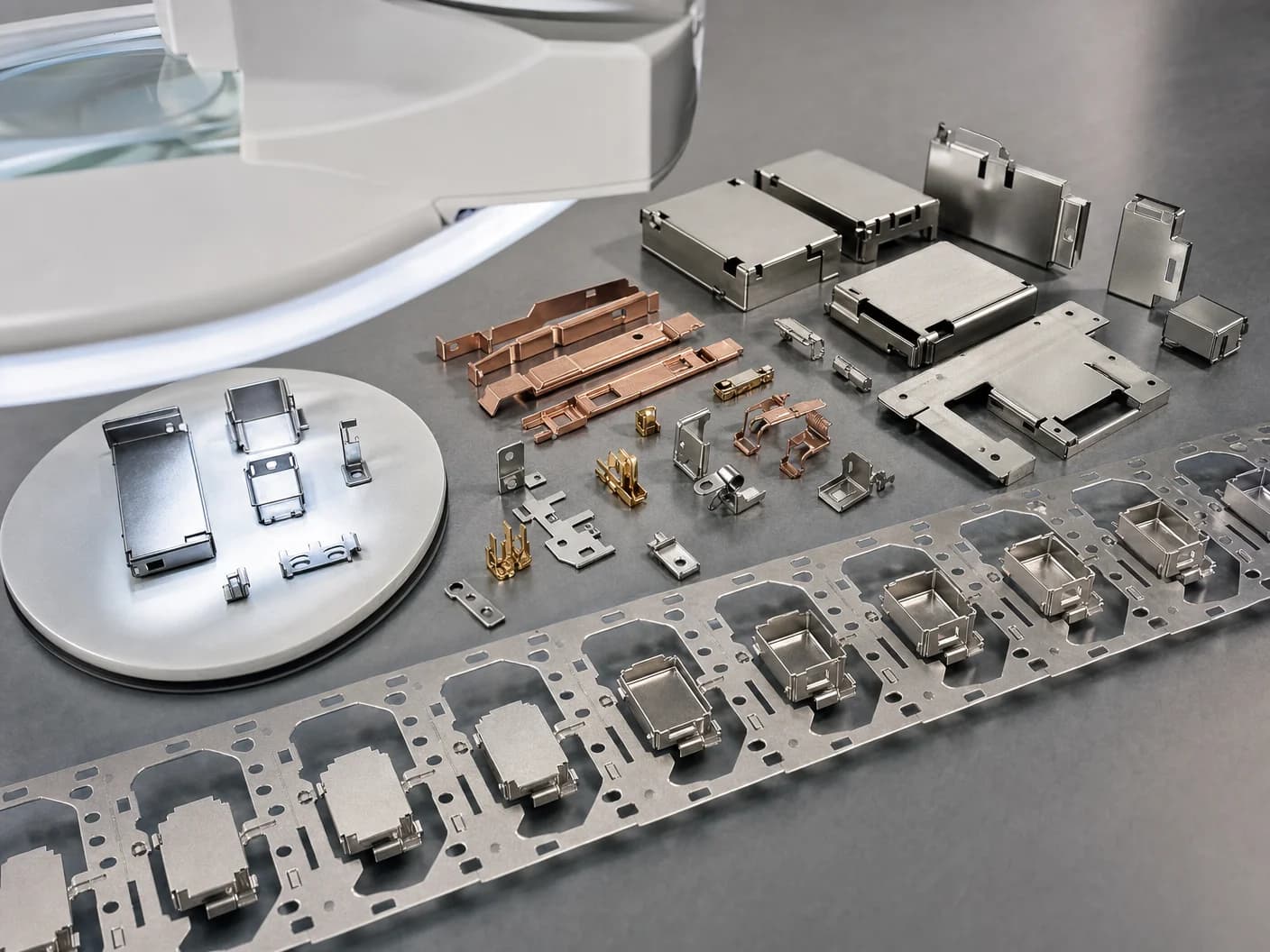
Metal stamping forms sheet metal between a matched pair of hardened dies in a press. Each part matches the last, because the geometry lives in the tool, and each cycle takes a fraction of a second. The trade is a real tooling cost up front, then a per-part cost that, at volume, is lower than cutting and bending each part. Illuminious is a U.S. NPI engineering company. Engineered in San Francisco. Prototype builds, DFM and mass production in our own factory in Shenzhen. You choose stamping when the quantity pays back the die.
Engineering comes before the die
Stamping is priced after engineering review, because the price depends on a tool that must be designed first. Sheet metal fabrication (laser cutting and press braking, with no dedicated tooling) is ordered online, and a specialist prices it within 24 hours on business days. For most of a product's life it is the right route.
A stamped part is usually a bracket, a shield, a busbar, a contact or a shallow housing inside a larger product. Our engineers design it with the rest of the product: the board, the enclosure and the assembly order. Through the demo build, EVT and DVT, the part is fabricated, so a change costs a new program and not a new tool. The die is designed after DVT closes the design. Before that, a DFM review checks the stamped geometry: bend radii against the material, hole-to-edge distances, burr direction, and the features a die can form in one stroke.
The review also answers the volume question with numbers from your part. You see the tooling cost, the per-part cost and the break-even quantity. The die is built in the in-house tool and die shop, and parts run on presses from 30–1000 t. Tooling you pay for belongs to you, and you may move it to another factory. Stamped parts can go into box build and test in the Shenzhen factory, next to the boards and housings of the same product.
Electrical parts need extra care. A busbar or a contact carries current, so its thickness, its plating and the burr on its edge all affect heat and contact resistance. A shield must close around a board area without touching parts on it. The stamped part is checked against the board layout as well as the drawing, and the DFM review is repeated before tooling so the last board change is in the die. For a battery pack, a charger or an EV part, the stamped metal is part of the power path, and the review treats it that way.
Stamping capabilities
From flat blanks to deep-drawn shells, matched to the part and the volume.
| Capability | What it covers |
|---|---|
| Progressive die stamping | A strip advances through several stations, and one press stroke makes one finished part. For parts with several operations at volume. |
| Deep draw stamping | A flat blank drawn into a one-piece hollow shape, such as a shell, can or cup, with wall thinning checked in review. |
| Single-station tools | For simple blanks that do not need several operations combined. The tool is simpler and costs less to build. |
| Blanking | Flat parts with clean edges and a known burr side, which can remove a secondary machining or deburring step. |
| Electrical parts | Contacts, terminals, EMI shields and busbars for electronic products, checked against the board layout they connect to. |
| Tooling and presses | Dies designed and built in the in-house tool and die shop. Presses from 30–1000 t. |
| Prototype route | The same part laser-cut and bent through the sheet metal route, with no tooling, while the design is still changing. |
| Secondary operations | Deburring, tapping, plating and assembly, confirmed in the official quote. |
How a stamped part moves from prototype to production
| Step | What we do | What you get or decide |
|---|---|---|
| 1. Fabricated prototypes | We make the part as laser-cut and bent sheet metal for the demo build, EVT and DVT. | Parts to test, and a design that can still change at low cost. |
| 2. DFM review for stamping | Our engineers check the stamped geometry, the material and the forming limits, and decide progressive or single-station tooling. | A DFM findings report and the tooling route. |
| 3. Die design and official quote | After DVT, the die is designed against the settled part and your annual volume. | An official quote with tooling cost, part price, break-even quantity and lead time. |
| 4. First articles | The tool and die shop builds the die. First parts are measured against your drawing and fitted to the real assembly. | Samples and a measurement record for your approval. |
| 5. Production and secondary operations | Parts run in volume, with the secondary operations you ordered, and are checked before shipment. | Batches with inspection results, ready for assembly. |
What stamping gives a product
Low cost per part at volume
After the die exists, each part costs mostly material and seconds of press time, and scrap stays low.
Parts that repeat
The geometry lives in the tool, so dimensions hold from part to part across the life the tool was designed for.
Several operations in one stroke
A progressive die punches, forms and cuts in one cycle, so there is less handling and less to go wrong.
A planned path from prototype to tool
Fabricated parts carry the design through DVT. The die is cut only when the design is stable.
At what quantity does stamping beat sheet metal fabrication?
There is no single number. The crossover is where the tooling cost divided by your annual quantity falls below the per-part saving, and both sides depend on the part. A simple flat blank has a cheap tool and a small saving. A deep-drawn shell has an expensive tool and a large one.
What holds for every part is the shape of the decision, and our engineers put both costs in front of you before you choose. Fabricate while the design is moving and volumes are uncertain, because a fabricated part absorbs a revision for the cost of a new program. A stamped part absorbs it for the cost of a new tool. Tool up when the design has stopped changing and the forecast is firm. If the forecast is uncertain, a single-station tool for the highest-volume part is often a sensible first step.
What is a progressive die, and when do I need one?
A progressive die does several operations at successive stations as a metal strip moves through it: punching at one, forming at the next, cutting free at the last. One press stroke makes one finished part. Stamped parts are then cheap at volume and the tool is expensive, because every station is designed and proven together.
You need one when the part has more than one or two operations and the volume justifies combining them. For a simple blank, a single-station tool is often enough. This is one of the first answers a stamping review gives, because it changes the tooling cost more than any other decision. The stamping design guide explains die types and tolerances.
Which route should I use while the design is still changing?
The fabricated route. A laser-cut and press-braked version of a stamped part is close enough for most testing, needs no tooling, and can be reissued the same day the drawing changes. You declare it as a flat cut part, a bent part, a welded part or a sheet-metal assembly, at any quantity from one.
Then tool up from a validated design. In our stage path, that usually means fabricated parts through the demo build, EVT and DVT, and the die after DVT closes the design. Order the bent version on the sheet metal route now, and send the same drawing for a stamping review when the forecast is firm. Our DFM review in the design phase plans that change-over from the start.
Stamping against the sheet metal route you order online
The sheet metal column is configurator limits; the stamping column is set in review.
| Consideration | Sheet metal fabrication (ordered online) | Metal stamping |
|---|---|---|
| Dedicated tooling | None | A die, designed and proven before the first part |
| Ordered online | Yes, priced by a specialist within 24 hours on business days | No, priced after engineering review |
| Declared product type | Flat cut part, bent part, welded part, sheet-metal assembly (welded and assembly go to review) | Confirmed in review against the part and the volume |
| Material | Aluminum, Mild steel, Stainless steel, Copper / brass | Confirmed in review |
| Sheet thickness | 0.3–25 mm | Confirmed in review |
| Quantity | 1–100,000 parts | Justified by the volume that pays back the tool |
| Presses | Laser cutting and press brakes | Presses from 30–1000 t |
| Cost of a design change | A new program | A new or reworked tool |
| Best suited to | Prototypes, low and mid volume, designs still moving | Settled designs at sustained volume |
Recent work
An EV charging startup combined a progressive-die part with an integrated board for its charging stations. The stamped part and the board were designed to fit each other. Read the EV charging stamping case.
Facts and questions
Can you quote a stamped part online?
No, on purpose. A stamped part's cost depends on a die that must be designed before it can be priced, so a configurator figure would be a guess. Sheet metal fabrication is ordered online, and a specialist prices it within 24 hours on business days. Stamping is priced after engineering review against your part and your annual volume.
What is deep drawing?
Deep drawing forms a flat blank into a hollow shape, such as a shell, can or cup, whose depth is large compared with its diameter. The material is drawn into a die, and it can only move so far before it thins or tears, so each design is reviewed against its material and geometry.
What tolerance can a stamped part hold?
It depends on the feature. Holes and edges cut in one station repeat closely from part to part, while features across a bend vary more with the material and its thickness. The stamping review sets the tolerance for each feature on your drawing, and the first-article record measures it.
What do you need to quote a stamping job?
The part model and drawing, the material and thickness, and above all the annual volume and how firm it is. The volume decides whether a tool is worth building and which kind of tool it should be. Add any plating, tapping or assembly steps, so the official quote covers the finished part.
How your official quote is prepared
Stamping is priced after engineering review. For the fabricated parts that come first, a specialist prepares the official quote for your laser-cut and formed sheet-metal parts from your files and specifications, within 24 hours on business days. An engineer reviews every order. The review is free and comes before payment, and the official quote is the amount you pay.
Read the laser-cut and formed sheet-metal parts service detail
Bring us the part and the forecast
Send the drawing, the material and your volume plan for a free engineering review. Our engineers check the stamped design against the rest of the product, recommend the tool and publish an official quote. If the design is still moving, we start with fabricated parts and plan the die for later. Need molded parts too? See injection molding.
- An engineer runs a free engineering review of your files, and nothing is charged when you submit.
- You see the findings first.
- We publish the official quote with an itemized total, lead time and validity window.
- You accept the official quote, and only then does payment open.