Engineering connected devices that stay online
A sensor on a factory wall, a thermostat in a hallway, a tracker on a digger: each must stay online for years with nobody touching it. When the radio sits behind the battery or an update fails, a whole fleet goes quiet. Our engineers design the radio, the power budget, the firmware and the enclosure together, then build the device from the same files. Engineered in San Francisco. Prototype builds, DFM and mass production in our own factory in Shenzhen.
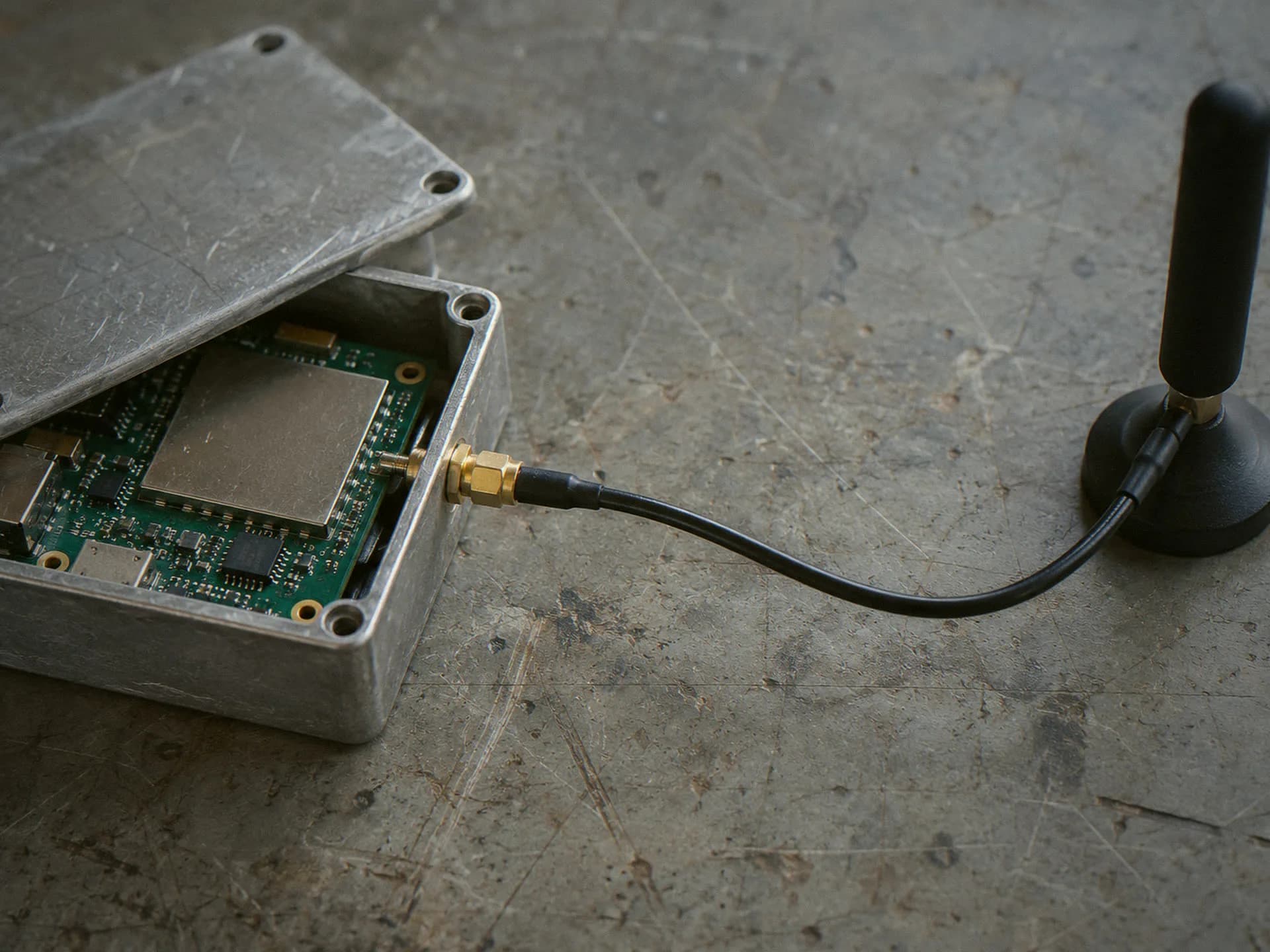
What makes a connected device hard to build?
Four things pull against each other: radio range, battery life, size and cost. A small enclosure puts the antenna next to the battery and the processor. A long battery life needs firmware that sleeps hard. Certification needs margin you cannot add after tooling. We set these trade-offs in the schematic, not at the last build.
What we engineer for connected devices
Wireless integration. Wi-Fi 6, Bluetooth Low Energy, Zigbee, Thread and Z-Wave, and Matter for smart home products. Our engineers test pairing and interoperability against the profiles your device has to speak. See product design.
Long range and cellular. LoRaWAN, NB-IoT and LTE-M for devices outside Wi-Fi range. We help pick the module, plan carrier approval where the network asks for it, and tune the antenna for range and battery life in dense cities or open fields.
Power budget. Multi-year battery life starts with sleep current. Our engineers measure quiescent current on the demo build, pick the battery chemistry, for example lithium thionyl chloride or lithium polymer, and set the firmware's sleep and wake cycle to the target.
Security and updates. Secure boot, signed firmware images and hardware key storage. OTA updates are designed to verify each image and fall back to the last good one, and production units ship with debug ports locked. See firmware development.
Provisioning. Each unit gets its own identity and credentials at the end of the line, so it can join your cloud platform on first power-up.
Sensors and processors. From low-power microcontrollers to processors that run edge AI. Accelerometers, gyroscopes and environmental sensors are calibrated and checked in production test.
Enclosure. Housings designed for IP ratings, heat and the antenna's keep-out, then molded in the factory. See injection molding.
Where does the antenna go, and when is that decided?
In the schematic and the first layout, before the enclosure is frozen. Our engineers set the antenna keep-out, the ground plane and the feed line, then check the placement against the battery, the display and any metal in the housing. Tuning happens on the demo build, when real plastic and a real battery surround the antenna.
Problems we design out early
- RF noise. Processors and power supplies corrupt weak radio signals in small boards. Ground planes, via stitching and controlled-impedance traces keep the link clean.
- Heat in a small case. A sealed shell traps heat. We model it and add heat paths or vents before the enclosure is tooled.
- Parts that disappear. Our engineers check parts availability and alternates before the schematic is drawn, using a network of 350 audited suppliers.
- Rough environments. Outdoor and industrial sensors face shock, vibration, washdown and temperature swings. Rugged enclosures, conformal coating on the board and environmental tests at DVT find the weak points.
How a connected device moves to production
- Architecture review, then the DFM review. Our U.S. engineers review the architecture, the BOM and the schematic for power, RF performance and part availability. The DFM review follows in Shenzhen, next to the lines. Start with project initiation.
- Demo build and EVT. Boards and parts come from the portal, for example Standard PCB & PCBA, and EVT units get functional, power and radio pre-checks.
- DVT and the certification path. DVT units go through EMC and RF pre-scans, then to an accredited lab for FCC, CE and IC testing. We plan design margin from the first layout, build DVT units for the lab and supply the documents it asks for. Your team or your lab files the submission.
- PVT and production. ICT and FCT stations run the production test firmware at PVT. In production, each unit is provisioned, flashed and tested for function and connectivity, and firmware test results are kept per serial number.
Connected products we build
Agricultural and outdoor sensors add IP-rated housings, UV-stable plastics and years of unattended battery life. Soil, livestock and weather sensors sit far from power and from help, so a field fault costs a site visit. For radio test detail, see IoT capabilities, and for the full build sequence read the IoT device manufacturing guide.
- Industrial IoT sensors. Vibration and condition monitors, asset trackers on LoRaWAN and environmental gateways for factory floors and farms.
- Smart home devices. Motion and contact sensors on BLE or Thread, thermostats, lighting controls and leak detectors that must work in a crowded radio band.
- Personal AI devices. Microphones, an edge AI chip and Wi-Fi in a case small enough to carry.
What can I order online for an IoT prototype?
Most of the demo build. In the portal you order the boards and assemblies, a stencil, machined or printed housing parts and sheet-metal brackets, each at a price you see before you submit. Design work is there too: schematic design, PCB layout and firmware development at a published fixed price, each after a free engineering review.
Larger programs, molds and certification work are scoped by an engineer and priced in an official quote. A DFM review of the whole product is design work and sits in that scope.
- Dense or RF boards: Advanced PCB & PCBA.
- Board design: Schematic design and PCB layout.
- Housing parts for fit checks: 3D printing.
Recent work: sleep current on a LoRa tracker
A logistics startup brought a LoRa asset tracker for construction equipment. During EVT, our engineers reworked the antenna keep-out and cut the sleep current toward the battery-life target, while early printed shells were used only for fit checks. The tracker then moved to an overmolded housing for field use. Read the case study.
Questions about IoT hardware
How is a device tested if it only works on our network?
At the end of the line, each unit is provisioned and must join a network before it is packed. For that test your team supplies a staging endpoint or test credentials, and our engineers define the pass criteria with you before the demo build, and the test fixtures are built before PVT. A unit that cannot join is pulled, and the cause goes to an engineer.
Can you write the firmware as well as build the board?
Yes. Firmware is in scope: bring-up, drivers, power management, the radio stack and the update path. Firmware handover includes the toolchain version, the build steps and the programming procedure. You can order firmware work in the portal as firmware development.
Who files the FCC and CE submissions?
Your team or your lab files them; the approval belongs to your product. We plan design margin from the first layout, build DVT units for the lab and supply the documents it asks for. DVT includes EMC and RF pre-scans, so most problems show up before the formal lab, when a fix still costs a board revision, not new tooling.
How long will the battery last?
It is a design target, not a guess. We start from your duty cycle: how often the device wakes, measures and sends. Our engineers build a power budget from it, measure sleep and active current on the demo build, and adjust firmware and parts until the measured numbers meet the target you set.
Tell us what you are building
- An engineer runs a free engineering review of your files, and nothing is charged when you submit.
- You see the findings first.
- We publish the official quote with an itemized total, lead time and validity window.
- You accept the official quote, and only then does payment open.