Shenzhen tour · Dec 6–11

Apply
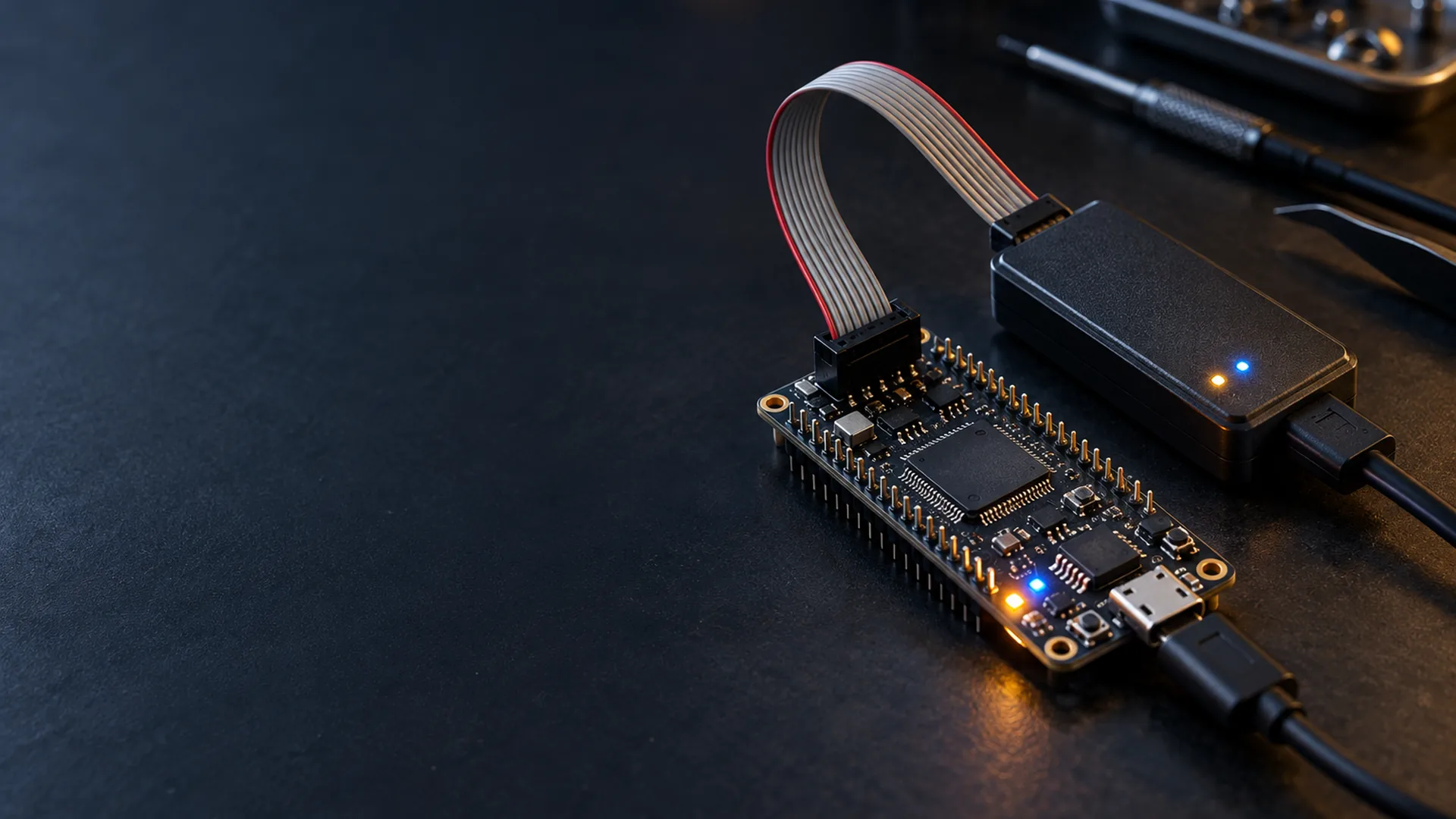
Embedded engineer debugging firmware on a microcontroller development board

Order firmware sized to the platform you are actually building.

Illuminious is a U.S. NPI engineering company. Firmware Development covers embedded software from bare-metal MCU logic to Linux/Android SoC platforms, priced from three published tiers by platform class and code size. Engineered in San Francisco. Prototype builds, DFM and mass production in our own factory in Shenzhen. Upload your files, get a free engineering review, and pay only the official quote that review publishes.

Describe the MCU or SoC class and the rough code size, then pick the tier. You receive binaries and documentation, and source code when the order includes it.

Configure it online, or send the job to an engineer. Online, you get a live supplier price, a published tier, or an official quote prepared by a specialist within 24 hours on business days, depending on the service. Engineering review is free either way and comes before you pay.

Payment
Official price after free review
Review target
Within two business days after you submit

An engineer reviews every order. Account required before the persistent configurator opens. Engineering review is free and comes before payment, and payment does not authorize production.

Is Firmware Development the right route for your embedded platform?

  • Bare-metal 8/16-bit MCU firmware
  • 32-bit MCU firmware with RTOS and bus support
  • High-performance MPU/SoC firmware on Linux or Android
  • Projects moving from Schematic Design into embedded software
Typical orders
Fixed-scope firmware projects, scoped to one of three published tiers by platform class and estimated code size.
Source files
A written project brief (PDF or TXT) describing the target platform and firmware goals is required to start; a hardware schematic, pinout reference, or protocol specification helps but isn't required.
Accepted formats
ZIP, RAR, 7Z, PDF, PNG, JPG, JPEG, TXT
Payment basis
Official price after free review
Preparation workbook
Download the intake workbook

A shared order lifecycle with service-specific depth.

The configurator collects the factors that drive a responsible preliminary amount. Engineering then reviews the exact source revision, assumptions, and approvals that control release.

Platform scaling

Starter targets an 8/16-bit bare-metal MCU; Standard targets a 32-bit MCU with RTOS; Premium targets a high-performance MPU or SoC running Linux or Android.

Code scope

Estimated code size sets the tier: up to 2,000 lines at Starter, up to 10,000 at Standard, and beyond that at Premium.

Connectivity

I/O scales from basic UART/I2C at Starter, through CAN/LIN bus support at Standard, to Ethernet, Wi-Fi, and Bluetooth at Premium.

Delivery

Every tier delivers reviewed binary files with the documentation the platform needs to integrate and maintain them.

What can you configure for firmware development?

These are the ranges the Firmware Development configurator accepts. Anything outside them is still orderable — it goes to an engineer through the outlined path instead of through the form.

Firmware Development configurator bounds
ParameterAccepted range
Estimated code size100–200,000 lines

How is a Firmware Development price built?

Lead time, and what each tier trades

Economy
A longer target lead time than Standard, for work that is not on a deadline. Takes a discount line off the price, never below the service minimum, shown before you commit.
Standard
The lead-time range quoted for your configuration, counted from approved files. No schedule charge. It is the price you were quoted.
Express
Shortens the standard range where the process and the queue allow it. Adds an expedite line, priced on your own configuration and shown before you commit.
  • Tier selected (Starter, Standard, or Premium)
  • MCU/MPU/SoC platform class
  • Estimated code size
  • Connectivity and bus requirements (UART/I2C, CAN/LIN, Ethernet/Wi-Fi/BT)
Fixed tiers. Engineering review is free and happens before payment, so nothing is charged to reach this figure. Priced from our three published Firmware Development tiers — Starter, Standard, and Premium — confirmed by a specialist during review. Scope is confirmed during review, and the official quote is what you are asked to pay.

What engineering reviews

Customer approvals may include

  • The published tier and its deliverables
  • Any itemized price revision if the platform or code size exceeds the selected tier
  • Any source-code delivery added beyond the tier's binary-file default
  • Platform class and code-size estimate against the selected tier
  • Hardware interface and protocol completeness
  • RTOS or OS integration requirements
  • Test and delivery expectations

Free review first. Keep every later decision explicit.

  1. Create your account

    Verify your email before the persistent quote workspace opens. Every file, estimate, message, and payment stays attached to that account.

  2. Configure and upload

    Provide service-specific inputs and place technical files in private project storage. Saved drafts remain available across sessions.

  3. Free engineering review

    Submit the configured cart at no charge. A reviewer checks the exact file and specification revision, then prices it or opens a documented question or correction request.

  4. Official quote

    Review publishes an itemized quote with lead time and a validity window. That is the binding figure; anything shown earlier was a preliminary estimate.

  5. Accept and pay

    Accepting opens payment rather than charging you. Lead time is counted from settled payment, and any later itemized revision needs your approval first.

  6. Produce and deliver

    After all commercial, technical, and customer gates are complete, the project moves through the service-specific production or design milestones.

What this service is intended to produce.

Reviewed embedded firmware delivered as binaries at the tier you selected.

Related engineering: Firmware development and bring-up

Protected and traceable by default

Private files, immutable revisions, authenticated approvals, itemized commercial changes, and customer-visible history are part of the order system rather than a loose email trail.

Boundaries

  • This route is not schematic design or PCB layout
  • It does not include hardware fabrication or assembly
  • Third-party stack licensing (where applicable) is confirmed during review, not included by default

Answers before you start the workspace.

What do I need to start a Firmware Development order?

A written description of the target hardware platform and what the firmware needs to do, uploaded as a PDF or TXT file. A schematic, pinout reference, or protocol specification helps but is not required to start.

How is the tier decided?

Starter covers 8/16-bit bare-metal MCUs under roughly 2,000 lines of code, Standard covers 32-bit MCUs with RTOS under roughly 10,000 lines, and Premium covers high-performance MPU/SoC platforms running Linux or Android. Review confirms your platform matches the tier before pricing.

Is the amount at checkout final?

The free engineering review comes first. Depending on the service you see a live supplier price, a published fixed price, or a price from a specialist within 24 hours on business days, and nothing is charged when you submit. After the review we publish an official quote with an itemized total, lead time and a validity window, and that is the amount you are asked to pay. Accepting the official quote opens payment rather than charging you. If a later correction changes scope or price, you see an itemized revision and can approve, question or decline it. We never silently charge an increase.

What do I receive?

Binary files built for your platform, plus the documentation to integrate and maintain them. Firmware source code is delivered only when the order includes it; the handover then adds the toolchain version, the build steps and the programming procedure.

Start the Firmware Development price in your private workspace.

Your account preserves drafts, uploads, assumptions, estimate revisions, payments, review questions, and approvals in one project record. An engineer reviews every order.

  1. An engineer runs a free engineering review of your files, and nothing is charged when you submit.
  2. You see the findings first.
  3. We publish the official quote with an itemized total, lead time and validity window.
  4. You accept the official quote, and only then does payment open.