CNC machining services
Machined parts from one prototype to production quantities. Our engineers check setups, tolerance and material on your drawing before any metal is cut.
No CAD yet? Our design team can take it from a sketch or a spec.
Walk Shenzhen factories with us, Dec 6–11. See the tour
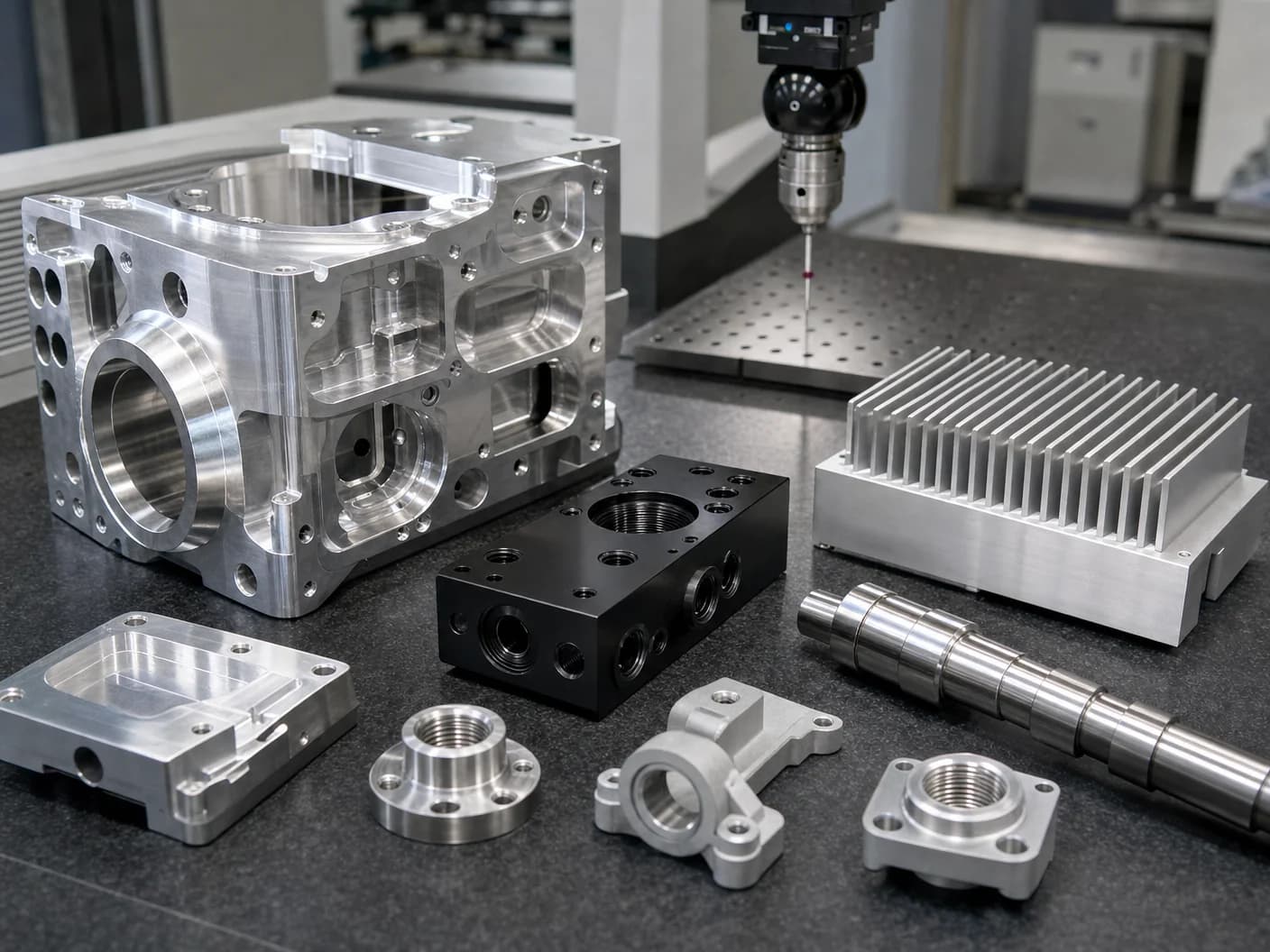
CNC machining removes material from a solid block until only your part is left. The part keeps the full strength of the parent material and holds tolerances that no additive process reaches. It needs no tooling, so one part costs only a little more than the hundredth. Illuminious is a U.S. NPI engineering company. Engineered in San Francisco. Prototype builds, DFM and mass production in our own factory in Shenzhen. Choose it when the part must be strong, accurate, or made from a specific engineering alloy.
CNC machining is one of the 12 services you configure in the portal. It is also one of the nine processes the Shenzhen factory runs in-house, beside SMT, bare PCB fabrication, injection molding, sheet metal, die casting, stamping, box build and test.
From the drawing to the machine
Most machined parts in a new product are drawn during design, long before production. A bracket or a motor mount often changes between the demo build and DVT, so the first step is an engineering read of the drawing. Four things decide the cost of a machined part, in roughly this order: the number of setups, the tightest tolerance on the drawing, the material and the finish. Putting the tightest band on every dimension is the most common and most expensive drawing error, and our engineers flag it before you pay.
When a part belongs to a design project, it goes through a DFM review while it is still in CAD. Our engineers look at the features that set the process: deep pockets, thin walls, small internal radii, threads and datums. They ask what each tolerance does. A bore that locates a bearing needs a tight band, and a clearance hole does not. The findings report sorts each finding by when it must be fixed: before the demo build, before EVT or before production.
When you order a part through the portal, engineering review checks your files against the configuration you chose. It confirms whether the declared tolerance band is achievable on the feature, at that length, in that material and finish, and it checks the setups the geometry implies against the setup complexity you declared.
Material choice follows the same logic. The configurator declares eight material families. Parts in PEEK, Ultem, Inconel or other alloys outside those families go through engineering review. You can select titanium online, and every titanium order goes to an engineer for review.
For regulated products, the Shenzhen factory holds ISO 9001, ISO 13485, IATF 16949 and AS9100. Medical device parts are built under ISO 13485, automotive and EV parts under IATF 16949, and aerospace and drone parts under AS9100.
Order CNC machining online
Configure the job and upload your files privately. An engineer reviews them, and a specialist publishes the official quote within 24 hours on business days. You pay only after you accept it.
Machining capabilities
What each route covers, and where the reviewed capability goes beyond the online configurator.
| Capability | What it covers |
|---|---|
| 3-axis milling | The default for prismatic parts that can be reached from one or two directions: plates, brackets, covers, heat spreaders. Simple parts at one or two setups are the cheapest machined parts you can order. |
| 4-axis and 5-axis milling | Rotary axes let the cutter reach the part from several angles in one clamping. Fewer setups mean fewer chances to lose a datum, so complex parts hold position better and cost less to fixture. The configurator declares this as "Complex / 5-axis" setup complexity. |
| Turning and mill-turn | Turning makes round parts with good concentricity: shafts, bushings, standoffs, knobs. Mill-turn adds milled flats, cross holes and threads in the same setup. Both are declared machining processes. |
| Small and precise features | Small features need short, rigid tools and the tolerance stated on the drawing. Achievable machining tolerance on controlled features is 0.01 mm. The tightest configurator band always routes to engineering review, which answers achievability on your feature. |
| Tool-room precision | Tool-room EDM and high-speed CNC hold a positional tolerance of 0.005 mm on critical mold features. This capability supports our injection molding tooling as well as precision parts. |
| EDM | Wire and sinker EDM cut hardened steel and tungsten carbide workpieces, and make sharp internal corners a rotating cutter cannot. EDM is a declared machining process. |
| Surface finish | Machined surfaces from as-machined to a mirror-polish route with a surface finish of Ra 0.4 µm. Declared finishes: anodized, hard anodized, bead blast, powder coat and plating. |
| Materials | Eight declared families: aluminum 6061 and 7075, stainless steel 304 and 316, mild steel, brass, titanium and engineering plastic. PEEK, Ultem and Inconel are machined through engineering review. |
| Fixtures | Workholding for awkward shapes is part of the setup plan. Fixtures you pay for belong to you, and you may move them to another factory. |
How a machined part moves through the factory
Each step has an action on our side and an output or decision on yours.
| Step | What we do | What you get or decide |
|---|---|---|
| 1. Drawing and model review | Our engineers read the STEP model and the drawing. They check the tolerance on each functional feature, the setups the geometry implies and the material. | A list of what was confirmed, what was assumed and what needs your decision. |
| 2. Design changes (design projects) | In a design project, the DFM review proposes changes that cut setups or relax a band that has no function. The review is repeated at the later stage gates. | You approve, question or decline each change. The changed files come back to you. |
| 3. Official quote | A specialist publishes the official quote with an itemized total, a lead time and a validity window. | You accept the official quote, and only then does payment open. |
| 4. Programming and setup | Our machinists program the toolpaths, check them before cutting, and set up the tools and fixtures for the agreed setup plan. | Nothing to do. Questions about a datum or a thread come to you before cutting. |
| 5. Machining | The part is cut on the agreed route: milling, turning, mill-turn or EDM. Critical features are checked during the run. | Parts for a demo build, an EVT or DVT build, or a production batch. |
| 6. Inspection and finish | The part is inspected to the declared level, then finished: anodizing, bead blast, powder coat or plating. | Parts with the inspection record you ordered: standard, a dimensional report or a CMM report. Material certificates on request. |
Why order machined parts from us
Tolerance where it has a function
Tolerance is declared per order in four bands, from general ISO 2768 down to ±0.02 mm and tighter. The tightest band routes to engineering review. Achievability depends on the feature, its length, the material and the finish.
One route from prototype to production
The same configuration covers 1 to 100,000 parts. The demo build part is reviewed and inspected the same way as the production batch.
Materials beyond the catalog
Eight families can be selected online. PEEK, Ultem and Inconel parts are machined after engineering review, with a material certificate when you ask for one.
Inspection you agree before production
Standard inspection, a dimensional report or a CMM report is a declared option. What is measured is part of the reviewed scope, so it is agreed before the part is cut.
What makes one machined part cost more than another?
Mostly the number of setups. Each time the part is unclamped, turned and fixtured again, a machinist does the work and the machine waits. A part cut from two directions costs much less than one that needs five. After setups, the tightest tolerance, the material and the cosmetic finish add cost, in that order.
Setup complexity is a declared field with three settings: simple at one or two setups, moderate at three or four, and complex or 5-axis. You declare it, and the review checks it against the model.
The tightest tolerance anywhere on the drawing sets the process for the whole part. Titanium and stainless cut far more slowly than aluminum. A cosmetic surface limits how the part can be held and deburred. A DFM review in design removes a setup for the cost of a CAD edit.
Which tolerance band should I ask for?
The loosest band that still works. The configurator offers four bands: general ISO 2768, ±0.10 mm, ±0.05 mm, and ±0.02 mm or tighter. The tightest band always routes to engineering review. Tolerance belongs to a feature, so the review answers it against your drawing.
The review asks one question: is this band achievable on this feature, in this material, at this length?
Tolerance every feature that has a function, such as a bearing bore, a sealing face or a locating pin. Leave the rest at the general band. The same part becomes cheaper and no worse.
How do I choose between aluminum, steel and titanium?
Start with aluminum 6061: it machines fast, anodizes well and is stiff enough for most structures. Move to 7075 for more strength, stainless 304 or 316 for corrosion, and titanium for strength-to-weight or biocompatibility. Brass suits fine detail; engineering plastic suits electrical isolation and low weight.
Aluminum 7075 is stronger than 6061, but it resists corrosion less well and cannot be welded. Stainless 316 is the better choice near chlorides. Titanium is the slowest of the eight declared families to cut, and most of its cost comes from that machine time.
PEEK and Ultem suit hot or chemically harsh parts; Inconel suits parts near heat. Each goes through engineering review. The CNC machining design guide covers material and 5-axis choices in more depth.
CNC machining limits in the configurator
These are the limits the CNC configurator accepts; a part outside them goes to an engineer.
Declared optionSettings available
- Machining process
- Milling, turning, mill-turn, EDM, or engineer selected (the last three go to review)
- Material
- Aluminum 6061, Aluminum 7075, Stainless steel 304, Stainless steel 316, Mild steel, Brass, Titanium, Engineering plastic (titanium goes to review)
- Envelope
- 0.1–2500 mm per axis
- Finished part volume
- 0.01–1,000,000 cm³
- Quantity
- 1–100,000 parts
- Setup complexity
- Simple (1–2 setups), moderate (3–4 setups), or complex / 5-axis (complex goes to review)
- Tightest tolerance
- General ISO 2768, ±0.10 mm, ±0.05 mm, or ±0.02 mm or tighter (±0.02 mm goes to review)
- Precision features
- Threads, threaded inserts, thin walls, deep pockets, critical datums
- Finish
- As machined, anodized, hard anodized, bead blast, powder coat, plating
- Appearance grade
- Standard, strict, or cosmetic
- Inspection
- Standard inspection, dimensional report, or CMM report
- Material certificate
- Available on request
- Required files
- STEP/STP model; dimensioned drawing before production for nonstandard requirements
- Review target
- Within 24 hours on business days after you submit
Facts and questions
What is the difference between 3-axis and 5-axis machining?
A 3-axis machine moves the cutter in three straight lines, so it reaches the part from one side at a time and complex parts need several setups. A 5-axis machine adds two rotary axes and reaches many angles in one setup. The configurator asks for setup complexity, because that is what drives the cost.
How tight a tolerance can I ask for?
The configurator accepts ±0.02 mm and tighter, and that band always routes to engineering review. On controlled features we machine to 0.01 mm. Whether a band is achievable on your feature depends on its length, the material and the finish, and the review answers it against your drawing.
Which materials can you machine?
Eight families are declared online: aluminum 6061 and 7075, stainless steel 304 and 316, mild steel, brass, titanium and engineering plastic. PEEK, Ultem and Inconel are machined after engineering review. A material certificate is a declared option, so you can ask for it when you configure the part.
Do I need a drawing as well as a 3D model?
A model is enough to configure online and get an official quote from a specialist within 24 hours on business days. Before production, add a dimensioned drawing when the part has a band tighter than general, a datum scheme, a finish callout, a thread specification or a cosmetic limit.
Do you inspect the parts, and what do I get?
Yes. Inspection is a declared option with three settings: standard inspection, a dimensional report or a CMM report. The report is part of the reviewed scope, so you and our engineers agree what is measured before the part is cut. You receive the parts with the record you ordered.
How your official quote is prepared
A specialist prepares the official quote for your CNC machining job from your files and specifications, within 24 hours on business days. An engineer reviews every order. The review is free and comes before payment, and the official quote it publishes is the amount you pay.
Ready to start your CNC machining project?
Upload your model and drawing for a free engineering review. An engineer tells you which setups, bands and materials drive the price before you pay. Building a physical AI or robotics product with machined actuator parts? We can review the whole assembly. Need a sheet or a printed part instead? See sheet metal fabrication and 3D printing.
- An engineer runs a free engineering review of your files, and nothing is charged when you submit.
- You see the findings first.
- We publish the official quote with an itemized total, lead time and validity window.
- You accept the official quote, and only then does payment open.