3D printing for prototypes and low-volume parts
Printed parts for a demo build, a fit check or a fixture. An engineer first checks your model against the process, so the part answers your question.
No CAD yet? Our design team can take it from a sketch or a spec.
Walk Shenzhen factories with us, Dec 6–11. See the tour
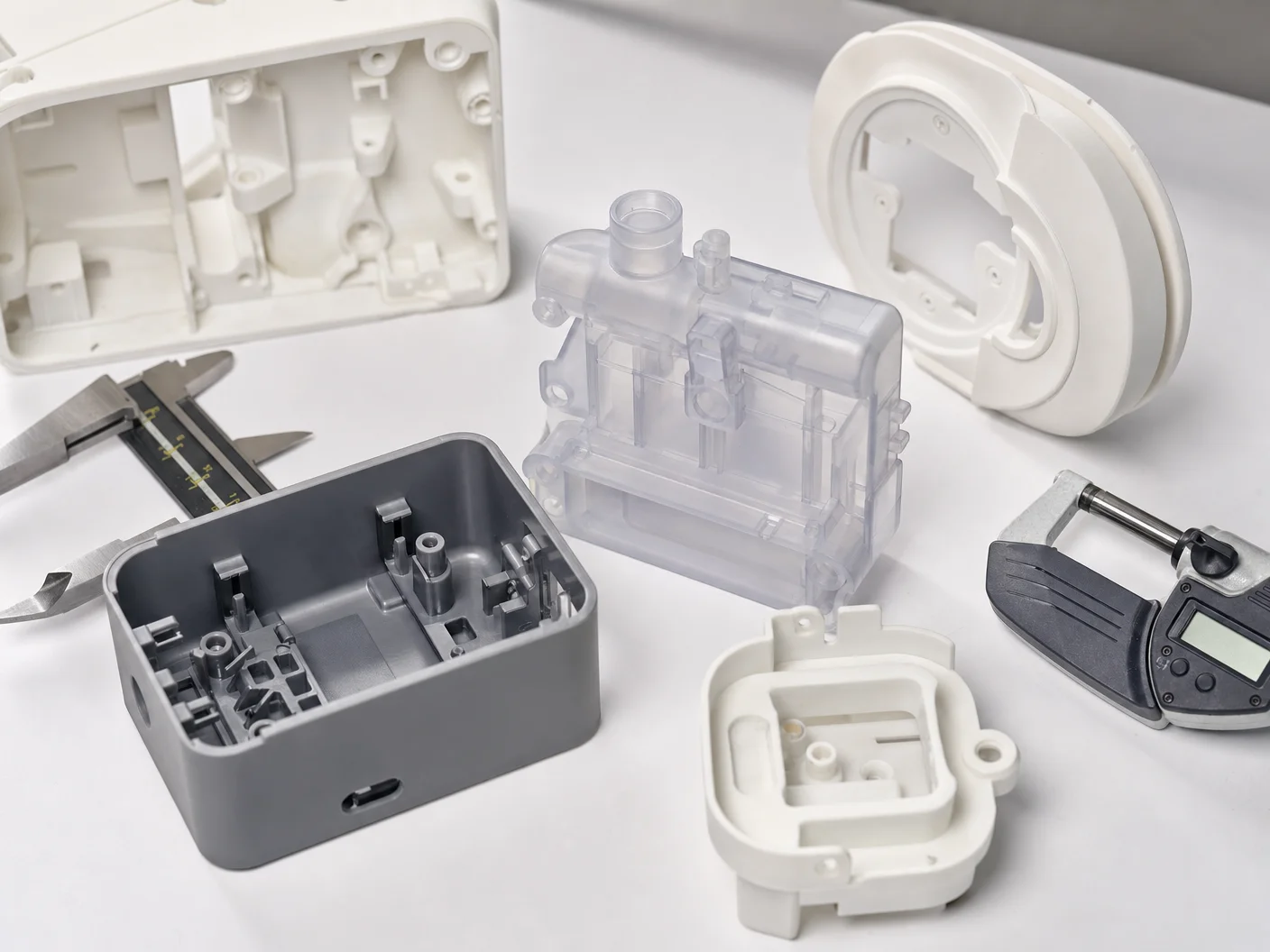
3D printing builds a part layer by layer instead of cutting it from a block. A shape with internal channels, lattices or no straight tool path costs about the same as a simple one. Choose it when the geometry is hard, when you need a few parts without tooling, or when people handle the part more than load it. Illuminious is a U.S. NPI engineering company. Engineered in San Francisco. Prototype builds, DFM and mass production in our own factory in Shenzhen.
At Illuminious, printing is usually one step on a longer path. A printed enclosure goes into a demo build for investors or a Kickstarter film. A printed housing checks fit before the injection mold is cut. A printed fixture holds a board during test. A DFM review checks whether the printed shape can later become a molded or machined part. Our DFM services page explains that review.
Engineering first, then the print
3D printing is one of the 12 services you configure in the portal, and the process is the first decision. Each of the six declared processes is a different technology. A wrong process usually shows up as a rough face, a brittle snap fit or a warped long wall. Our engineers start with what the part must prove. A cosmetic model for a pitch needs surface and color. A snap-fit housing needs a tough nylon. A bracket that carries load may belong on the CNC route, and the engineering review says so before you pay. Tell us what the print is for when you configure it. "Fit check for a 2 mm gasket" or "pitch unit, painted to match the render" gives the reviewer far more to work with than a file name. One sentence in the notes field often saves a second print.
The same team also knows the production route. When a printed housing stands in for a molded one, we flag draft, wall thickness and undercuts early, so the demo build does not hide a tooling problem. When the design moves to volume, injection molding, CNC machining and assembly run in the Shenzhen factory, from the same files.
Where printed parts sit on the stage path
On the stage path (design, DFM review, demo build, EVT, DVT, PVT, golden sample, production), printing does most of its work early. Demo builds use printed housings and brackets because the design still changes every week. At EVT, printed parts can still stand in for molded ones while the mold is designed. Production molds are cut after DVT closes the design, so from then on the enclosure should come from the production process. Printed jigs and test fixtures stay useful all the way to production.
Order 3D printing online
Configure the job and upload your files privately. An engineer reviews them, and a specialist publishes the official quote within 24 hours on business days. You pay only after you accept it.
Print processes we offer
The first six rows are options in the configurator. PolyJet, Carbon DLS and vapor smoothing are offered through engineering review.
| Process | What it covers |
|---|---|
| Fused deposition modeling (FDM) | Extruded filament for jigs, fixtures and large parts with little detail. Engineering plastics such as Ultem and PEEK are available. Large-format FDM builds parts up to 900 mm. |
| Stereolithography (SLA) | Light-cured resin with a smooth surface and fine detail. Use it for appearance models, fit checks and master patterns. Build envelope up to 300 mm. |
| Selective laser sintering (SLS) | Fused nylon powder with no support structures. Use it for functional parts, snap fits and closed shapes. Build envelope up to 380 mm. |
| Multi Jet Fusion (MJF) | Fused nylon powder with even properties across the build and a uniform surface. A good choice for small batches of end-use parts. Build envelope up to 380 mm. |
| Metal printing (SLM / DMLS) | Fused metal powder, with aluminum and stainless steel as the declared families. Choose it when the part must be metal and machining cannot reach the shape. Build envelope up to 325 mm. |
| Full-color printing | Multi-color models for appearance reviews and pitch units. |
| PolyJet | Jetted photopolymer with several materials and colors in one build, for soft-touch areas and models that must look like an overmolded part. |
| Carbon DLS | Light-cured elastomers and tough resins with even properties in every direction, for gaskets, lattices and short runs of end-use parts. |
| Finishing | As printed, sanded or polished, painted or dyed, bead blast, or secondary machining on critical faces. Vapor smoothing seals and smooths SLS and MJF nylon. |
The smallest feature we state for these processes is 0.3 mm. A thinner feature is flagged in review.
How a print job runs, step by step
| Step | What we do | What you get or decide |
|---|---|---|
| 1. File review | An engineer checks wall thickness, small features, orientation and support needs in your model. | Findings before payment, and a note if another process or route suits the part better. |
| 2. Process and material | We match the process and material to the job: look, fit, or load. | You confirm the process, material family and quantity in the configuration. |
| 3. Official quote | A specialist publishes the official quote with the total and the lead time. | You accept it, and only then does payment open. |
| 4. Print and finish | The part is printed, cleaned and finished to the declared option. | Parts with the finish you chose, plus any inserts or threads you declared. |
| 5. Inspection and shipment | We inspect to the declared level: standard visual, dimensional report, or advanced inspection. | Inspected parts and, where declared, the inspection report. |
Why print at the demo-build stage
No tooling before the first part
No tool has to exist before the first part. You change the model, print again, and hold the new part soon after. For a demo build with a fixed date, that loop matters more than unit cost.
Shapes other routes cannot make
Internal channels, lattices, organic shapes and parts merged into one piece are normal work for a printer. On a mill they cost more or are impossible.
Low quantities at a fair cost
Without a mold, ten parts cost about ten times one part. There is no tool cost to pay back, which makes printing the right bridge until the design closes.
A path to the production part
Our engineers review a printed housing with the later molded part in mind. Draft and wall thickness are part of the conversation from the first print.
Which 3D printing process should I choose?
Choose by what the part must prove. SLA gives a smooth surface and fine detail for appearance models and fit checks. SLS and MJF give tough nylon parts for snap fits and functional tests. FDM suits jigs and large, simple parts. Metal printing is for metal shapes a mill cannot reach. Engineering review confirms the choice.
SLA cures liquid resin with light. Standard resins are brittle and age in sunlight, so engineering resin is a declared option where the part must survive handling. SLS and MJF both fuse nylon powder, and the loose powder holds the part up, so no supports are needed. They are the practical choice for living hinges, snap fits and closed shapes. FDM is the coarsest of the plastic processes. SLM fuses metal powder and is chosen only when the part must be metal and machining cannot make it. PolyJet and Carbon DLS answer narrower questions: a soft-touch look on one model, or an elastomer part with even properties.
How accurate is a printed part?
Accurate enough to check fit, and rarely accurate enough to replace a machined tolerance. Tolerance is a declared field with three settings: process standard, controlled dimensions and critical tolerance. The answer depends on the process, the part size and the build direction, so no single number describes it.
A part is not equally accurate in Z as in X and Y. When a dimension must be held, the usual answer is a secondary operation, not a tighter print. Secondary machining is a declared finish, and critical surface control is a declared secondary operation. A printed part can then carry one or two machined features without being machined throughout.
When is machining the better answer than printing?
When the part is simple or must carry load. A bracket that is a plate with holes is stronger and cheaper on the CNC route. A printed part is weaker across its layers, and settings do not change that. Printing wins on complex shapes, single parts and short lead times without tooling.
You configure both routes from the same account. The comparison is then practical: one model, two configurations, two official quotes, and one engineering review before you pay for either. See CNC machining for the machined route and injection molding for the step after the design closes.
3D printing limits in the configurator
These are the limits the 3D printing configurator accepts; a part outside them goes to an engineer.
Declared optionSettings available
- Printing process
- SLA resin, SLS nylon, MJF nylon, FDM, SLM metal, Full-color (SLM metal and Full-color go to review)
- Material family
- Standard resin, Engineering resin, Nylon, ABS / ASA, Flexible TPU, Aluminum, Stainless steel (the metals go to review)
- Model envelope
- 0.1–2000 mm per axis
- Model volume
- 0.01–1,000,000 cm³
- Quantity
- 1–100,000 parts
- Minimum wall / feature
- Within standard process guidance, thin feature present, or unknown
- Surface finish
- As printed, sanded / polished, painted / dyed, bead blast, secondary machining
- Secondary operations
- Threads/tapping, heat-set/threaded inserts, assembly, critical surface control
- Tolerance
- Process standard, controlled dimensions, or critical tolerance
- Inspection
- Standard visual, dimensional report, or advanced inspection
- Required files
- STL, STEP/STP, OBJ, or 3MF model
- Review target
- Within 24 hours on business days after you submit
Facts and questions
What is the difference between SLS and MJF?
Both fuse nylon powder in a bed, and neither needs supports, so both handle closed and interlocking shapes. They fuse the powder in different ways, so surface texture and fine detail differ. Both are declared process options. Where the choice matters for your part, engineering review tells you which one suits it.
Can printed parts have threads?
Yes, in two ways, and both are declared secondary operations. We can tap threads into the printed material, which suits light loads. Or we install a heat-set or threaded insert, which is the right choice for any joint you will open and close again. Declare the method with the order so the official quote includes it.
Can you print in metal?
Yes. SLM metal is a declared process option, with aluminum and stainless steel as the declared material families. Choose metal printing when machining cannot make the shape. If a part can be machined, it usually should be, and the review will say so.
How large a part can you print?
The configurator accepts 0.1 to 2000 mm per axis. You configure online and get an official quote from a specialist within 24 hours on business days. Single-piece builds are limited by each process envelope, up to 900 mm on large-format FDM. Larger parts are often better split and joined than printed whole.
Which faces should I mark for a fit check?
The faces that touch another part: a gasket seat, a snap-fit lip, a bore for a pin, or a face that must sit flush. Name them in the order notes. The reviewer then sets the build orientation so those faces print as accurately as the process allows, and the inspection checks them first.
How your official quote is prepared
A specialist prepares the official quote for your 3D printing job from your files and specifications, within 24 hours on business days. An engineer reviews every order. The review is free and comes before payment, and the official quote it publishes is the amount you pay.
Ready to print your next demo build?
Upload your model for a free engineering review. An engineer checks the process and material choice, and tells you early if the part belongs on another route. See how printed shells led to a production enclosure in this smart-home controller case study, or read how a prototype build moves from CAD to first article.
- An engineer runs a free engineering review of your files, and nothing is charged when you submit.
- You see the findings first.
- We publish the official quote with an itemized total, lead time and validity window.
- You accept the official quote, and only then does payment open.