Rapid prototyping: 72-hour builds, one question at a time
No CAD yet? Our design team can take it from a sketch or a spec.
Walk Shenzhen factories with us, Dec 6–11. See the tour
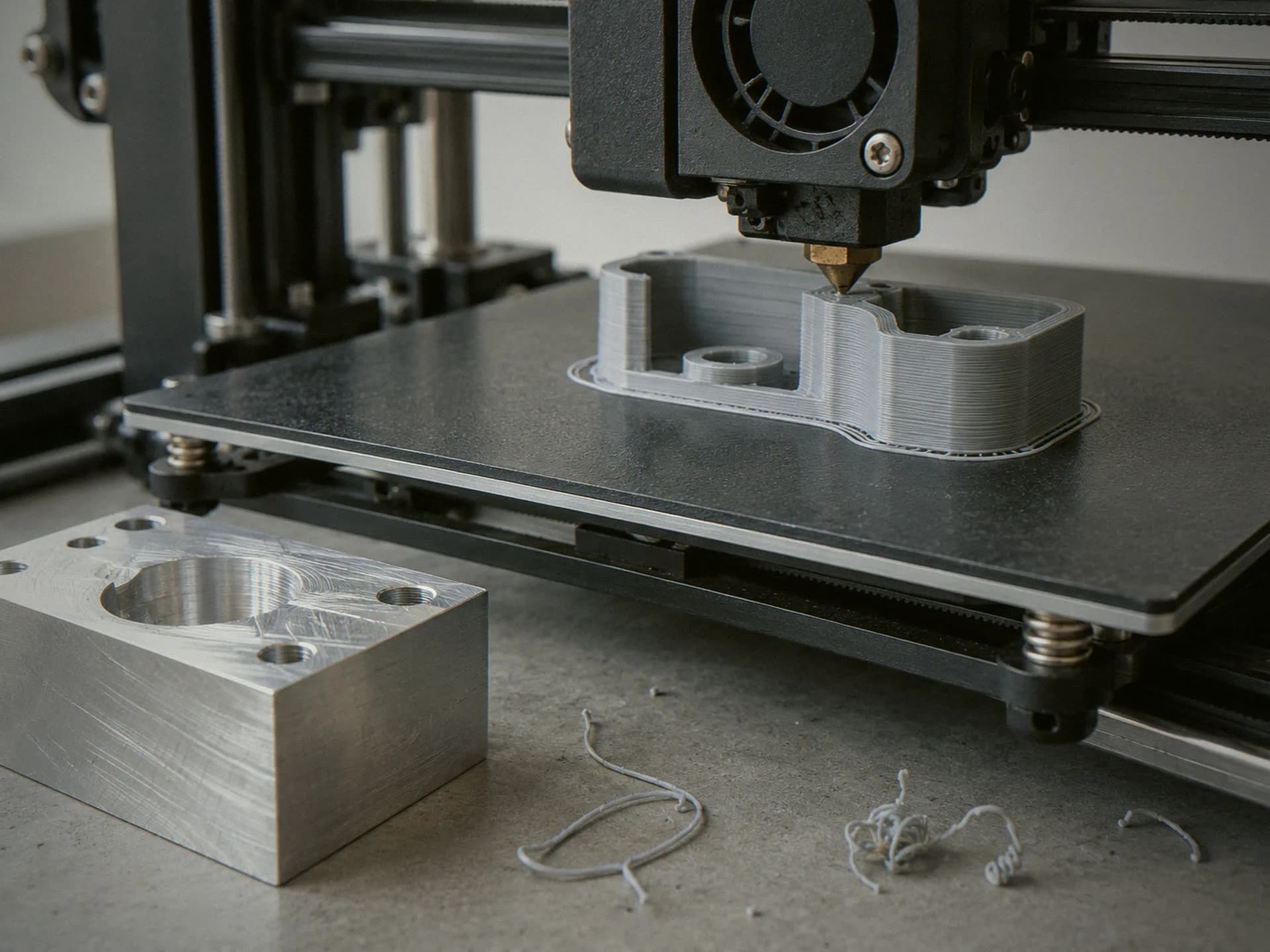
A prototype gets a specific answer before you spend on tooling: whether it fits, feels right in the hand, carries the load, or whether the circuit works. Each question has its own route. A prototype that answers a question you did not have is money spent on reassurance, not on learning. Illuminious is a U.S. NPI engineering company, and a prototype buys an answer to one question: our engineers help you pick the route that answers it. Engineered in San Francisco. Prototype builds, DFM and mass production in our own factory in Shenzhen.
Three portal services cover the tooling-free part routes: 3D printing, CNC machining and sheet metal fabrication. All three are configured online, all three accept a quantity of one, and all three go through the same free engineering review before payment. Boards come from Standard PCB & PCBA, and assembled units from custom mechatronic parts and assemblies. For teams with a demo date that cannot move, the portal takes 72-hour prototype builds.
What is a demo build, and what goes into one?
A demo build is your first working unit: the one you show investors, hand to a pilot user or film for Kickstarter. It combines prototype boards, printed or machined housing parts and early firmware. It proves the idea works. It does not prove the product can be built in volume; EVT, DVT and PVT do that.
That difference matters when you plan. A demo build can carry known problems, as long as everyone knows they are there. Its job is to work on the day. The golden sample comes later, after DVT and PVT, and production is held to it. See what a golden sample is for the full difference.
Our engineers build demo units in the Shenzhen factory from reviewed files. The boards are assembled on the same SMT lines that later run production, and the SMT program, stencil and reflow profile carry into production, so the step to EVT does not start over with a new supplier.
How a prototype iteration runs
Name the question
Fit, feel, load or function. One question per iteration keeps the loop short.
Pick the route
Print, machine, fabricate or build a board, by the question, not by habit.
Free engineering review
An engineer reads the files against the route and flags problems before you pay.
Build
Parts are made and, where needed, assembled with boards and firmware.
Check
Measure the answer: dimensional report, fit check, load test or bring-up.
Decide
Iterate once more, or move to the next stage gate.
What each prototype route can make
| Route | What it covers |
|---|---|
| Prototype PCBA | Assembled boards for the demo build, with parts down to the 01005 package and BGA pitch down to 0.25 mm, plus flying-probe and functional checks. |
| CNC machining | Milling, turning, mill-turn and EDM in aluminum 6061 and 7075, stainless 304 and 316, mild steel, brass, titanium and engineering plastics. Tolerances to 0.01 mm on controlled features, and a mirror finish of Ra 0.4 µm where the route allows. |
| 3D printing | SLA resin for fine detail, SLS and MJF nylon for functional parts, FDM for large form checks, SLM metal, and full color. Build envelopes up to 300 mm (SLA), 380 mm (SLS and MJF), 325 mm (SLM metal) and 900 mm (large-format FDM). Features down to 0.3 mm. |
| Sheet metal | Laser-cut and bent enclosures, brackets and panels in aluminum, mild steel, stainless and copper or brass, with no tooling. |
| Assembly and firmware | Boards, parts and harnesses assembled into a unit, firmware loaded, and the unit checked against the demo's needs. |
| Finishing | Anodizing, powder coating, brushing, plating and marking, declared per order. |
Not every demo build needs every route. A wearable demo may need prototype boards, a printed housing and a few machined metal parts where screws bite. A robot gripper demo needs machined parts for the load paths and printed covers for the rest. A sensor demo may need only boards and a sheet metal bracket. Our engineers propose the mix with the free engineering review, so you do not pay for a route your question does not need.
Which prototype route answers which question?
For shape, fit and appearance, print it. SLA gives a fine surface for a model people will look at; SLS or MJF nylon gives a functional part for something that will be handled. For strength and stiffness, machine it from the real alloy. For enclosures, brackets and panels, fabricate it in sheet metal.
A machined prototype is made from the same wrought material as the production part and has none of the layer weakness a printed one has. A laser-cut and bent sheet metal part is close enough to the stamped version for fit and function checks. A printed housing arrives soonest when the question is whether the product looks and feels right.
What can a prototype not tell you?
Whether the production process will work. A printed housing tells you the shape is right. It says nothing about draft angles, gate positions or sink marks in the molded version. A machined bracket tells you the geometry carries the load; it says nothing about springback on a press brake or a stamping die.
That gap is what EVT, DVT and PVT exist to close, and why the portal records a project phase: concept, prototype, pilot or production. Treat a prototype as proof of the process and you find process problems after tooling. A DFM review during design closes part of the gap before the first part is cut.
How do I keep prototype iterations from becoming the schedule?
Change one thing per iteration and decide in advance which result ends the loop. An iteration without an exit condition produces another iteration. When two designs both look plausible, build both at once: on every part route the quantity starts at one, and the setup costs more than the second part.
The free engineering review is the other lever. It comes before payment, and its findings arrive before you commit, so submitting a design for review spends an engineer's reading time instead of a build cycle.
When should a prototype move to EVT?
When the demo build does what the product must do and the design questions are answered. EVT then proves the design works as drawn, on boards and parts built from frozen files. Moving earlier means EVT finds design problems; moving later means you pay for prototype parts that production will never use.
At that point the parts change route. Printed housings move toward molded ones, which is why the DFM review is repeated before tooling. Production molds are cut after DVT closes the design.
The three tooling-free part routes
A specialist prices every order; a build outside a bound goes to an engineer.
| 3D printing | CNC machining | Sheet metal | |
|---|---|---|---|
| Answers | Does the shape work? | Does it carry the load? | Does the enclosure fit together? |
| Process options | SLA resin, SLS nylon, MJF nylon, FDM, SLM metal, full color | Milling, turning, mill-turn, EDM, engineer selected | Flat cut, bent, welded, or assembly |
| Materials | Standard and engineering resin, nylon, ABS, ASA, flexible TPU, aluminum, stainless | Aluminum 6061 and 7075, stainless 304 and 316, mild steel, brass, titanium, engineering plastic | Aluminum, mild steel, stainless steel, copper and brass |
| Envelope | 0.1 to 2,000 mm per axis | 0.1 to 2,500 mm per axis | 1 to 3,000 mm width and height |
| Quantity | 1 to 100,000 parts | 1 to 100,000 parts | 1 to 100,000 parts |
| Tolerance settings | Process standard, controlled, critical | General ISO 2768, ±0.10 mm, ±0.05 mm, ±0.02 mm and tighter | General, controlled, or critical |
| Inspection | Standard visual, dimensional report, advanced | Standard, dimensional report, CMM report | Standard, dimensional report, first-article report |
| Required files | STL, STEP, OBJ or 3MF | STEP; drawing before production for nonstandard needs | STEP plus drawing; DXF for flat parts |
| Free engineering review | Within 24 hours on business days | Within 24 hours on business days | Within 24 hours on business days |
Recent work: smart glasses for an investor demo
A stealth hardware startup needed working smart glasses for an investor demo and a trade show, on a date its previous supplier could not meet. Our engineers ran the tooling work in parallel with the prototype builds and planned around parts already in stock, so the units were ready for both events. Read the case study
Order prototype parts online
For 3D printing, CNC machining and sheet metal, configure online and get an official quote from a specialist within 24 hours on business days, after a free engineering review. Boards for the demo build go through Standard PCB & PCBA, with a live supplier price where suppliers can price the build. Assembled demo units go through custom mechatronic parts and assemblies. For a worked example from CAD to first article, read 72-hour NPI prototyping.
Facts and questions
Can I order a single prototype part?
Yes. Every part route accepts a quantity from 1 to 100,000, and none needs tooling, so a specialist prices the order from your files within 24 hours on business days. Molded, cast and stamped parts are different: a tool has to be designed first, so an engineer scopes the tool before any price exists.
Should a prototype be made from the production material?
When its job is to answer a mechanical question, yes: a machined part in the real alloy behaves like the real part. When it answers a question about shape or feel, a printed part in the process with the finest surface arrives sooner and tells you the same thing.
Can you assemble the prototype parts into a working unit?
Yes. Custom mechatronic parts and assemblies covers that: boards, machined and printed parts and harnesses assembled into a unit, with fasteners and torque, adhesive, wiring, calibration and functional test declared as assembly needs. Firmware can be loaded before the unit ships, so it arrives ready for the demo.
How long does a prototype build take?
The portal takes 72-hour prototype builds. The official quote, published after the free engineering review, states the lead time for your files, because the parts, the route and the quantity all change it. The review target is within 24 hours on business days on these routes.
Can one order mix printed, machined and sheet metal parts?
Each route has its own order, because each has its own fields and its own reviewer. For a demo build that needs all three plus boards, declare the assembly on custom mechatronic parts and assemblies, and our engineers plan the parts and the build as one scope with one delivery date.
How your official quote is prepared
A specialist prepares the official quote for each part route from your files and specifications, within 24 hours on business days after you submit. An engineer reviews every order, and the review comes before payment. The official quote it publishes is the amount you pay.
- An engineer runs a free engineering review of your files, and nothing is charged when you submit.
- You see the findings first.
- We publish the official quote with an itemized total, lead time and validity window.
- You accept the official quote, and only then does payment open.