ODM services: we design your product, then build it
No CAD yet? Our design team can take it from a sketch or a spec.
Walk Shenzhen factories with us, Dec 6–11. See the tour
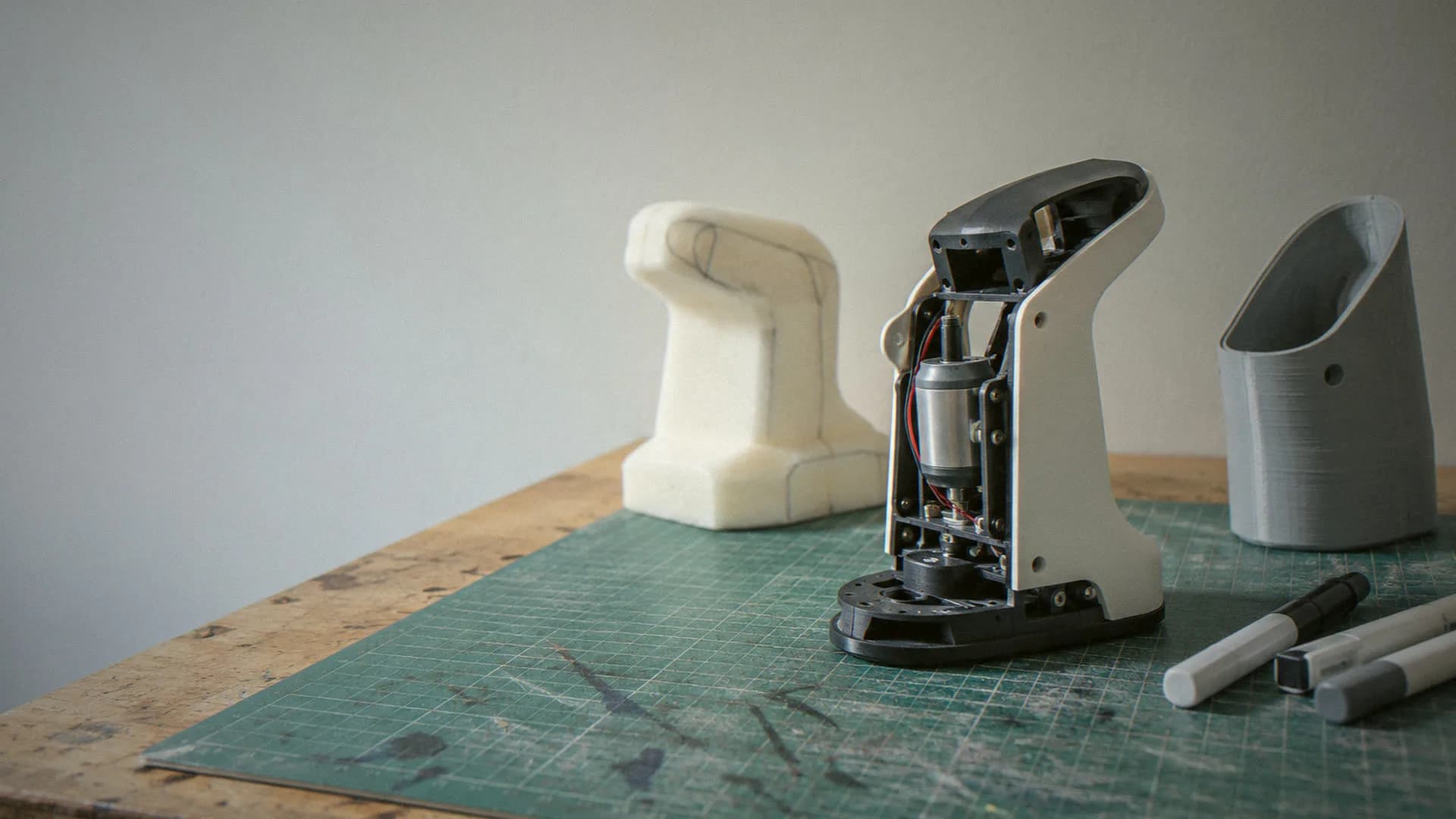
ODM, or original design manufacturing, means the manufacturer does design work as well as building. It can mean finishing a concept you sketched, or developing a product against a specification you wrote. You need it when the requirement is clear but the engineering to reach a buildable design is not in your team. Illuminious is a U.S. NPI engineering company, and on an ODM project our engineers design the electronics, the enclosure and the firmware, build the demo build, and take the same files into production. The design files are yours. Engineered in San Francisco. Prototype builds, DFM and mass production in our own factory in Shenzhen.
The value is timing. The people who will build the product are involved while the design can still move. A wall that will sink in the mold, a part with one source, a test point no probe can reach: each is an edit in CAD and a delay after tooling. A team with no hardware engineers hands us the whole design. A team with one generalist hands us a discipline. A team with a gap, such as RF and antenna, power electronics and battery/BMS, FPGA or motor control, hands us that specialty.
What we design
| Discipline | What it covers |
|---|---|
| Requirements and architecture | Function, success criteria, envelope, duty cycle and environment, turned into a block diagram and a parts plan. Part availability and alternates are checked before the schematic is drawn. |
| Electronics | Schematic and PCB layout, including RF and antenna, low-power battery designs, power electronics and BMS, and FPGA. A second engineer checks every schematic and layout: power tree, footprints, connector pinouts and parts against the BOM. |
| Firmware | Board bring-up, drivers, power management, connectivity, an update path that verifies each image and falls back to the last good one, and production test firmware. Firmware engineers review the schematic before layout starts. |
| Mechanical and enclosure | Enclosure CAD, molded and machined parts, sealing and fit. In engineering nylon the factory molds walls down to 0.8 mm. |
| DFM and DFA review | The design read against how the factory will build, test and source it. Repeated before DVT and before tooling. |
| Certification path | Pre-scans and test units for the certification path, with your test lab. |
| Builds and production | Demo build, EVT, DVT and PVT in the Shenzhen factory, then volume held to the golden sample you sign. |
Source files, not only outputs
Design files and IP are assigned to you at hand-off, and contracts are with Illuminious LLC (Wyoming). Ask for the source files as well as the outputs. A design you hold only as Gerbers can be built anywhere and changed nowhere. On a PCB layout order, required outputs are a declared field: EDA source, Gerbers, BOM and placement files, mechanical DXF, assembly and fabrication PDFs, the 3D model and production instructions. Declaring the EDA source is the difference between owning the product and owning a copy. Tooling you pay for, such as molds, fixtures and test stations, is yours as well, and you may move it to another factory. We sign your NDA before the first call, and project files live in private project storage.
How an ODM project runs
Requirements
We turn your brief into a requirement you can sign. You receive the requirement document.
Architecture and parts
Key parts, radios, power and the enclosure concept are chosen. Alternates are checked first.
Design
Schematic, layout, enclosure CAD and firmware are drawn and checked by a second engineer.
DFM review
The design is read against the factory's processes. You receive a findings report and the changed files.
Demo build
Your first working unit, for investors, a pilot user or a Kickstarter film.
EVT, DVT and PVT
The design is proven, validated and built on production fixtures. Our engineers attend each build in person.
Golden sample and production
You sign the reference unit, and every batch is compared with it.
Each step ends at a stage gate with a written report, and you receive the design source files at each one. You can stop at any gate and take the files elsewhere.
Which decisions are yours, and which are ours?
You approve the requirement, each stage gate, every change to scope or price, and the golden sample. Our engineers make the engineering choices inside the requirement: parts, topology, layout, enclosure details and firmware structure. Each choice is written into the stage-gate report with its reason, so you can question it before the next build.
When two people own one choice, the design stalls. One owner per choice keeps it moving. When a choice changes cost, schedule or what the product does, it comes back to you as an itemized change. When it does not, the report records it and the work moves on.
What happens at each project phase?
Concept makes the requirement specific enough to price. Prototype builds a few units whose job is to answer questions, not to be sold. Pilot builds the design the way production will, so the process is tested. Production is where the design stops changing and the controls take over: alternates policy, traceability and approved revisions.
In stage terms, the portal's pilot phase is the PVT build. Each control is a declared field on the mechatronic order, so a phase change is a decision you make, not a drift. Production molds are cut after DVT closes the design, and production test fixtures are built before PVT.
What goes wrong in ODM projects, and how is it prevented?
Four things. The scope grows without anyone deciding it. A key part goes end-of-life mid-design. Certification problems appear after tooling. And nobody can say which files are current. A signed requirement, alternates checked before the schematic, EMC and RF pre-scans at DVT and source files at each stage gate answer each one.
Scope growth is the quiet one. A feature added in a meeting can force a board respin after layout. On our projects a new feature is an itemized change with its cost and its effect on the date, and it waits for your yes. Late certification problems are the expensive one. DVT units go through pre-scans for the certification path before the molds are cut, and the DFM review is repeated before tooling.
What happens when I want a change after DVT?
A change after DVT is an itemized change. It shows its cost and its effect on the date, and it waits for your yes. A declined proposal stays declined. Production molds are cut after DVT closes the design, so a change that reaches tooling costs the most. The DFM review is repeated before tooling.
Three things set what a late change costs: whether tooling is cut, whether fixtures exist and whether the golden sample is signed. Production test fixtures are built before PVT. Tooling you pay for is yours. A design change after the golden sample is re-measured against the old reference, and the golden sample is signed again.
When is OEM the better model than ODM?
When you already have a design you trust and need capacity, not engineering. Paying for design work you do not need slows a project, because each design decision then has two owners. If you can hand over a complete file package and expect it to build, choose OEM manufacturing instead.
ODM earns its place when the specification is clear but the implementation is not, when the electronics, mechanics and firmware have to agree with each other, or when the manufacturability of the design is itself the risk. See OEM manufacturing for build-to-print work.
What we design and build
Wearables such as smart rings, smartwatches and wristbands, smart glasses and data gloves for robot training. Robot hands and grippers, robots and teleoperation rigs, exoskeletons and rehab devices. Industrial IoT sensors, smart home devices and personal AI devices. Battery packs and BMS, chargers and power electronics, and lab and test instruments. Battery packs we build go through UN38.3 shipping tests. Regulated work runs under the Shenzhen factory's certificates: medical devices and rehab devices under ISO 13485, with the FDA path run with your regulatory team; automotive and EV parts under IATF 16949; aerospace and drone parts under AS9100.
How is an ODM project priced?
In parts. Design work ordered through the portal is priced from published tiers for project initiation, schematic design, PCB layout and firmware development, confirmed in the free engineering review. A full program is priced in an official quote: engineering, each build, tooling and the unit price, itemized. Nothing is charged before you accept the official quote.
Tooling is listed on its own lines, because it is yours once you pay for it. Unit prices depend on volume, so the official quote states the quantities it assumes. When the volume changes, the price is revised as an itemized change, not a surprise on the invoice.
What each declared project phase covers
Each row names the order route that records it.
| Declared phase or field | What you supply | What the reviewed scope produces |
|---|---|---|
| Concept (mechatronic route) | Function, success criteria, envelope, motion and load, duty cycle, environment | A specification you can price, and a make-or-source plan |
| Prototype (mechatronic route) | A CAD file or drawing, a BOM, or a detailed requirement | Units built to answer questions, with the assumptions written down |
| Pilot, or PVT (mechatronic route) | The validated design and the alternates policy you want enforced | A run built the way production will build it |
| Production (mechatronic route) | A settled design and a target quantity of 1 to 100,000 units | Controlled production, with lot and material traceability as a toggle |
| Layout milestones (PCB layout route) | Schematic or source archive, footprints, datasheets | Placement approval and routing approval |
| Alternates policy (mechatronic route) | Your rule | No alternates without approval, form and fit alternates with approval, or engineer may propose |
| Free engineering review | The submitted project | Within 24 hours on business days for mechatronic parts; within two business days for the four design services |
Recent work: a patch that had to bend with the skin
A small seed-stage team had a wearable health patch that had to stay thin and flexible on the body. The circuit went onto flex PCBA, and the electronics were sealed in biocompatible encapsulation. The team ran a small pilot first, then moved to volume units with the same partner and the same files. Read the case study
Order design work online
Five portal services carry ODM work. Project initiation, schematic design, PCB layout and firmware development are priced from published tiers, confirmed in a free engineering review within two business days. For custom mechatronic parts and assemblies, configure online and get an official quote from a specialist within 24 hours on business days. A full ODM program is scoped with an engineer and priced in an official quote. For the design disciplines in depth, see product design, firmware development and DFM services. For the trade-offs of a connected product, read the IoT device manufacturing guide.
Facts and questions
Will I get the source files, or only the outputs?
On an engineering project you receive the design source files at each stage gate, and the IP is assigned to you at hand-off. On a PCB layout order, EDA source is one of the required outputs you can declare, so declare it. Gerbers alone let you build a board but not change it.
How are part substitutions handled during development?
By the alternates policy declared on the mechatronic order: no alternates without approval, form and fit alternates with approval, or an engineer may propose. Whichever you choose, a proposal arrives as an itemized change that you approve, question or decline. Nothing is substituted silently, and the change is recorded against the revision.
Can an ODM project include mechanical parts as well as electronics?
Yes. The custom mechatronic parts and assemblies route exists for that. Scope is declared as a custom part, an assembly, a sourced component, or mixed fabrication and sourcing. Assembly needs are declared with it: fasteners and torque, adhesive, wiring, calibration, functional test and custom packing.
Do you write the firmware as part of an ODM project?
Yes. Firmware is in scope: bring-up, drivers, power management, connectivity, the update path and production test firmware. Firmware engineers review the schematic before layout starts, so the board suits the code. Handover includes the toolchain version, the build steps and the programming procedure.
Can I start with only a sketch or a written idea?
Yes. Project initiation turns a sketch or a written idea into a feasibility assessment, major component selections and a BOM cost estimate. It is priced from three published tiers, and the free engineering review takes up to two business days. From there, each stage is a separate decision, and you can stop at any stage gate.
Can you work alongside our own engineers?
Yes. A project can split the work: your team keeps the system design or the firmware, and our engineers take the board, the enclosure or a specialty such as RF or power electronics. Each side's files go through the same stage gates, and a second engineer checks every schematic and layout we deliver.
When do I learn the schedule?
In the official quote, after the free engineering review. The schedule depends on which stage you start at, which parts are scarce and how many builds the requirement needs, so our engineers set it once they have read the brief. Each later change to the date arrives as an itemized change you approve.
How your official quote is prepared
A specialist confirms the published tier for each design service, or prices a mechatronic order from your files and specifications, after the free engineering review. An engineer reviews every order before payment. The official quote it publishes is the amount you pay.
- An engineer runs a free engineering review of your files, and nothing is charged when you submit.
- You see the findings first.
- We publish the official quote with an itemized total, lead time and validity window.
- You accept the official quote, and only then does payment open.