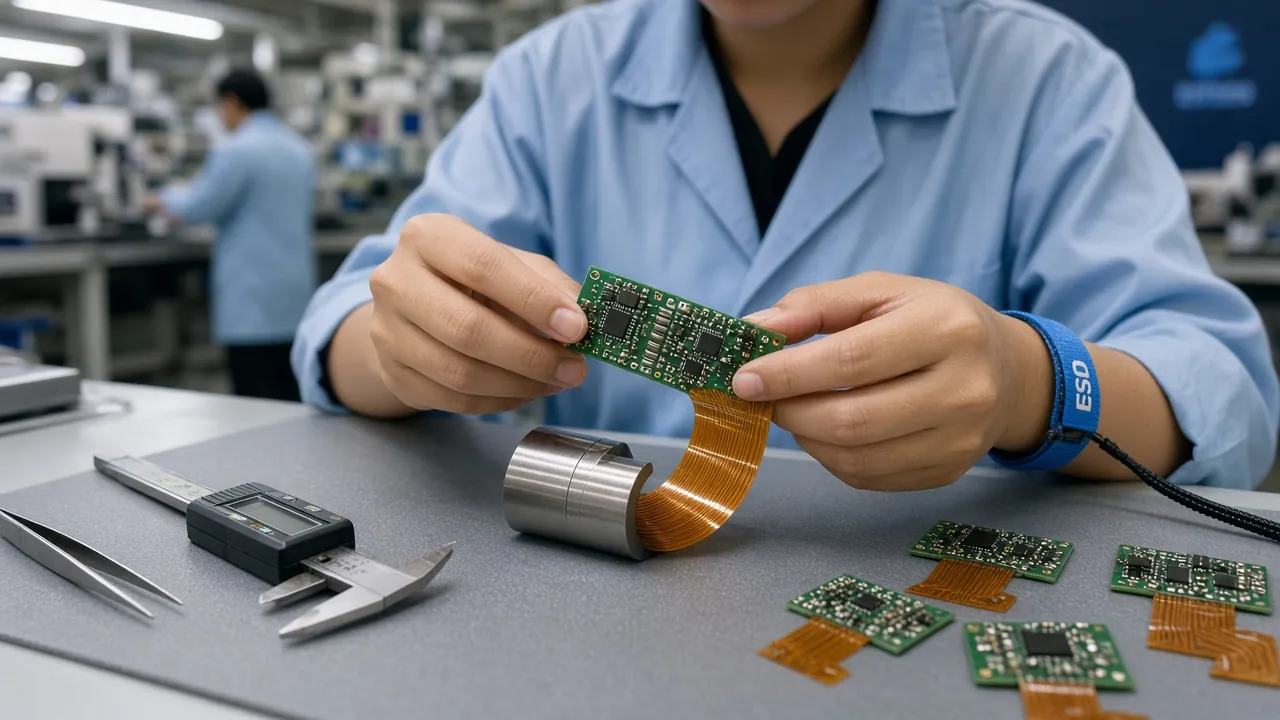
Bringing a connected device from a great idea to a mass-produced reality is a journey filled with unique manufacturing hurdles. Unlike standard electronics, Internet of Things (IoT) devices demand a specialized approach, where wireless performance, power efficiency, and global certifications are not afterthoughts but core to the design process itself.
The Core Pillars of IoT Manufacturing Success
Successfully manufacturing an IoT product hinges on mastering three critical, interconnected domains. Getting any of these wrong can lead to costly delays, poor performance, and a failed product launch. This guide provides a strategic overview of the essential considerations for any team looking to manufacture a connected device at scale.
1. RF & Wireless Design
The foundation of any IoT device is its ability to communicate reliably. This requires meticulous RF engineering from the PCB layout to antenna selection to ensure optimal signal integrity and range.
2. Power Management
For battery-powered devices, longevity is paramount. Every component and line of code must be optimized for ultra-low power consumption to meet user expectations for battery life.
3. Regulatory & Compliance
Navigating the complex web of global wireless certifications (FCC, CE, etc.) is a non-negotiable step. Early planning and testing are crucial to avoid being blocked from key markets.
Deep Dive: RF Design & Layout Considerations
The wireless performance of your IoT device is not magic; it's a direct result of careful physics-based design and layout. Even minor mistakes in the PCB design can drastically reduce range, introduce interference, and cause certification failures. Below are the four most critical areas to focus on during the layout phase.
Antenna Placement is King
The location of your antenna is the single most important factor in wireless performance. It must be kept clear of metal enclosures, ground planes, and noisy components to radiate effectively.
Shielding Sensitive Circuits
Isolating the RF front-end from high-speed digital sections (like a microprocessor) with metal shield cans prevents electromagnetic interference (EMI) from degrading receiver sensitivity.
Maintain 50-Ohm Impedance
All RF transmission lines on the PCB must be designed to a 50-ohm impedance to ensure maximum power transfer from the radio to the antenna. This requires precise control of trace width and dielectric spacing.
Isolate from Digital Noise
High-speed digital signals create radio noise that can interfere with your receiver. Physically separating RF and digital sections on the board is a fundamental principle of good IoT design.
Mastering Power Management for Extended Battery Life
For many IoT applications, operating for months or even years on a single battery is a key product requirement. This necessitates a holistic power management strategy that considers hardware, firmware, and system-level behaviors.
- Ultra-Low Power Components: Select microcontrollers, sensors, and radios specifically designed for low-power operation with deep sleep states in the nanoamp (nA) range.
- Aggressive Sleep Modes: The device firmware must be designed to keep the main processor in its lowest power sleep state for the maximum amount of time, waking only briefly to transmit data.
- High-Efficiency Power Supplies: Utilize high-efficiency DC-DC converters instead of linear regulators (LDOs) to minimize energy loss when converting battery voltage.
- Battery Chemistry Matching: Choose a battery chemistry (e.g., Li-SOCl2 for long-life, Li-Po for rechargeability) that aligns with your product's use case and power profile.
The difference between a 1-year and a 5-year battery life is rarely the battery itself, but rather the discipline of the engineering team to scrutinize every microamp of current draw.— Advanced IoT Power Management, 2025
Navigating the Global Maze of Wireless Certifications
Your product cannot be legally sold in major markets without passing rigorous wireless certification tests. Each region has its own regulatory body and specific set of rules. Engaging with a certification lab early in the design process is critical to ensure a smooth path to compliance.
FCC (United States)
Governs all radio-frequency devices. Key regulations include Part 15 for unlicensed transmitters. Testing involves radiated and conducted emissions to ensure the device does not interfere with other wireless products.
CE RED (European Union)
The Radio Equipment Directive (RED) is the standard for all radio products sold in the EU. It covers radio performance, EMC, and electrical safety. A CE mark is mandatory for market access.
Key Takeaways for IoT Manufacturing
- Design for Compliance Early: Don't treat RF design and regulatory planning as an afterthought. Engage experts and labs from the beginning.
- Power is Everything: Meticulous power budgeting and low-power design techniques are essential for battery-powered devices.
- Partner Wisely: Select a manufacturing partner with proven experience in RF testing, module integration, and navigating global certifications.
- Test, Test, and Test Again: IoT devices require a specialized suite of tests, including RF performance, power consumption profiling, and over-the-air (OTA) update validation.