Hardware engineering for startups at any stage
Illuminious is a U.S. NPI engineering company, and a hardware engineering partner for startups at any stage: no engineers yet, one generalist, or a gap like FPGA. Engineered in San Francisco. Prototype builds, DFM and mass production in our own factory in Shenzhen. We design the product and build it.
A free engineering review comes before you pay.
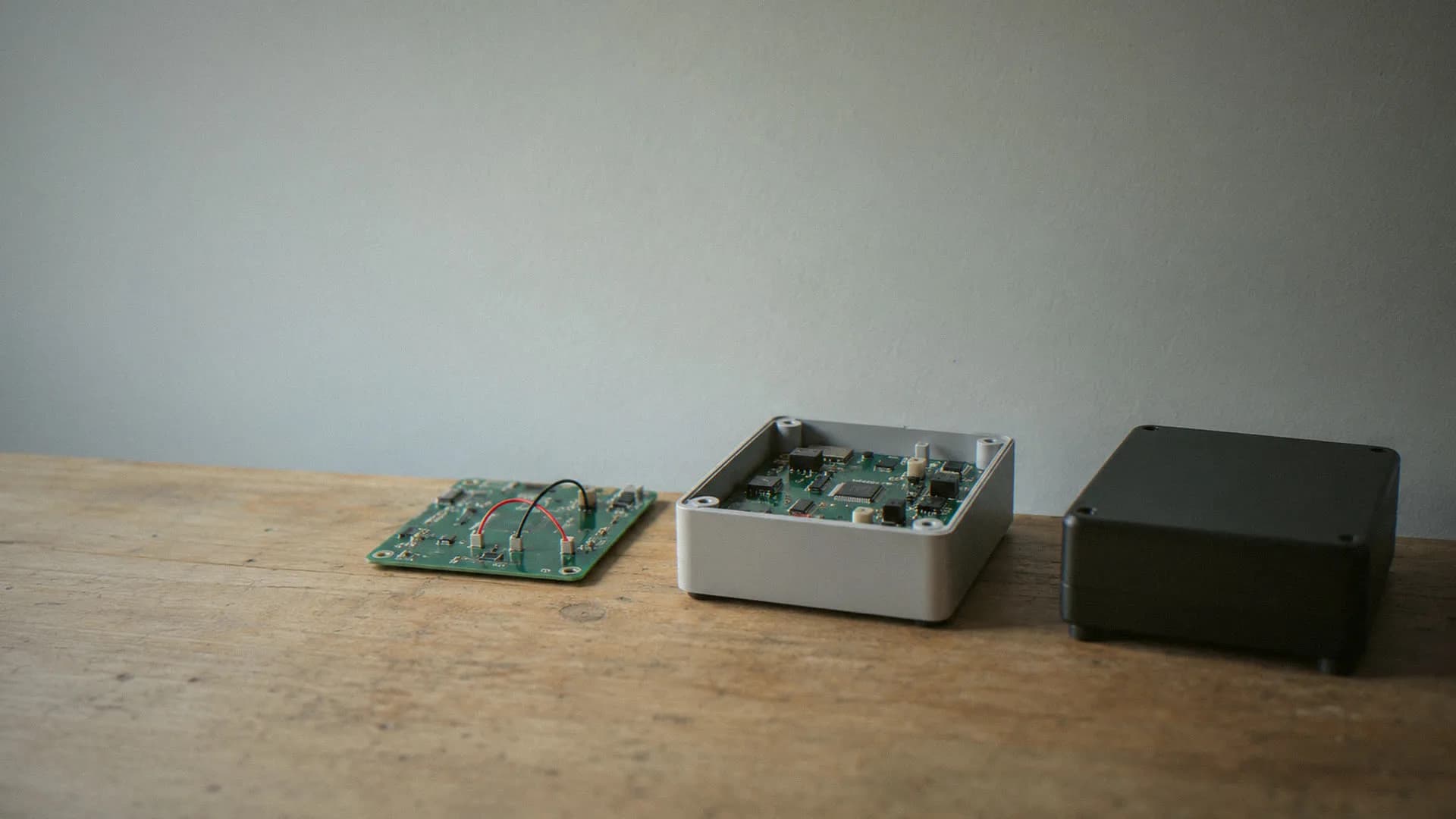
- 500+ projects delivered
- 200+ hardware teams served in 30 countries
- 12 services to configure and order online
How does a hardware product get from idea to production?
It moves through eight stages: design, DFM review, demo build, EVT, DVT, PVT, golden sample and production. Each stage ends at a stage gate with a written report and the files or units you can test. You can start at any stage, and the engineers who draw your schematic stay on the project in the Shenzhen factory.
Demo build or golden sample? The demo build proves the idea; the golden sample is what production must match. Read what a golden sample is, and why you sign it.
- Design. Our engineers draw the schematic, lay out the PCB, model the enclosure and write the firmware. See product design and firmware development.
- DFM review. While the design is still in CAD, we check it against how the factory will build, test and source it. See DFM services.
- Demo build. Your first working unit: the one you show investors, hand to a pilot user or film for Kickstarter. The portal takes 72-hour prototype builds.
- EVT. Engineering validation units prove that the design works as drawn.
- DVT. Design validation units, built closer to production, prove that it meets its specification and start the certification path.
- PVT. Production validation units come off the line on production fixtures and prove the process.
- Golden sample. You sign the reference unit after PVT, and production is held to it.
- Production. Volume runs in the Shenzhen factory, and each batch is compared with the golden sample. See transfer to production.
Who do you work with?
Founders and product teams who need a device built, whatever team they already have. On each project our engineers take the roles that are missing: the whole design, one discipline, or one specialty.
When to bring us in
- Before the first schematic. Parts and architecture are cheapest to change now.
- When a specialty is missing. FPGA, RF and antenna, power electronics and battery/BMS, motor control, embedded Linux, or the certification path.
- Before a demo date. An investor meeting, a pilot or a trade show that cannot move.
- Before you pay for tooling. Molds and fixtures should be cut once, from a frozen design.
How do the options compare?
| Option | What it covers | What stays with you | Where it fits |
|---|---|---|---|
| In-house hire | The disciplines you hire, on your product only | Recruiting, lab tools, the missing disciplines and the factory | Steady work on a long product line |
| Freelancer | One person's skills on a defined task | Reviews, other disciplines and the factory hand-off | A narrow task with a clear end |
| Design-only firm | A design team and a file set | Finding a factory and repeating the DFM work there | You already have a factory you trust |
| Design-and-build partner | Design, DFM review, prototype builds and production with one team | The approval at each stage gate | One team from schematic to volume |
What we build
Wearables
Smart rings
tiny battery, BLE, health sensors, sealed shell, wireless charging.
Smartwatches and wristbands
sensor fusion, all-day battery, BLE, strap, water rating.
Smart glasses
camera and audio in grams, heat control, balanced frame.
Data gloves for robot training
finger and touch sensors, synced high-rate data, washable build.
Wellness wearables, with no medical claims.
Robotics and data collection
Robot hands and grippers
small motors, encoders, touch sensors, tough cable routing.
Robots and teleoperation rigs
embedded Linux, motor drives, low-latency links, safety stops.
Exoskeletons and rehab devices
actuators, battery packs, motion sensors, careful fit.
Connected devices and sensors
Industrial IoT sensors
years on battery, LoRa or LTE-M, rugged sealed housing.
Smart home devices
Wi-Fi or Matter, mains design, easy pairing, retail finish.
Personal AI devices
microphones, an edge AI chip, Wi-Fi, heat control in a small case, and a housing people carry all day.
Power and energy
Battery packs and BMS
cell balancing, protection, heat checks, UN38.3 shipping tests.
Chargers and power electronics
efficient converters, heat control, a UL certification path.
Instruments
Lab and test instruments
precise analog, FPGA or fast ADC, calibration, motion control.
Regulated fields. Each runs under a Shenzhen factory certificate: medical devices under ISO 13485, with the FDA path run with your regulatory team; automotive and EV parts under IATF 16949; aerospace and drone parts under AS9100; exoskeletons and rehab devices under ISO 13485. See medical and automotive.
What you receive at each stage
| Stage | What you receive |
|---|---|
| Design | Schematics, PCB layout and Gerbers, the BOM, enclosure CAD and STEP files, firmware source (engineering projects) |
| DFM review | A findings report and the changed design files |
| Demo build | Working units built from the reviewed files |
| EVT | EVT units, test results and the updated files |
| DVT | DVT units, a validation report and units for the certification path |
| PVT | PVT units, the test plan and the fixture definitions |
| Golden sample | The sign-off record; the signed unit stays in the factory |
| Production | Batches compared with the golden sample, with inspection and test results |
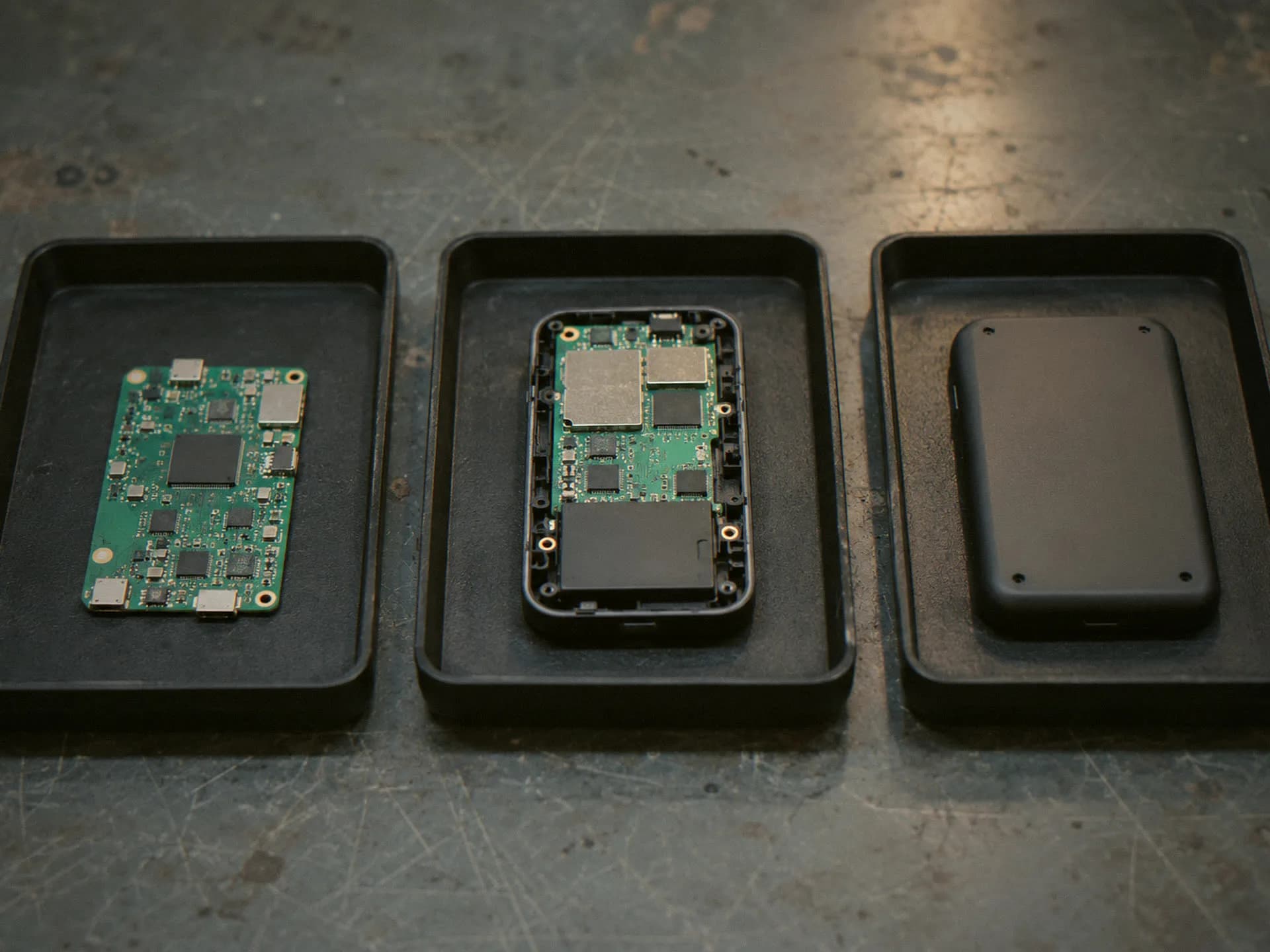
Who owns the files?
On an engineering project, you do. You receive design source files at each stage gate, and design files and IP are assigned to you at hand-off. A portal order records ownership in the scope you approve. Contracts are with Illuminious LLC, a Wyoming company.
Tooling you pay for (molds, fixtures, test stations) is yours; you can move it to another factory. We sign your NDA before the first call; files live in private project storage.
Order engineering work online
Four design services have a published fixed price in the portal, and each starts with a free engineering review in 2 business days.
- Project initiation: a feasibility check, the major parts and a BOM cost estimate.
- Schematic design: a reviewed, simulated schematic, priced by how many parts and modules it has.
- PCB layout: a new layout or a controlled change, and you can approve placement before routing.
- Firmware development: embedded firmware priced by platform and code size.
Recent work: an antenna boxed in by the battery
A connected-health team needed one partner for a wearable health patch, from hand-built EVT units to volume. The DFM review during EVT caught an antenna keep-out conflict with the battery before layout freeze. Read the case study.
Facts and questions
- Office
- San Francisco, CA 94107. Factory: Shenzhen, owned by Illuminious.
- Shenzhen factory certificates
- ISO 9001, ISO 13485, IATF 16949, AS9100, ISO 14001.
How much does hardware product development cost?
It depends on the stage and the scope, so we price it after reading your files. The four design services show a published fixed price in the portal. Larger work gets an official quote with an itemized total, a lead time and a validity window, after a free engineering review. Nothing is charged when you submit.
Do I need a finished design before I contact you?
No. A sketch, a brief, a dev-kit prototype or a full file set is enough. An engineer reads it and names your stage.
What are EVT, DVT and PVT?
They are the three validation builds between a demo build and volume. EVT asks whether the electronics and mechanics work together. DVT asks whether the product meets its specification under stress and starts the certification path. PVT asks whether the line can build it at rate. After DVT and PVT you sign the golden sample.
How do I protect my IP in Shenzhen?
We sign your NDA before the first call, and files live in private storage. Design files and IP are assigned to you at hand-off; tooling you pay for is yours.
Tell us where your product is today
Send a sketch, a schematic or a full file set. An engineer replies with your stage and what to build first. See the founder playbook.