Injection molding, from the DFM review to production parts
Production plastic parts from a mold cut after DVT. Draft, walls and gates are settled in CAD first.
No CAD yet? Our design team can take it from a sketch or a spec.
Walk Shenzhen factories with us, Dec 6–11. See the tour
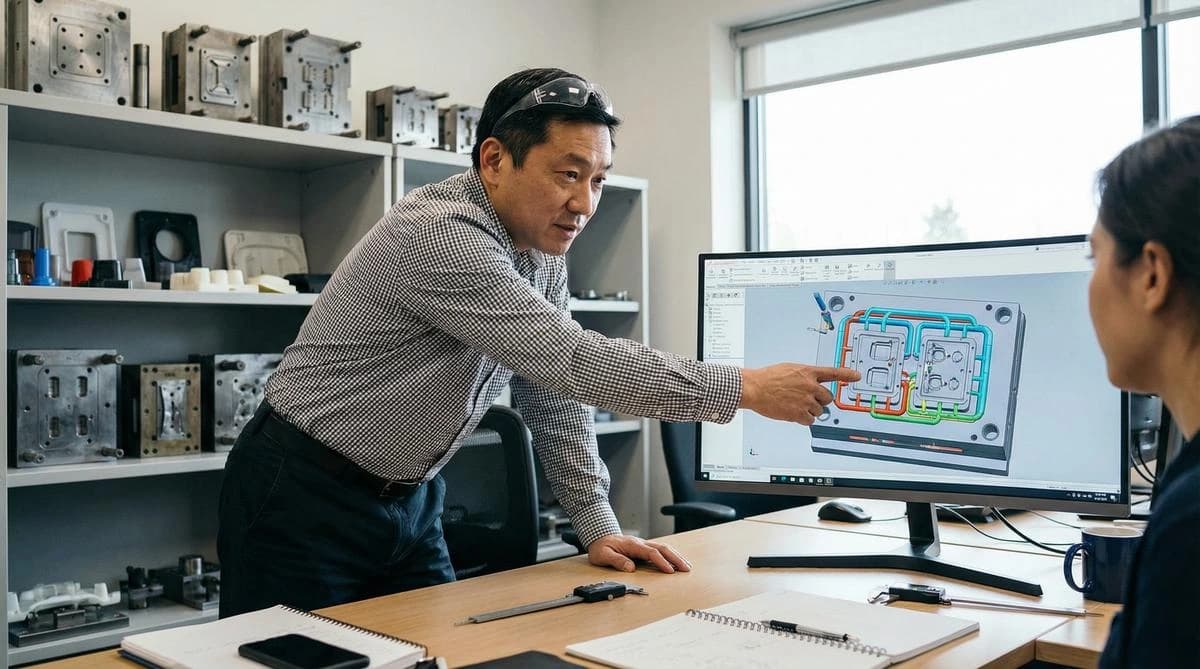
Injection molding forces molten plastic into a steel or aluminum mold, cools it and ejects a finished part. After the mold exists, each part takes seconds, and the cost is mostly material. Almost every plastic part made in quantity is molded. Illuminious is a U.S. NPI engineering company. Engineered in San Francisco. Prototype builds, DFM and mass production in our own factory in Shenzhen. The price of entry is the mold itself: an engineering project with its own lead time, review cycle and validation.
Molding is priced after engineering review, because a molded part's price follows from a tool that must be designed first. Draft, wall thickness and gate position are permanent decisions. A mistake in them is a tool you cut again, so our engineers spend most of the effort on a molded part before any steel is ordered.
The design decides the tool
Our engineers treat the mold as part of the product design. A housing for a smart ring, a handheld instrument or a smart home device has to hold a board, a battery, buttons and often a window or a light pipe, and each one sets a wall, a rib or a boss. The DFM review runs while the enclosure is in CAD, and it is repeated before DVT and before tooling. Molds are cut after DVT closes the design, so a change found in DVT testing costs a new file and not a new tool. For an electronics housing, the review also checks where the board, the battery and the connectors sit, because a boss or a rib in the wrong place moves a component. The engineers who drew the schematic stay on the project when it moves to the Shenzhen factory, so the person who placed a connector also answers the toolmaker who asks to move a boss.
For a demo build, housings are usually printed or machined. If EVT or DVT needs molded parts in the real resin, we quote a prototype tool, not the production mold, and both options appear in the official quote. Tool room, presses, assembly and test are in one building. The tool room holds critical mold features to 0.005 mm with EDM and high-speed CNC, and builds molds in P20, H13 or S136 tool steel. A hardened steel production mold is built for 500,000+ shots, and the tool class is confirmed against your volume in the review. Tooling you pay for (molds, fixtures, test stations) belongs to you, and you may move it to another factory.
Molding and tooling capabilities
| Capability | What it covers |
|---|---|
| Mold design and DFM | Our engineers check draft, wall thickness, undercuts, gate and ejector positions, cooling and knit-line locations before the tool is designed. Findings come back sorted by when they must be fixed: before the demo build, before EVT, or before production. |
| Tooling | Single-cavity prototype tools to multi-cavity hardened steel production molds built for 500,000+ shots, in P20, H13 or S136 tool steel. Slides, lifters and hot runners where the part needs them. Soft tooling for EVT and DVT. |
| Precision | Dimensional tolerance of 0.3% of the nominal dimension, smallest feature 0.3 mm, critical mold features held to 0.005 mm in the tool room. |
| Thin walls | Molded walls down to 0.8 mm in engineering nylon, for light parts in wearables and handheld products. The wall you can reach depends on the resin and the flow length, and the review confirms it. |
| Insert molding and overmolding | Threaded inserts or electrical contacts placed in the mold before injection, and two-shot overmolding of a soft grip onto a rigid part. |
| Production molding | 30+ injection molding presses from 50–1000 t in the Shenzhen factory, run by the same team that ran the tool trials, so the process window set at T1 carries into volume. |
| Clean room molding | A Class 100,000 (ISO 8) clean room for parts that must stay clean, such as medical housings and optical parts. |
| Assembly after molding | Box build and test run in-house, so molded housings, boards and cables become finished units in one factory. |
How a molded part moves from CAD to production
| Step | What we do | What you get or decide |
|---|---|---|
| 1. DFM review | Our engineers check draft, walls, undercuts, gate and ejector positions on your CAD while the design can still change. | A DFM findings report and changed files. You decide which findings to fix now. |
| 2. Prototype validation | We print or machine prototype parts to test fit, look, assembly order and handling before steel is cut. Each round feeds changes back into the CAD. | Parts you can hold, for the demo build and for EVT, and a design that is ready to close at DVT. |
| 3. Mold design | After DVT closes the design, we design the tool: cavities, gate, runners, cooling and actions. The DFM review is repeated before tooling. | You approve the mold design and the tool class. |
| 4. Tool build and T1 trial | The tool room cuts the mold, and the first trial shots (T1) are molded and measured against your CAD. Small corrections to the steel are made before the next trial. | T1 samples and a measurement record for your approval. You sign off the samples before production starts. |
| 5. Process set-up | Process engineers set fill, pack and hold as separate phases and look for a wide, stable process window on the press. | A molding process tied to the approved samples, recorded so the next batch starts from the same settings. |
| 6. Production | Parts run in production, are checked at set intervals against the approved samples, and go to box build and test when you order the full product. | Batches compared with the golden sample, with inspection and test results. |
Material selection and surface finishing
The resin and the finish decide how the part performs and how it looks. Our engineers help you choose against strength, chemical resistance, heat, UV exposure and cost. Resin choice also changes the tool: glass-filled grades wear a mold faster, and some resins shrink more than others, so the cavity is cut for the resin you choose. Changing resin after the tool exists can mean recutting it.
Engineering and commodity resins
- ABS: good toughness and impact strength
- PC: high impact and temperature resistance
- PP: good chemical resistance, flexible
- Nylon (PA6, PA66): high mechanical strength and wear resistance
- POM (acetal): high stiffness, low friction
- PMMA (acrylic): high optical clarity
- HDPE and LDPE: low cost, high flexibility
- TPE and TPU: rubber-like flexibility, for overmolding
- PC/ABS alloy: tough and strong
- PEEK: very high temperature and chemical resistance
- Ultem (PEI): high strength and flame retardant
- Glass-filled grades: more stiffness and stability
In-mold and post-process finishes
- SPI finishes: from A-1 (mirror polish) to D-3 (dull matte), molded directly from the tool.
- VDI and Mold-Tech textures: grains and leather patterns etched into the mold cavity.
- Painting, printing and coating: multi-coat paint including EMI shielding, pad printing for logos, screen printing, soft-touch and UV-resistant clear coats.
- Laser marking: permanent serial numbers, logos or text after molding.
How quality is held
The Shenzhen factory holds ISO 9001, ISO 13485, IATF 16949, AS9100 and ISO 14001. Housings for medical devices are molded under its ISO 13485, and automotive and EV parts under its IATF 16949. T1 samples are measured against your CAD, and production batches are compared with the golden sample you signed. Cpk data and full PPAP are available on custom parts. When a result drifts from the reference, an engineer reviews the drift before the next batch runs. Each stage ends with a written report. At PVT you receive the test plan and the fixture definitions, and production fixtures are built before PVT, so the first volume batch is tested the same way as the last. Firmware test results for assembled units are kept per serial number.
What does a molded design have to get right before the tool is cut?
Draft, wall thickness and the gate position. Every face parallel to the ejection direction needs draft to release from the mold. Walls should be as even as the function allows, because a thick section cools last and pulls a sink mark into the face above it. The gate decides how material flows and where knit lines form.
After those, check where the ejector pins land, because they leave marks. Each of these is a design decision with permanent results, and a molding project has a DFM review before it has an official quote for this reason. Our DFM review in the design phase covers the enclosure and the board together, so a rib that clears the board in CAD also clears the components that sit on it.
How do I validate a design before committing to a mold?
Print it, in a material that answers your question. SLA resin gives the finest surface for fit and looks. SLS or MJF nylon gives a functional part for snap fits and handling, with no tooling. Machining from an engineering plastic comes closest to final stiffness. None of them copies the molded material exactly.
Both routes are ordered online: order 3D printing at quantities from 1 to 100,000 parts and envelopes up to 2000 mm per axis, or order CNC machining in engineering plastic. They answer the geometric and ergonomic questions, which are the costly ones to change after steel is cut. For a demo build, printed housings are often enough. For EVT, a mix of printed and machined parts usually answers the fit and stiffness questions well enough to close the design at DVT, which is the point where the mold is cut.
When is molding the wrong answer?
When the quantity will not pay back the tool, when the design is still changing, or when the part is simple enough to machine for less over its whole life. A mold is a commitment to one geometry and one resin. The cheapest mold is the one you never had to modify, so tool up only after DVT.
Molding is also a poor fit for very large parts in small numbers, and for parts with undercuts that need several actions to release. Each action adds cost and one more thing that can fail on the line. The review says so before the tool is designed. Where a part is close to the line, our engineers show both options in the official quote: a molded version with its tooling cost, and a machined or printed version with no tooling. You then decide with real numbers for your own volume. The injection molding guide for electronics housings covers the same trade-offs with examples.
Molding against the plastic routes you order online
The CNC and printing columns are configurator limits; the injection molding column is set in review.
| Consideration | Injection molding | 3D printing (ordered online) | CNC machining (ordered online) |
|---|---|---|---|
| Dedicated tooling | A mold per geometry | None | None |
| Ordered online | No, priced after engineering review | Yes, priced by a specialist within 24 hours on business days | Yes, priced by a specialist within 24 hours on business days |
| Plastic materials | Confirmed in review | Standard resin, Engineering resin, Nylon, ABS / ASA, Flexible TPU | Engineering plastic |
| Tolerance | Confirmed in review against the tool | Process standard, controlled dimensions, or critical tolerance | General ISO 2768, ±0.10 mm, ±0.05 mm, ±0.02 mm or tighter |
| Quantity | Justified by the volume that pays back the mold | 1–100,000 parts | 1–100,000 parts |
| Envelope | Confirmed in review | 0.1–2000 mm per axis | 0.1–2500 mm per axis |
| Cost of a design change | A change to the mold | A new file | A new program |
| Surface finish options | Set by the tool's own finish | As printed, sanded / polished, painted / dyed, bead blast, secondary machining | As machined, anodized, hard anodized, bead blast, powder coat, plating |
| Best suited to | Settled designs at sustained volume | Geometry validation and low volume | Functional prototypes in engineering plastic |
Recent work
A smart-home startup moved a heat-pump controller from 3D-printed shells to production housings with overmolding and an integrated board. The printed shells answered the fit questions first, and the tools were cut once the design was settled. Read the heat-pump controller case.
Facts and questions
Can I get an injection molding quote online?
No. Molding is priced after engineering review, because a mold must be designed before it can be priced. Printing, machining and sheet metal need no tooling: you order them online, and a specialist prices them within 24 hours on business days. For molding, send your CAD and volume for an official quote on the tool and parts.
How much draft does a molded part need?
Enough to release from the tool. The amount depends on the depth of the face, the resin and the texture, and a textured face needs more than a polished one. We confirm it against your geometry in the DFM review, face by face, instead of applying one global figure to the whole part.
Why do sink marks appear on molded parts?
A thick section keeps cooling and shrinking after the surface above it has set, so it pulls that surface inward. The fix is in the design: keep walls as even as the function allows, and core out thick bosses and ribs instead of leaving them solid.
How many cavities should the first tool have?
Usually one. A single-cavity tool costs less, reaches T1 sooner and shows how the part fills before you copy it. Move to a multi-cavity tool when the volume is firm and the process window is stable. The review sizes the cavity count against your annual volume, and the official quote shows both options.
How your official quote is prepared
Molding is priced after engineering review. For the prototype parts that come first, a specialist prepares the official quote for your 3D-printed parts from your files and specifications, within 24 hours on business days. An engineer reviews every order. The review is free and comes before payment, and the official quote is the amount you pay.
Start your next molding project
Send your 3D files and your planned volume for a free engineering review. Our engineers run the DFM review, plan the tool against DVT, and publish an official quote for tooling and production. Molded parts can go straight into box build in the same factory. If you only need prototype parts today, order them online and keep the mold for later. The mold design guide explains tool classes.
- An engineer runs a free engineering review of your files, and nothing is charged when you submit.
- You see the findings first.
- We publish the official quote with an itemized total, lead time and validity window.
- You accept the official quote, and only then does payment open.