Box build assembly, from working boards to a finished unit
Most box build problems are designed in. Our engineers review the assembly in CAD, and the Shenzhen factory builds, tests and packs each unit.
No CAD yet? Our design team can take it from a sketch or a spec.
Walk Shenzhen factories with us, Dec 6–11. See the tour
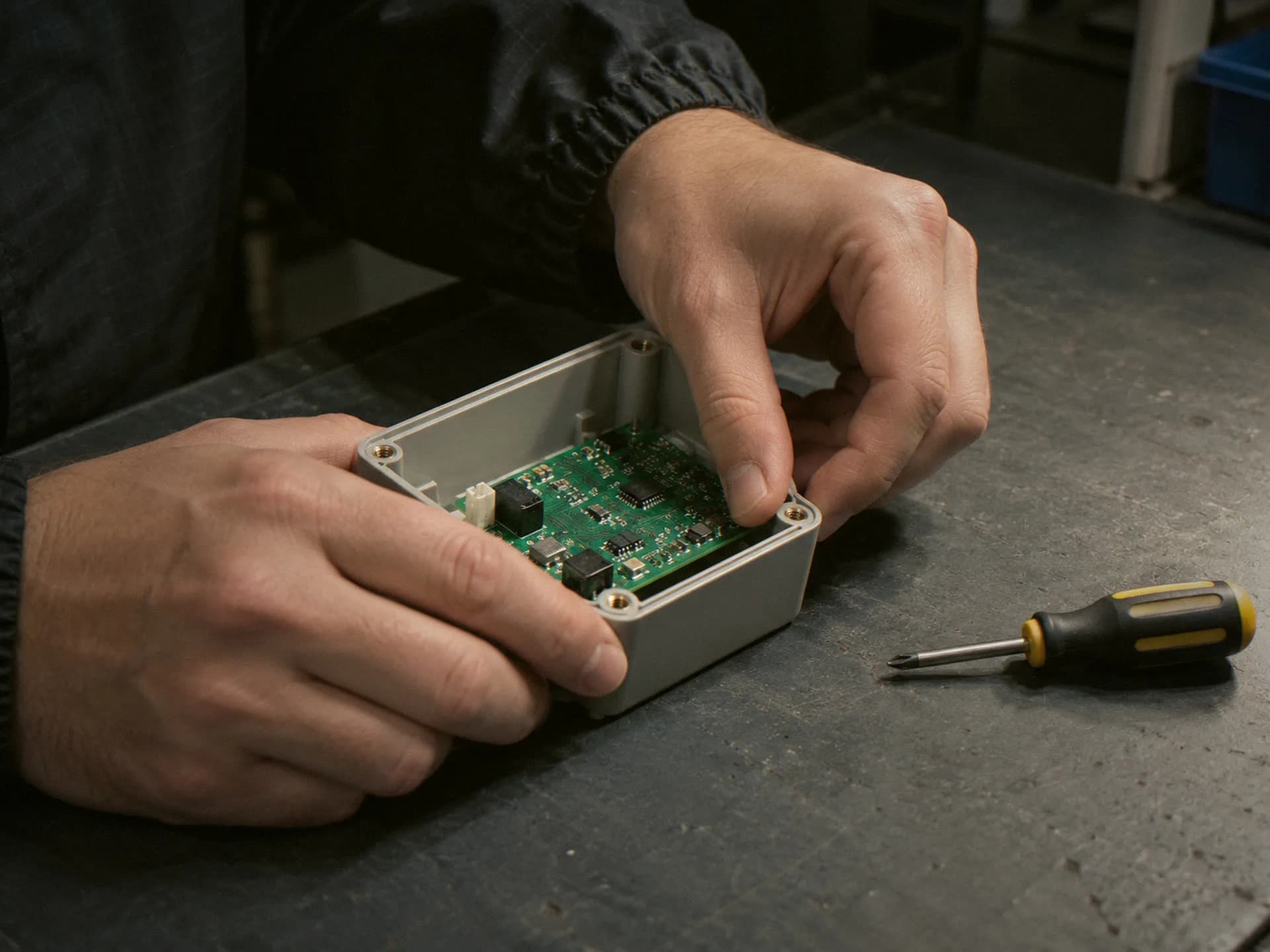
Box build is the step after the boards work. The assembled boards, the enclosure, the harnesses, the display, the fasteners and the labels become one finished unit, which is tested, packed and shipped. People also call it system integration. The hard part is rarely one operation. Illuminious is a U.S. NPI engineering company. Engineered in San Francisco. Prototype builds, DFM and mass production in our own factory in Shenzhen. Parts from many suppliers must arrive together and fit.
You order box build through the custom mechatronic parts and assemblies route. Its declared assembly needs are fasteners and torque, adhesive, wiring, calibration, functional test and custom packing. Those six are the operations a box build is made of. The unit cannot be assembled until the slowest item arrives, and the slowest item is almost never the board.
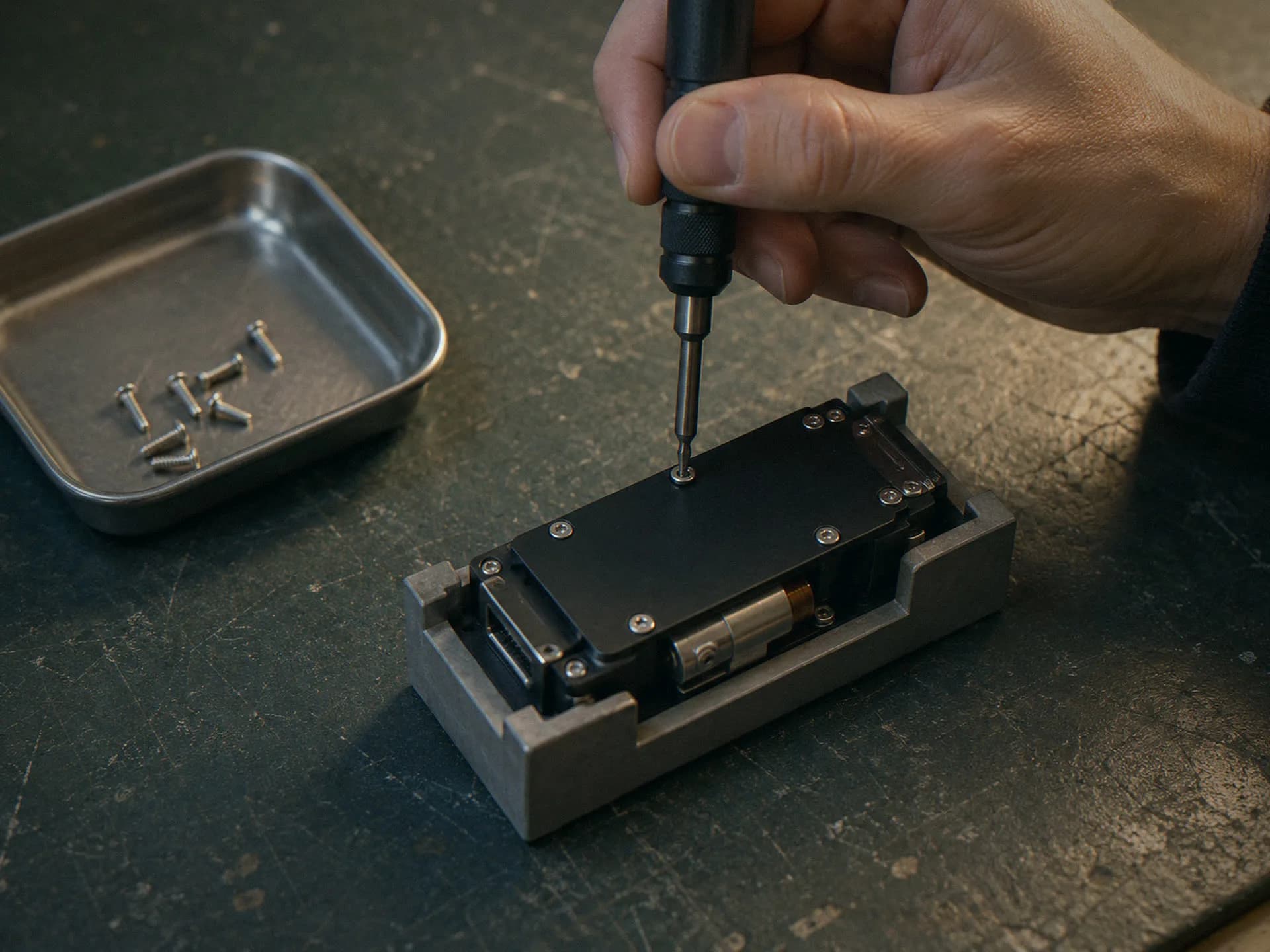
Design for assembly comes before the line
A screw the driver cannot reach, a cable with no route, a gasket that can go in two ways: each one costs time on every unit. Our engineers find these in a DFM review while the enclosure is still a model. The DFM services page explains how that review fits into the design phase.
Our engineers also review the test plan early. A functional test needs a fixture and a pass definition, and both take longer than people expect. The pass definition is set before the demo build, and the fixtures are built before PVT, so the test you approve at PVT is the test every production unit gets. Box build is one of the nine processes the Shenzhen factory runs in-house: SMT, bare PCB fabrication, injection molding, CNC machining, sheet metal, die casting, stamping, box build and test. The engineers who reviewed your assembly stay on the project when it reaches the line, and nothing moves to a new supplier between pilot units and volume. The factory assembles the boards on 8 automated SMT lines before they reach the box build line. Our engineers attend the EVT, DVT and PVT builds in person, so questions on the line get answers the same business day. We sign your NDA before the first call, and project files live in private project storage. One reviewed record holds the boards, the made parts, the bought parts and the build itself, and it shows the critical path while you can still change it.
What a box build covers
| Capability | What it covers |
|---|---|
| Electro-mechanical assembly | Boards, power modules and user interfaces fitted into the enclosure. Fasteners go in at the stated torque, under ESD controls, with calibrated tools at each station. |
| Cables and harnesses | Harnesses built to IPC/WHMA-A-620 from your drawing and tested on Cirris harness testers before they reach the main line. See cable and harness assembly for what the drawing must state. |
| Sub-assemblies | Self-contained modules, such as a display stack or a power module, built and tested before final assembly. A fault is then found in the module, where it is cheaper to fix. |
| Firmware loading and configuration | Bootloader and firmware programmed through the debug port. Serial numbers, keys and calibration data are written per unit. Production units ship with debug ports locked. |
| Functional test | A fixture built for your product checks power-up, sensors, radios, display, buttons and ports. Test results are kept per unit, by serial number. |
| Reliability testing | Burn-in and accelerated-aging cycles of up to 168 hours. HALT and ESS in temperature and vibration chambers, where the test plan calls for them. |
| Thermal parts | Thermal pads, paste, heat sinks and fans fitted to your drawing, with contact checked during assembly. |
| Packing and kitting | Accessories, manuals and power supplies kitted, then the unit packed to your packing specification. |
How a box build runs, step by step
| Step | What we do | What you get or decide |
|---|---|---|
| 1. Assembly review | An engineer reviews the BOM, the 3D assembly model, drawings and the test plan for design-for-assembly issues. | A findings report, sorted by when each item must be fixed: before the demo build, before EVT or before production. |
| 2. Incoming inspection | Incoming parts are checked against the BOM and drawings, from screws to the enclosure. | Only approved parts reach the line. Alternates follow the policy you declared. |
| 3. Kitting and line set-up | Parts are kitted per station. Work instructions and calibrated tools are set at each station. | A line ready for your unit, with instructions you can review. |
| 4. Sub-assemblies | Modules such as harnesses or display stacks are built and tested first. Connectors are contact checked. | Faults found at module level, where they are cheaper to fix. |
| 5. Final assembly | Technicians fit boards, modules and parts into the enclosure at the stated torque and routing. | Assembled units that match the approved build sequence. |
| 6. Firmware and configuration | Firmware is loaded and unit data is written: serial number, keys, calibration. | Each unit carries the release you approved. Debug ports are locked on production units. |
| 7. Functional test | The fixture runs your test sequence. A failed unit goes to diagnosis. | Test results stored per serial number. |
| 8. Final check and packing | A final visual check against cosmetic limits, then cleaning, kitting and packing. | Packed units, labeled for shipment to the address you give. |
Quality held to a signed reference
In a box build, quality covers the whole unit. The Shenzhen factory holds ISO 9001, so the build runs under a certified quality management system. Assemblies inside the unit are built to IPC-A-610, and Class 3 applies when you state it with the order. Harnesses are built to IPC/WHMA-A-620. At volume, each production batch is compared with the golden sample you signed after PVT. The sign-off record lists the design revision, the BOM, the firmware release, the measured values and the cosmetic limits, judged under set light at a set distance. When a result drifts from the reference unit, an engineer reviews the drift before the next batch runs.
Per-unit records: firmware test results are kept for each serial number. Test fixtures: functional test stations run your test sequence, the same one at each build stage. Named standards: ISO 9001 at the Shenzhen factory, IPC-A-610 for electronic assemblies and IPC/WHMA-A-620 for harnesses. Your tooling: fixtures and test stations you pay for belong to you, and you may move them to another factory.
What you receive at each build stage
Each stage ends with a written report, so you always know what was built, what was tested and what changed. The golden sample is signed off in a record that both parties keep, and that record is what the line is held to.
StageWhat you receive
- DFM review
- The findings report and the changed files.
- EVT
- EVT units with test results and the updated files.
- DVT
- DVT units with a validation report, and units for the certification path.
- PVT
- PVT units with the test plan and the fixture definitions.
- Production
- Batches compared with the golden sample, with inspection and test results.
Production test fixtures are built before PVT. At PVT, the ICT and FCT stations run the production test firmware, so the test you approve is the test every unit gets. The factory runs 30+ ICT/FCT test stations. For regulated products, name the field with the order. The Shenzhen factory holds ISO 13485 for medical and rehab devices, IATF 16949 for automotive and EV parts, and AS9100 for aerospace and drone parts.
What does a box build package need to contain?
A BOM that covers the mechanical parts as well as the electronics: enclosure, fasteners, gaskets, labels and packing. A 3D model of the assembly. Drawings for every custom part. Assembly instructions with torque values. And a test definition that states what the test proves and what counts as a pass.
The test definition is the item most often missing. Functional test is a declared assembly need. But what the test proves, what the fixture is and what counts as a pass all come from you. Agree them in the free engineering review. Finding out at first article that nobody defined them costs far more. If you have no test plan yet, our engineers can write one from your product requirements and review it with you before the fixture is built.
Why do box build projects slip more than board projects?
Because a board has one supply chain and a box build has many. The unit cannot be assembled until the slowest item arrives. That item is often a custom mechanical part or a molded enclosure with its own tooling lead time. A board that is ready early is worth little if the enclosure is not.
Make-or-source preference is a declared field with four settings, and traceability and the alternates policy are declared beside it. With the made parts, the bought parts and the build on one reviewed record, the critical path is visible while it can still change. Production molds are cut after DVT closes the design, so plan the enclosure tooling into the schedule from the start. Our engineers check parts availability and alternates before the schematic is drawn, and again for the mechanical parts before the enclosure is released. A long-lead connector, display or battery found at that point is a design choice you can still change. Found at the first production order, it is a delay you must accept. The review lists each long-lead item with the date it must be ordered to meet the build.
What is design for assembly, and what does it save?
Design for assembly means a product that takes few steps to build and is hard to build wrong. Fewer parts, fewer fasteners, features that fit only one way, and room for the tool to reach each fastener. Every part you remove cannot go missing, go in backwards or arrive at the wrong revision.
Do it before the enclosure tooling is committed. After that point, changes stop being cheap. Declare the project phase (concept, prototype, pilot or production), so the review addresses the decisions that are still open. Our engineers repeat the DFM review at the later stage gates, so late changes are checked against the line too. Typical findings are simple: four screw sizes reduced to one, a snap fit that replaces two fasteners, a keyed connector that cannot be plugged in backwards, or a label moved to a face the operator can reach. Each one removes a step from every unit you build.
What a box build declares on the mechatronic route
These are the fields the mechatronic route asks for; anything outside them goes to an engineer.
Declared optionSettings available
- Requested scope
- Custom part, assembly, sourced component, or mixed fabrication and sourcing (assembly and mixed go to review)
- Assembly needs
- Fasteners/torque, adhesive, wiring, calibration, functional test, custom packing
- Project phase
- Concept, prototype, pilot, or production
- Target quantity
- 1–100,000 units
- Make / source preference
- Engineer selected, fabricate, source catalog parts, or mixed
- Approved alternates
- No alternates without approval, form/fit alternates allowed with approval, or engineer may propose alternates
- Traceability
- Lot/material traceability on request
- Tolerance expectation
- General, precision, or critical / fit stack (critical goes to review)
- Duty cycle
- Light / intermittent, regular, or continuous (continuous goes to review)
- Required files
- At least one CAD/drawing, BOM, or detailed requirements record
- Review target
- Within 24 hours on business days after you submit
Facts and questions
What do you need to quote a box build?
At least one CAD file or drawing, a BOM, or a detailed requirements record. For a full box build, send a BOM with the mechanical parts, a 3D model of the assembly, drawings for custom parts, assembly instructions with torque values, and your test requirements. Engineering review tells you what is still missing.
Can you source the enclosures and mechanical parts?
Yes. Make-or-source preference is a declared field with four settings: engineer selected, fabricate, source catalog parts, or mixed. One build can combine parts we make, parts we buy and parts you supply, all on one reviewed record. Alternates follow the policy you declare, and nothing is swapped without your approval.
What testing is done on the finished unit?
Functional test and calibration are declared assembly needs. You state what the test must prove and what counts as a pass, and we agree it in review. Burn-in, HALT and ESS are added where the test plan calls for them. Results are kept per unit, by serial number.
Which workmanship standards apply to a box build?
The electronic assemblies inside the unit are judged against IPC-A-610, and harnesses against IPC/WHMA-A-620, under the ISO 9001 quality system the Shenzhen factory holds. Class 3 is the strictest IPC-A-610 level. State it with the order, so the extra inspection is part of the reviewed scope and the official quote.
How your official quote is prepared
A specialist prepares the official quote for your box build from your files and specifications, within 24 hours on business days. An engineer reviews every order. The review is free and comes before payment, and the official quote it publishes is the amount you pay.
Ready to build your product?
Send your assembly model, BOM and test requirements for a free engineering review. An engineer reviews the assembly before you pay. If you are still at the demo build, we start there and carry the same files, fixtures and test plan through EVT, DVT and PVT to production. See how an automation team shortened assembly with integrated PCBA and enclosures in this box build case study, or read the box build assembly guide.
- An engineer runs a free engineering review of your files, and nothing is charged when you submit.
- You see the findings first.
- We publish the official quote with an itemized total, lead time and validity window.
- You accept the official quote, and only then does payment open.