DFM analysis: what a DFM review checks, by route
A findings report that names each change and its deadline stage. We run the review in design, before DVT and before tooling.
No CAD yet? Our design team can take it from a sketch or a spec.
Walk Shenzhen factories with us, Dec 6–11. See the tour
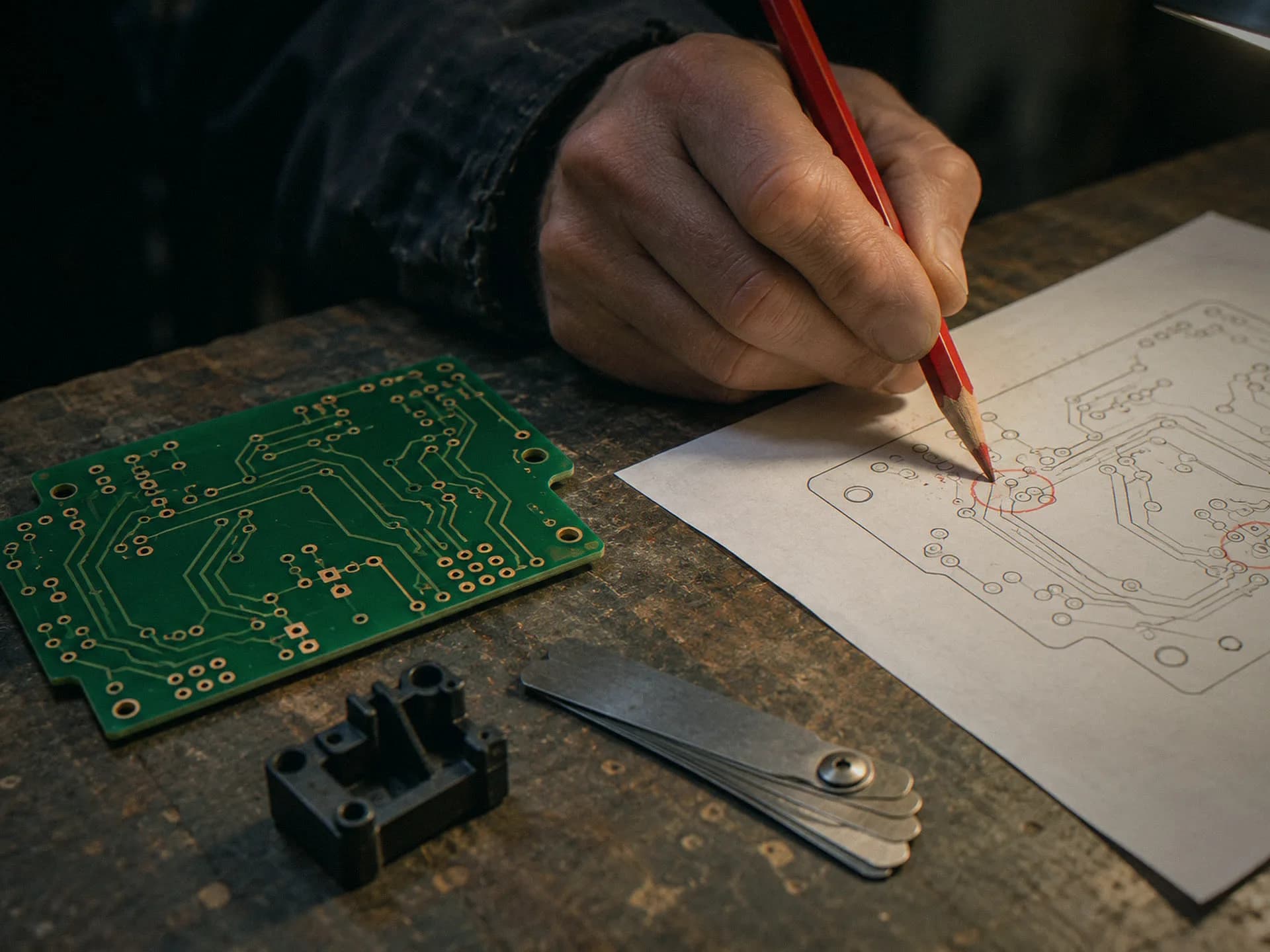
Design for manufacturability means reviewing a design against how it will be built, and changing it while a change still costs a CAD edit. It is neither a quality inspection nor a second opinion on whether the circuit works. It asks one question: given this drawing, stack-up and process, what will go wrong, and what does prevention cost? Illuminious is a U.S. NPI engineering company. Engineered in San Francisco. Prototype builds, DFM and mass production in our own factory in Shenzhen.
Two checks on this site use similar words. The engineering review is a file check on every portal order: an engineer confirms that your files match the configuration you chose, before you pay. The DFM review is a design stage. Our engineers run it while the product is still in CAD. If you want to hire that stage as part of a design project, see our DFM services.
Why DFM decides the build
The design fixes the process. Once a drawing calls for a tolerance, that tolerance chooses the machine, the setups, the inspection and the scrap. Once a layout places a part, that placement decides the panel, the paste and the test access. No purchasing skill later recovers what the drawing gave away. Most of a product's manufacturing cost is committed by the end of design; the exact share varies by industry, and the direction does not.
A DFM review in CAD can move a capacitor out of a high-strain zone, add test points, or relax a tolerance that has no function. The same finding after tooling costs a new mold insert, a new fixture or a scrapped batch.
The review also follows the product through its stages. A demo build proves the idea works. EVT proves the design works on units built from production-intent files. DVT proves it passes its tests, and PVT proves the line can build it. A finding that is cheap to fix before the demo build can be very expensive after DVT, because production molds are cut once DVT closes the design and the certification path has started. Every finding in our report carries the stage by which it must be closed, and the review returns before DVT and before tooling.
Our engineers review all three parts of a product together: the board, the mechanical parts and the final assembly. Firmware engineers review the schematic before layout starts, and a second engineer checks every schematic and layout before delivery. The engineers who run the review stay on the project when it moves to the Shenzhen factory, so a finding is fixed by the people who found it.
What a DFM review covers
| Area | What it covers |
|---|---|
| PCB layout and stack-up | Trace width, spacing and via structures against IPC rules; layer stack-up for signal integrity, impedance and cost; copper balance and registration risk on advanced boards. |
| Components and BOM | Footprints, lifecycle, availability and second sources. Parts availability and alternates are checked before the schematic is drawn. At-risk parts get a proposed alternate from our component sourcing team. |
| Mechanical fit and enclosure | Tolerance stack-up between the board and the housing, wall thickness, draft and material choice. Molded walls down to 0.8 mm in engineering nylon are achievable. |
| Assembly | Part spacing, polarity, orientation and access for placement and soldering on SMT lines, and the build order for box build. |
| Testability | Test-point access for in-circuit and functional test, and boundary scan where the design supports it. Production test fixtures are built before PVT. |
| Cost | Alternative materials, fewer parts, a better panel, and the route that suits each part. The review states any saving against your part, never as a general percentage. |
| Materials and substrate | Thermal and dielectric needs, from FR-4 to Rogers and other RF laminates, and polyimide for flexible circuits. |
| Fabrication data | Gerber, ODB++ and drill files checked for completeness and for rule violations, so the data matches your design intent. |
How a DFM review runs
Each step has an action on our side and an output or decision on yours. Each stage gate ends with a written report.
| Step | What we do | What you get or decide |
|---|---|---|
| 1. Design package | We receive your Gerber or ODB++ files, BOM, 3D CAD (STEP), assembly drawings and test or compliance needs. We sign your NDA before the first call. | Files go into private project storage. |
| 2. Kick-off | Electrical, mechanical and manufacturing engineers agree what the product must do and which features are critical to quality. | You confirm the goals, the limits and the target stage. |
| 3. Rule check and manual review | Valor NPI checks the data against fabrication and assembly rules. Engineers then review what software cannot judge: fit, heat, test access and cost. | Nothing to do yet. |
| 4. Findings report | We write a DFM findings report. Each finding is sorted by when it must be fixed: before the demo build, before EVT or before production. | A report you can act on in order of urgency. |
| 5. Walk-through | We go through the report with your team. You keep the design intent; we suggest how to build it. | You approve, question or decline each change. |
| 6. Release | We check the changed files and release them to the next build. The review is repeated before DVT and before tooling. | The changed files and a design released for the build. |
Why does design decide most of a product's cost?
Because the design fixes the process. A tolerance on a drawing chooses the machine, the setups, the inspection and the scrap. A part placed on a layout decides the panel and the test access. Purchasing cannot win back later what the drawing committed. The cheapest hour in a project is the one spent reviewing the design.
Each industry gives a different share of cost committed in design, and the direction is always the same. Our engineers place the DFM review inside the design phase and repeat it at the two points where a change gets expensive: before DVT and before tooling.
What does a DFM review check?
It depends on the part. On a board, it checks the fabrication package, the layer and material choices, the panel, and for assembly the BOM, placement data, availability, polarity and test scope. On a machined or sheet-metal part, it checks each tolerance, the setups or bends, and the finish against how the part is held.
On a board: whether the fabrication package is complete, whether the layer, material, copper, finish, drill and feature choices work together, and whether the panel works. Where assembly is included: the BOM, the placement data, part availability, polarity and the test scope. On an advanced board it also covers stack-up completeness, the impedance approach, microvia and lamination feasibility, copper balance and registration risk.
On a machined part: whether the tolerance band is achievable on the specific feature, at that length, in that material, and whether the setups implied by the geometry match the declared complexity. On sheet metal: the flat pattern, the bend allowance and formability at the declared thickness. On a stencil: aperture feasibility, bridging risk and fine-pitch features against the paste layers.
What do I get back from a review?
A DFM findings report and the changed files. The report says what was confirmed, what was assumed and what needs your decision, with each finding sorted by when it must be fixed. On a portal order, engineering review ends with an official quote: an itemized total, a lead time and a validity window.
Where the review proposes a change, such as another finish, a substituted part or a new panel, it reaches you as an itemized revision. You approve, question or decline it. A correction that changes scope or price is never applied silently.
See a DFM finding that saved a launch demo: a capacitor in a high-strain zone, found in the review and moved before the build. For a longer walk through the checks, read the DFM guide for hardware startups.
What engineering review confirms, by route
On every portal order, engineering review confirms the points below before payment. These are the checks the portal publishes for each route.
| Route | What engineering review confirms |
|---|---|
| Standard PCB & PCBA | Fabrication package completeness and dimensions; layer, material, copper, finish, drill and feature compatibility; panelization and DFM risks; BOM, placement data, availability, polarity and test scope |
| Advanced PCB & PCBA | Stack-up completeness and material availability; impedance, microvia, lamination, backdrill and press-fit feasibility; copper balance, drill structure, registration and yield risk; assembly access and inspection |
| SMT Stencil | Correct paste layers and orientation; aperture feasibility, bridging risk and fine-pitch features; foil thickness, step regions, frame size and usable area; fiducials and labels |
| CNC Machining | Whether the declared tolerance band is achievable on the feature, at that length, in that material and finish; setup complexity against the geometry |
| 3D Printing | Minimum wall and thin-feature risk; tolerance class against process and orientation; secondary operations and inspection scope |
| Sheet Metal Fabrication | Flat pattern and bend allowance; formability at the declared thickness; feature and hardware placement; finish and appearance compatibility |
| Custom Mechatronic Parts & Assemblies | Sourcing and fabrication plan; envelope, motion, loads and tolerance stack; assembly, wiring, calibration and test scope |
| Every route | That the price matches the files, and that any change reaches you as an itemized revision to approve, question or decline |
Facts and questions
Do I have to pay for the review?
Not for the free engineering review. It comes before payment on every portal order, nothing is charged when you submit, and the official quote it publishes is the amount you pay. A DFM review as a design stage is engineering work. It is scoped and priced in the official quote for your design project.
What happens if the review finds a problem?
You are told what the problem is and what the options are, as an itemized revision you can approve, question or decline. A change that affects scope or price is never applied silently. Declining a proposed change does not oblige you to go ahead with the order, and the findings stay yours.
Can you review a design I have not decided to build with you?
Yes. Submitting files for review is not a commitment, because the review is free and comes before payment. We sign your NDA before the first call. Files are stored in private project storage and reached through short-lived authenticated links, so only the people working on the review see them.
Does a review approve my stack-up?
The price covers the configuration you declared; it does not approve it. Engineering review confirms the stack-up, the material, the impedance approach and the production files, and names any revision needed before fabrication. On an advanced board, the DFM review in design is where a stack-up change costs least.
What a DFM review returns
Each finding names the stage by which it must be fixed, so you can see what waiting would cost.
Lower unit cost
Building for the line the board will run on, proposing alternate parts and improving the panel all reduce what a design commits you to. The saving is specific to the part, so the review states it against your design.
Fewer stops on the way to market
A finding fixed in CAD cannot stop a line later. The review prevents tool changes, part shortages and line stops, and the weeks each of them costs.
Better quality and reliability
A design built for its process makes better solder joints, runs cooler and holds together under vibration. That means higher yield in production and fewer failures in the field.
How your official quote is prepared
Configuring a DFM-reviewed PCB build online returns a live supplier price when suppliers can price the build. Otherwise a specialist prepares your official quote within 24 hours on business days. An engineer reviews every order. The review is free and comes before payment, and the official quote is the amount you pay.
Ready to review your design?
Send your design for a free engineering review before you commit to a build. For a DFM review inside a design project, start with project initiation or PCB layout; both are reviewed within two business days after you submit. Moving from DFM to volume? See NPI engineering and rapid prototyping.
- An engineer runs a free engineering review of your files, and nothing is charged when you submit.
- You see the findings first.
- We publish the official quote with an itemized total, lead time and validity window.
- You accept the official quote, and only then does payment open.