Electronics manufacturing services, from first build to volume
Decide how much of the build to hand over: boards, test, box build or the whole product. One team takes it to volume.
No CAD yet? Our design team can take it from a sketch or a spec.
Walk Shenzhen factories with us, Dec 6–11. See the tour
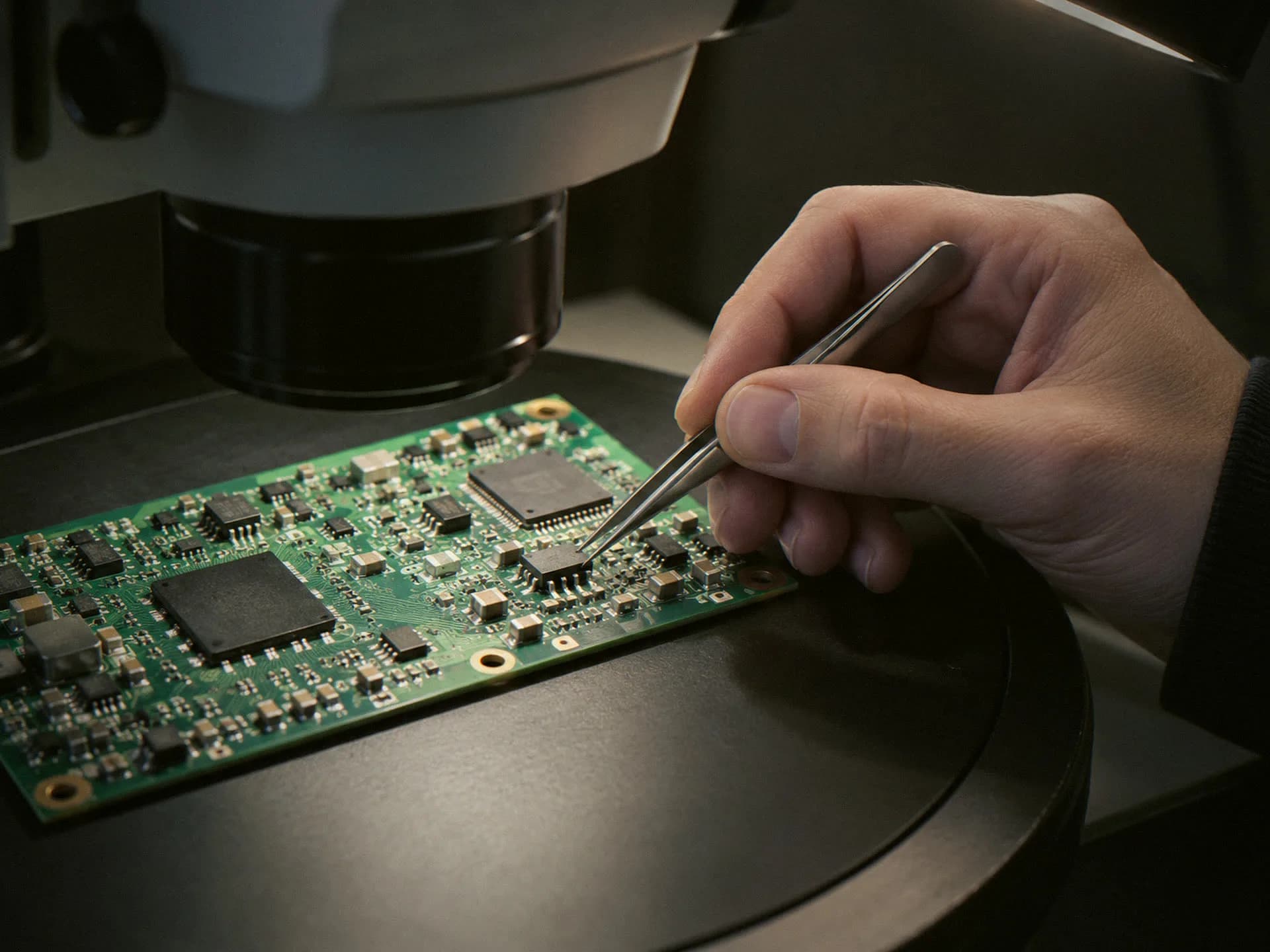
Electronics manufacturing services means you give a partner the job of making your electronic product, more than one step of it. That covers board fabrication, assembly, component sourcing, test, and often the final box build and shipping. You choose an EMS partner when building it yourself would mean buying equipment and hiring process engineers you do not otherwise need. Illuminious is a U.S. NPI engineering company. Engineered in San Francisco. Prototype builds, DFM and mass production in our own factory in Shenzhen.
The label matters less than three answers: who owns the drawings, who approves a change, and who carries the risk when a component goes end of life. At Illuminious the answers sit in the order record. 12 services are configured in the portal, from standard boards to custom mechatronic assemblies to schematic design, and every one gets the same engineering review before you are asked to pay.
Engineering first, then the production line
Most EMS problems start before the first board is placed. A footprint that does not match the part, a connector with no room for the cable, or a part that goes end of life in six months will stop a line. Our engineers start with the design. Parts availability and alternates are checked early. A second engineer checks every schematic and layout we deliver: the power tree, footprints, connector pinouts and parts against the BOM.
Then the product is built in small numbers before it is built in large ones. The demo build is the first working unit, the one you show investors or film for Kickstarter. EVT, DVT and PVT follow, and our engineers attend each of those builds in person in Shenzhen. Each stage ends with a written report. After PVT you sign the golden sample, the reference unit that production is held to.
Volume runs in the Shenzhen factory, which runs nine processes in-house: SMT, bare PCB fabrication, injection molding, CNC machining, sheet metal, die casting, stamping, box build and test. The engineers who drew the schematic stay on the project when it moves into the factory, so nobody has to learn your product from a hand-off document. When a test fails on the line, the person who reads the failure already knows why each part on the board was chosen. You can start with one board and add the enclosure, the harness, the test and the box build to the same account when you need them.
Our EMS capabilities
| Capability | What it covers |
|---|---|
| PCB assembly (SMT) | 8 automated SMT lines on Fuji, Panasonic and Siemens equipment. A high-speed line places 150,000 components per hour, down to the 01005 package (0.4 mm x 0.2 mm), with ±25 µm placement accuracy and BGA pitch down to 0.25 mm. Every board gets AOI. X-ray is an inspection option on the advanced board route. |
| Box build and system integration | Boards, enclosures, power supplies, cable harnesses and user controls are assembled into a finished unit. Firmware is programmed and the unit is tested before it is packed. |
| New product introduction | The demo build, then EVT, DVT and PVT, each with a named report. Production test fixtures are built before PVT, and ICT/FCT stations run the production test firmware at PVT. |
| Design for manufacture, assembly and test | Our engineers run a DFM review on layout, parts and enclosure, and repeat it at the later stage gates, so changes land while they are still cheap. |
| Component sourcing | Parts come from a network of 350 audited suppliers. You choose whether we source, you consign, or the supply is mixed, and no part is swapped without your approval. Buffer stock is held on request. |
| Test development | Flying-probe test, in-circuit test and functional test fixtures on 30+ ICT/FCT test stations. HALT and ESS where the product needs them. Firmware test results are kept per unit, by serial number. |
| Quality systems | The Shenzhen factory holds ISO 9001, ISO 13485, IATF 16949, AS9100 and ISO 14001. Workmanship is judged against IPC-A-610 for assemblies and IPC-6012 for rigid boards. Production data runs through Valor NPI and Aegis FactoryLogix. |
| Life of the product | We track component end of life, propose alternates for your approval, and re-measure any design change against the golden sample before it is signed again. |
How an EMS engagement runs
| Step | What we do | What you get or decide |
|---|---|---|
| 1. Files and engineering review | You upload Gerbers, BOM and CAD. An engineer checks them against the configuration you declared. | Findings first, then an official quote with an itemized total, lead time and validity window. |
| 2. DFM review | Our engineers review layout, parts, panel, assembly and test access. | A DFM findings report, each finding sorted by when it must be fixed, plus changed files. |
| 3. Demo build and EVT | We build the first working units and test them against your requirements. | Demo-build units for investors or a pilot, then EVT units with test results and updated files. |
| 4. DVT | We validate the closed design and repeat the DFM review before tooling. | DVT units, a validation report, and units for the certification path. |
| 5. PVT and golden sample | Production fixtures and test stations run the production test firmware on units built from production files. | PVT units, the test plan and fixture definitions. You sign the golden sample. |
| 6. Volume production | SMT, test and box build run in the Shenzhen factory, and each batch is compared with the golden sample. | Production batches with inspection and test results. An engineer reviews any drift before the next batch. |
What is the difference between EMS, ODM and OEM?
They differ in who owns the design. Under EMS or OEM work the design is yours: you supply the files, you own the IP, and the manufacturer builds what you specify. Under ODM work the manufacturer designs the product, or co-designs it with you, and you buy design work as well as production.
Read more on ODM and OEM. In practice the labels matter less than the record. Every service in our catalog declares its alternates policy, its approval milestones and its traceability requirement as fields on the order. On engineering projects, design files and IP are assigned to you at hand-off, and the design source files arrive at each stage gate. On portal orders, ownership is recorded in the approved scope. If you move production later, you hold the files and the tooling you paid for.
What do I keep control of when I outsource manufacturing?
You keep the design and every change to it. No component is swapped silently. The alternates policy is a declared field with three settings: no alternates without approval, form and fit alternates allowed with approval, or an engineer may propose alternates. Any proposed change arrives as an itemized revision that you approve, question or decline.
You also keep the production file. Confirmation of the production file before fabrication is a declared option. When you ask for it, production stays blocked until you approve. Files, prices, replacements and approvals stay in your account with their revision history. We sign your NDA before the first call, project files live in private project storage, and production units ship with debug ports locked.
How does an EMS engagement start?
Start with one service and one real order. Configure what you need next, such as a board, an assembly or a machined part. Upload the files privately and submit them for a free engineering review. You get an engineer's findings on your files before you pay.
From there the work grows by adding services to the same account, without a wider agreement. The catalog has 12 separately configured services for this reason. If you have only an idea, start with Project initiation. If you have files, start with Standard PCB & PCBA. For a planned path from first build to volume, read DFM services and our guide to choosing an NPI partner.
Every service an EMS engagement is built from
Review targets as the portal publishes them.
| Service | Category | Review target |
|---|---|---|
| Standard PCB & PCBA | Electronics | Within 24 hours on business days after you submit |
| Advanced PCB & PCBA | Electronics | Within 24 hours on business days after you submit |
| SMT Stencil | Electronics | Within 24 hours on business days after you submit |
| Flexible Heater | Electronics | Within 24 hours on business days after you submit |
| Custom Mechatronic Parts & Assemblies | Engineering | Within 24 hours on business days after you submit |
| PCB Layout | Engineering | Within two business days after you submit |
| 3D Printing | Mechanical | Within 24 hours on business days after you submit |
| CNC Machining | Mechanical | Within 24 hours on business days after you submit |
| Sheet Metal Fabrication | Mechanical | Within 24 hours on business days after you submit |
| Project Initiation | Engineering | Within two business days after you submit |
| Schematic Design | Engineering | Within two business days after you submit |
| Firmware Development | Engineering | Within two business days after you submit |
Facts and questions
Which quality systems do you work to?
The Shenzhen factory holds ISO 9001, ISO 13485, IATF 16949, AS9100 and ISO 14001. ISO 13485 covers medical devices, IATF 16949 automotive and EV parts, and AS9100 aerospace and drone parts. Workmanship is judged against IPC-A-610 for assemblies and IPC-6012 for rigid boards. State Class 3 with the order if you need it.
Can you source the components as well as build the boards?
Yes. Parts supply is a declared field with three settings: Illuminious sources the parts, you consign them, or the supply is mixed. Parts come from our network of 350 audited suppliers. Availability, end-of-life risk and any proposed alternate are confirmed during engineering review, and no substitute is fitted without your approval.
Do you handle regulated products?
Yes, through review. Product class is a declared option on a board order with six settings. Four of them (medical, aerospace, military / defense, and other regulated use) route the order to engineering review, where documentation and traceability needs are confirmed before anything is built. For a medical device, we support the FDA path with your regulatory team.
How is lead time agreed?
Lead time is stated in the official quote published after engineering review. A lead time given before anyone has read your files is a guess. The portal does publish how long review takes: within 24 hours on business days for most services, and within two business days for the four design services.
What stays the same from schematic to factory
| Reason | What it means in practice |
|---|---|
| One team from schematic to factory | The engineers who draw your schematic stay on the project in the Shenzhen factory, where our engineers work next to the lines. Questions about a part or a test go to the people who designed it, and no new supplier has to read your files for the first time. Read how a wearable team moved from pilot to volume in our wearable patch case study. |
| Production held to a signed reference | Each batch is compared with the golden sample you signed. Its sign-off record lists the design revision, the BOM, the firmware release, the measured values, and the cosmetic limits judged under set light at a set distance. A design change is re-measured against the old reference and signed again, so the record always matches what the line builds. |
| Tools and files that stay yours | Tooling you pay for, such as molds, fixtures and test stations, belongs to you, and you may move it to another factory. Design source files reach you at each stage gate. Firmware source is delivered when the order includes it; otherwise you receive binaries. Contracts and payments are with Illuminious LLC (Wyoming). |
How your official quote is prepared
Configuring PCB fabrication and assembly online returns a live supplier price when suppliers can price the build. When they cannot, a specialist prepares your official quote within 24 hours on business days. An engineer reviews every order. The review is free and comes before payment, and the official quote it publishes is the amount you pay.
Ready to plan your production?
Send the design you have today, from a schematic to a full file set. An engineer reviews it and shows you the findings before any price is final. Then we plan the builds from demo build to volume.
- An engineer runs a free engineering review of your files, and nothing is charged when you submit.
- You see the findings first.
- We publish the official quote with an itemized total, lead time and validity window.
- You accept the official quote, and only then does payment open.