Supply chain management for hardware products
No CAD yet? Our design team can take it from a sketch or a spec.
Walk Shenzhen factories with us, Dec 6–11. See the tour
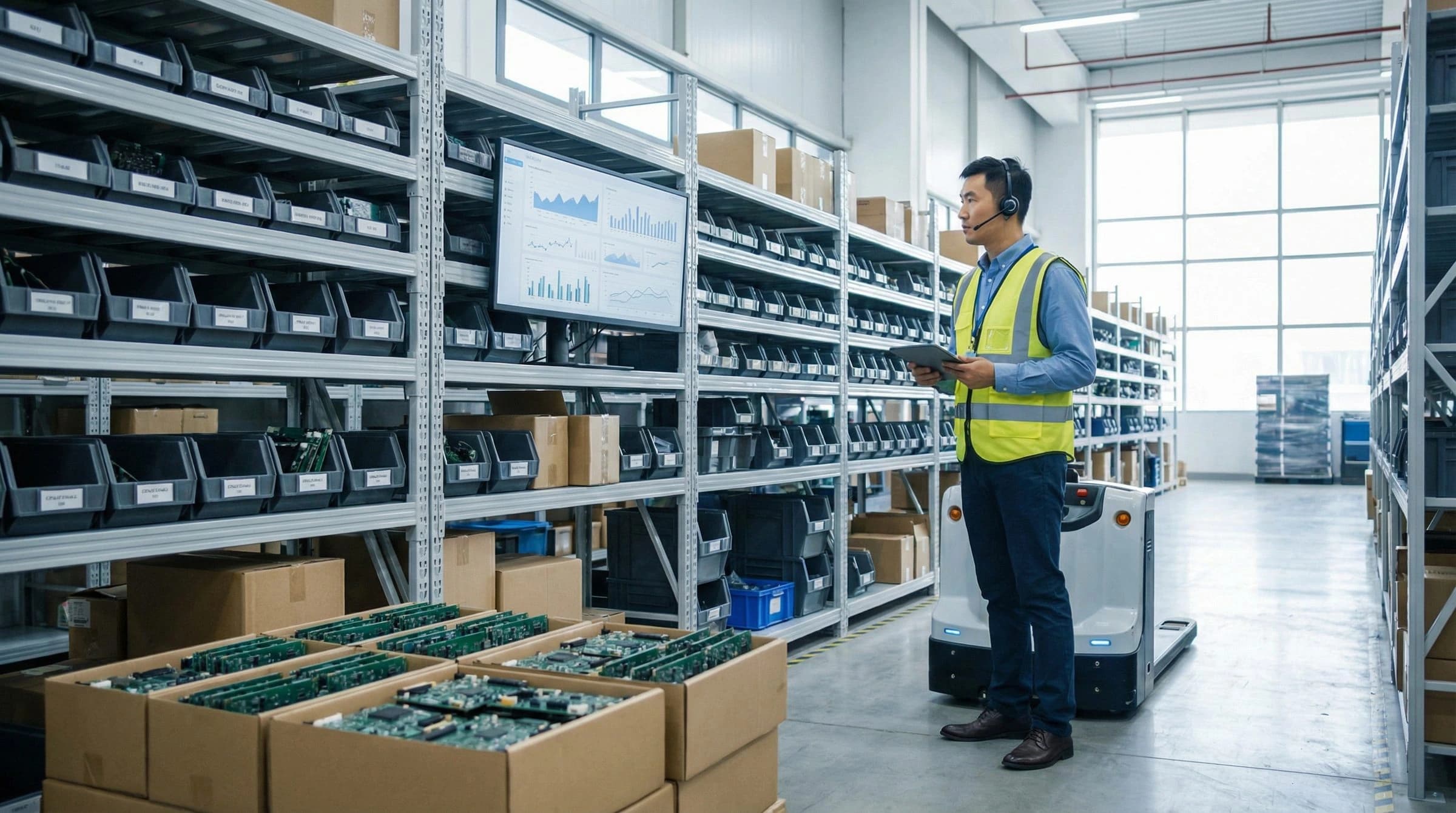
Supply chain management for a hardware product means controlling change: which part may replace which, who approves it, what is recorded, and how you find out later which units contain what. Freight and warehouses are the visible part. The failures that hurt are a change nobody recorded and a batch nobody can identify. Illuminious is a U.S. NPI engineering company, and our engineers check part availability and alternates before the schematic is drawn, then source from our network of 350 audited suppliers and record every change. Engineered in San Francisco. Prototype builds, DFM and mass production in our own factory in Shenzhen.
So the controls that matter are declared fields on the order: the alternates policy, lot and material traceability, production-file confirmation, board marking, and the product class that decides which paperwork is required. None of them is a separate service you buy. Each is declared on its order route, which is where it can be enforced.
When should supply chain work start?
Before the schematic. A part chosen at the schematic stage is a part you will buy for the life of the product. On our engineering projects, availability, lifecycle and alternates are checked before the schematic is drawn, so the design does not depend on a part with one source or a short life.
A second source approved at design time costs one check. The same decision taken during a shortage costs a board respin, new testing and possibly a new certification run. That is why parts planning sits in the design phase, next to the DFM services our engineers run in CAD, and not after the first purchase order.
What we manage
| Area | What it covers |
|---|---|
| BOM review | Availability, lifecycle status, single-source risk and lead-time risk for every line, with alternates proposed for your approval. |
| Sourcing | Parts bought from authorized distributors or the original manufacturer through our network of 350 audited suppliers, consigned by you, or a mix of both. |
| Alternates and obsolescence | Form, fit and function alternates for parts that are scarce or ending, each one an itemized change you approve. |
| Incoming inspection | Parts inspected on receipt against the BOM and the order before they reach the line. |
| Compliance | RoHS and REACH status confirmed in the reviewed scope. |
| Traceability | Lot and material traceability on the mechatronic route, and board marking on board orders, linked to each build. |
| Buffer stock | Stock of critical parts agreed in the official quote, where a shortage would stop your line. |
| Shipping | Packing and freight from the Shenzhen factory to the address you name, by courier, air or sea. |
For a startup, the list above comes down to three moments. Before the schematic, the parts are chosen with second sources in mind. Before the first production order, the alternates policy and traceability are declared. Before each batch, scarce parts are checked again, so a shortage shows up as a decision for you, not as a late shipment.
How is a new part or supplier qualified?
Before it is used, not after it fails. A new part is checked against its datasheet, the design's requirements and its lifecycle status. A new supplier is checked for its quality system, its traceability and its record on earlier orders. Only then does it join our network of 350 audited suppliers for your build.
Qualification takes less time for a drop-in alternate from a known supplier than for a new part from a new source. When time is short, our engineers propose the path with the least new risk first, and say plainly what has not been checked yet. You decide whether a build can carry that risk.
How parts move from BOM to shipped unit
BOM review
Each line is checked for availability, lifecycle and second sources. You receive the findings.
Sourcing plan
Which parts we buy, which you consign, and which need buffer stock.
Supplier and part checks
New parts and new suppliers are checked before they are used.
Purchasing
Orders are placed with authorized distributors or the manufacturer, against the approved BOM revision.
Incoming inspection
Parts are inspected on receipt before they go to the line.
Build with traceability
Lots are recorded against each build where you declared traceability.
Shipment
Units are packed, marked and shipped, with the paperwork the product class requires.
Turnkey, consigned or mixed: which suits a startup?
Turnkey suits a startup that wants one party to buy every part, own shortages and answer for the build. Consign the parts you already hold, or the ones where your allocation beats the open market. Mixed is a declared option too, so nobody is unsure who is buying which line.
Turnkey also moves the cash. You pay for parts through the official quote instead of holding inventory yourself. Consigned parts save that cost but move the risk of a missing reel to you, so the sourcing plan shows when each consigned line must arrive for the build date to hold.
What reduces supply chain risk?
Three things, in order. Know which parts are single-sourced and design an alternative in before you need one. Declare an explicit alternates policy, so a substitution is a decision and not an accident. Declare traceability, so when something is wrong you can bound the problem to a batch instead of everything you shipped.
The order matters. Traceability without an alternates policy tells you which units carry an unapproved part, but only after it was fitted. An alternates policy without second sources designed in leaves you choosing between a line stop and a substitution. Start at the design, then fix the policy, then mark and record.
How do I make units traceable after they ship?
Mark them, then record what the mark points to. Board marking is a declared field with four settings: none, an order number at our position, an order number at a position you specify, or a 2D data-matrix code. The data-matrix is the one a scanner can read. Then declare lot and material traceability on the mechatronic order.
Choose the order-number position yourself, so it does not land under a heatsink or inside the enclosure. A marked unit without traceability is a serial number that points at nothing; traceability without a mark is a record nobody can connect to a unit in the field.
What happens when a part goes end-of-life?
It arrives as an itemized revision under the alternates policy you declared, with a proposed alternative to approve, question or decline. Where you declared "no alternates without approval", production waits until you decide. That is the right behavior for a design under change control, and it is written into the order.
The earlier the notice, the more options remain: a last-time buy, a drop-in alternate, or a board change planned into the next revision. When we hold the design, our engineers propose the alternate with its datasheet comparison and any test it needs before it is fitted.
What changes when the product is regulated?
The paperwork, and how much of the process must be evidenced rather than only done. Product class is a declared field with six settings, and four of them (medical, aerospace, military or defense, and other regulated use) send the order to an engineer before anything is built, so the requirements are confirmed first.
A regulated build runs on the same lines; it is recorded differently, and the recording has to be planned before the first unit. The Shenzhen factory holds ISO 13485 for medical devices, IATF 16949 for automotive and EV parts, and AS9100 for aerospace and drone parts, alongside ISO 9001 and ISO 14001.
Shipping is the last control. Cartons leave the Shenzhen factory packed and marked to the order, by courier for samples and urgent parts, and by air or sea freight for volume. The choice is made per shipment from cost and date, and it is shown in the official quote before you commit.
The supply chain controls declared on an order
Each setting exists on the order route named in its row.
| Control | Settings available | The failure it prevents |
|---|---|---|
| Approved alternates (mechatronic route) | No alternates without approval; form and fit with approval; engineer may propose | A substitution nobody authorized |
| Lot and material traceability (mechatronic route) | Requested or not | A defect that cannot be bounded to a batch |
| Board marking (standard board route) | None; order number at our position or yours; 2D data-matrix code | Shipped units nobody can identify |
| Production-file confirmation (board and stencil routes) | Requested or not | Fabrication from a file you never saw |
| Product class (standard board route) | Consumer or industrial, automotive, medical, aerospace, military or defense, other regulated | Regulated paperwork found late |
| Parts supply (standard board route) | Illuminious sources; customer consigned; mixed | Unclear ownership of a stock problem |
| Delivery format (standard board route) | Single pieces; panel to your outline; panel we lay out | Handling that differs between fabrication and assembly |
| Packing (standard board route) | Humidity indicator card on request | Moisture-sensitive parts stored without evidence |
| Electrical test (standard board route) | Sample test; 100% flying-probe test | An escape that reaches your line |
| Free engineering review | Within 24 hours on business days, or within two business days for the four design services | A commitment made before anyone read the files |
Recent work: one owner for an actuator's parts
A humanoid robotics startup bought machined housings, motor drive boards and final assembly from three vendors, and no vendor owned the actuator as a whole. When a part ran short, each pointed at another. Moving all three into one program in the Shenzhen factory put the parts, the boards and the assembly on one BOM, one schedule and one owner. Read the case study
Order with sourced parts online
Choose "Illuminious sources parts" on a Standard PCB & PCBA order for turnkey boards, with a live supplier price where suppliers can price the build. For assemblies with sourced components, use custom mechatronic parts and assemblies: configure online and get an official quote from a specialist within 24 hours on business days. Part-level sourcing is covered on component sourcing. For a BOM that survives a shortage, read the AI hardware BOM strategy guide.
Facts and questions
Can I see the sourcing plan before you buy?
Yes. The BOM review lists each line with its source, its risk and any proposed alternate. Nothing is bought against a line you have not approved. When you consign some parts, the plan shows which lines you supply and when they must arrive, so the build date does not wait on a missing reel.
Which compliance standards apply?
ISO 9001 governs the Shenzhen factory's quality system, with ISO 13485, IATF 16949 and AS9100 where medical, automotive or aerospace requirements reach the build. Boards are fabricated to IPC-6012 and assemblies inspected to IPC-A-610. Class 3 is a level you state and the review confirms. RoHS and REACH are confirmed in the reviewed scope.
Can I trace a shipped unit back to its build?
Where you declared board marking and lot traceability, yes. A 2D data-matrix code on the board, combined with lot and material traceability on the mechatronic order, makes a shipped unit identifiable after the fact. The unit's test record is kept against its serial number, so it travels with the unit.
Where do the parts come from?
From authorized distributors or the original manufacturer, through our network of 350 audited suppliers, or from stock you consign. Every part is inspected on receipt before it reaches the line. When a part is scarce, our engineers propose an alternate as an itemized change instead of buying from an unknown source.
Do you hold buffer stock for us?
When a shortage of a critical part would stop your line, yes. Buffer stock is agreed in the official quote: which parts, how many, and who pays for them if the design changes. It is a decision you make with numbers in front of you, not a policy applied to every product by default.
Is the BOM review free?
On a portal order, yes: the free engineering review reads the BOM for that order before payment. On an engineering project, the parts check happens before the schematic is drawn and is part of the design work. A full BOM review of a large existing product is scoped with an engineer and priced in an official quote.
How your official quote is prepared
Turnkey board orders show a live supplier price where suppliers can price the parts. A specialist prices the rest, including assemblies with sourced components, within 24 hours on business days. An engineer reviews every order before payment, and the official quote is the amount you pay.
- An engineer runs a free engineering review of your files, and nothing is charged when you submit.
- You see the findings first.
- We publish the official quote with an itemized total, lead time and validity window.
- You accept the official quote, and only then does payment open.