Die casting, designed before the die is cut
Whether a metal housing is worth a die depends on its shape and volume. A DFM review answers that before any steel is cut.
No CAD yet? Our design team can take it from a sketch or a spec.
Walk Shenzhen factories with us, Dec 6–11. See the tour
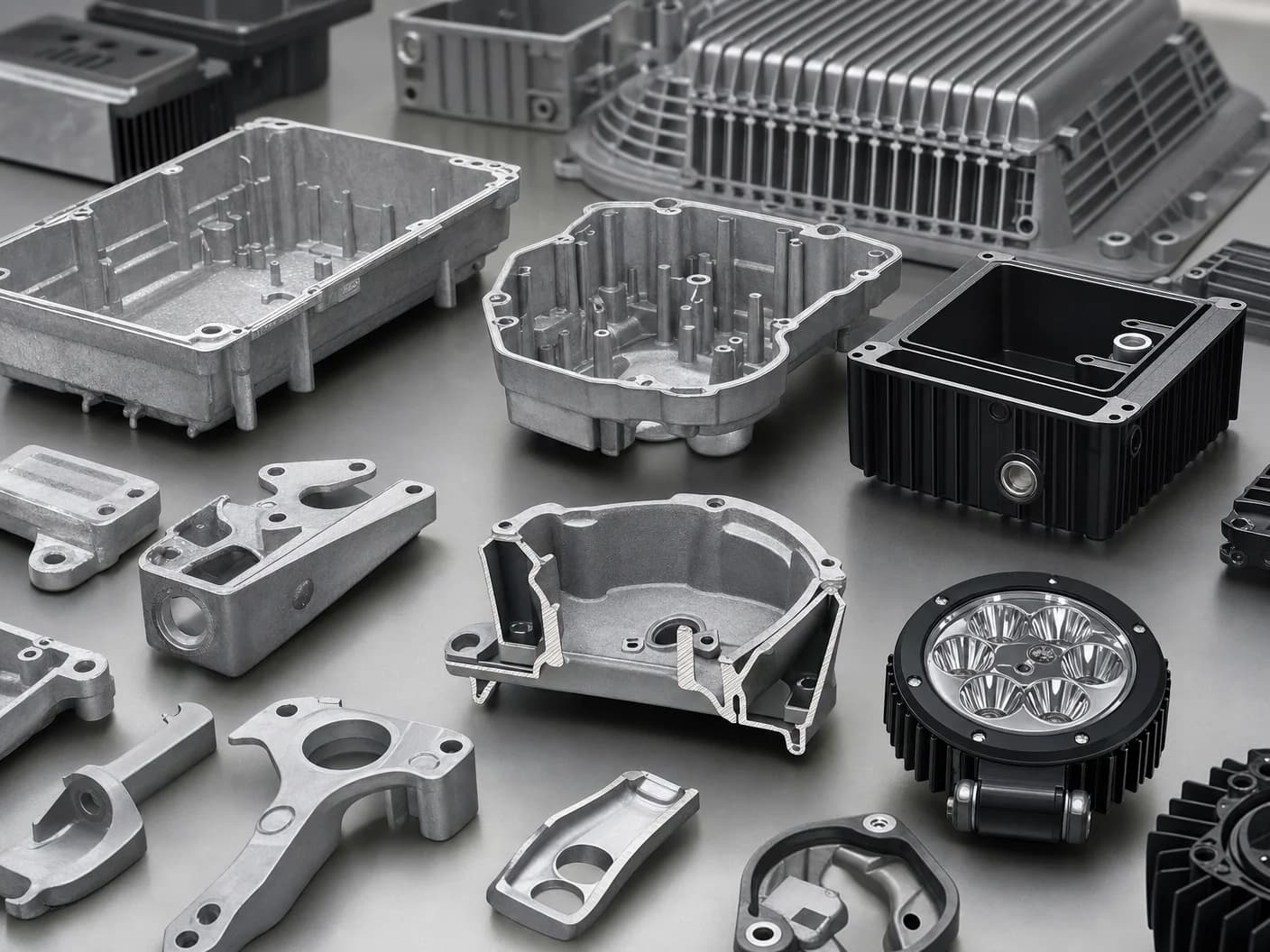
Die casting pushes molten metal, usually an aluminum or zinc alloy, into a hardened steel die under pressure. The part comes out with thin walls, complex inner shape and a good surface. It is the usual process for a metal housing that is too detailed to machine and too stiff to bend from sheet. Illuminious is a U.S. NPI engineering company. Engineered in San Francisco. Prototype builds, DFM and mass production in our own factory in Shenzhen. Choose it when the part is complex, must be metal, and will be made in numbers that pay for a die.
How a die-cast part is priced
Die casting is priced after engineering review. The cost of a cast part is mostly the cost of a die that must be designed first, and a casting request sent down the machining or printing route would be priced against the wrong process. Our engineers read your model, run a DFM review and publish an official quote that lists the die, the part price and the machining after casting as separate lines. You see what the tooling costs before you commit to it, and you can compare it with the cost of machining the same part at your volume.
A die is cut for one shape, and almost every decision that matters is made before the steel is cut. Our engineers repeat the DFM review before DVT and before tooling, and production tools are cut only after DVT closes the design.
How we prepare a cast part
The work starts with the design. Our engineers check draft angles, wall thickness, rib and boss shapes, the parting line and where ejector pins can touch the part. They mark the features that must be machined after casting, such as bearing bores, sealing faces and threaded holes, because a casting does not hold a machined tolerance.
Next comes a part you can hold. A printed part checks form and fit at no tooling cost. A machined part in the same alloy family checks strength, heat and fit in the real product. Both run through the portal, so the casting design is proven before money goes into a die. Many teams build their demo build and EVT units this way, and move to casting only when DVT has closed the design and the volume is known.
When the design is closed, the in-house tool room builds the die in H13 tool steel on 5-axis machines. Parts are cast on presses from 150–3000 t, and castings are checked by X-ray fluoroscopy for internal porosity. The Shenzhen factory then machines the critical features on its CNC lines, assembles the part with the boards and harnesses, and tests the finished unit. Tooling you pay for, including the die, belongs to you, and you may move it to another factory.
Die casting capabilities
Alloy grades are named as common industry choices. The grade for your part is confirmed in the DFM review and checked by OES.
| Capability | What it covers |
|---|---|
| High-pressure die casting | Molten alloy is forced into a steel die at high speed and pressure, then held while it solidifies. Shot speed and pressure are set to limit porosity in the walls and bosses that carry load. Presses from 150–3000 t. |
| Die making | Dies are designed and built in the in-house tool room, in H13 tool steel, on 5-axis machines. |
| Aluminum die casting | Common alloys such as A380 and ADC12 balance low weight, stable dimensions and good heat transfer. Aluminum is the usual choice for housings and heat-spreading frames where weight matters. |
| Zinc die casting | Zinc alloys such as Zamak 3 and Zamak 5 cast at a lower temperature. That is easier on the die and allows thinner walls and finer detail, at the cost of a heavier part. |
| Magnesium die casting | Magnesium gives the lightest structural metal part and some electromagnetic shielding. Common grades include AZ91D. Our engineers confirm whether its handling and finishing needs suit your part. |
| Inspection | X-ray fluoroscopy finds internal porosity in castings. Optical emission spectrometry (OES) confirms the alloy before parts are released. |
| Machining after casting | Critical features are machined after casting on CNC machines in the Shenzhen factory. Achievable machining tolerance on controlled features is 0.01 mm. |
| Finishing | Powder coating, anodizing, plating and deburring are chosen for appearance, corrosion and wear. The finish is fixed in the official quote, because it changes masking and the machining order. |
Our die-casting process
| Step | What we do | What you get or decide |
|---|---|---|
| 1. DFM review | Our engineers check draft, walls, ribs, bosses, parting line and ejector positions against your CAD, and mark the features to machine. | A DFM findings report, each finding sorted by when it must be fixed, plus changed files. |
| 2. Prove the shape | We print form-and-fit parts and machine functional parts in the alloy family through the portal. | Parts you can fit, load and test before any die exists. |
| 3. Close the design | Our engineers repeat the DFM review before DVT and before tooling. | Your approval of the frozen geometry. Tools are cut only after DVT closes the design. |
| 4. Die and first shots | The tool room builds the die to the frozen geometry, and the first parts are X-rayed and measured against the drawing. | First-shot parts and the measured values for your sign-off. |
| 5. Machine, assemble, test | The Shenzhen factory machines critical features, assembles the part into the product and runs the tests. | Finished parts, and inspection and test results per batch. Tooling you paid for stays yours. |
Why die casting works for a metal housing
| Benefit | What it means for your product |
|---|---|
| Complex shape at a flat part cost | Ribs, bosses, mounting points and thin walls come out of the die in one shot. The part cost does not rise with each added feature, as it does when a machine cuts every one of them from a solid block. |
| Stable dimensions from shot to shot | A well-designed die repeats the same shape for a long run. Assembly stays free of hand fitting, as long as the critical features are machined after casting and checked against the drawing. |
| Light, stiff metal parts | Aluminum and magnesium give a stiff part at low weight, and both move heat away from the boards inside the housing. Zinc gives the finest detail where weight matters less, such as small brackets and knobs. |
| Fewer parts in the assembly | One casting can replace a welded or screwed set of brackets. Fewer parts means fewer joints to check, fewer fasteners to stock and fewer steps on the assembly line. |
What does die casting do that machining cannot?
Die casting makes thin walls and complex inner shapes at a part cost that does not grow with complexity. A ribbed housing with bosses and a two-millimeter wall needs many setups to machine, and much material is cut away. The die makes it in one shot, and the part is often lighter too.
What casting cannot do is hold a machined tolerance or leave a machined surface. Cast parts are machined after casting on the features that matter: bearing bores, sealing faces and threaded holes. "Cast, then machine" is the normal route for this reason. Our engineers plan which features get machined as part of the casting design.
What should I use before the tooling exists?
Use a printed part for form and fit, and a machined part when the prototype must carry load or be tested in the real alloy. Both need no tooling and are ordered online. The printing route accepts parts from 0.1 to 2000 mm per axis. The machining route offers four tolerance bands, from general ISO 2768 to ±0.02 mm.
Neither one replaces a casting at volume. Both replace waiting for a die while the design is still changing, which is the more common problem. Order prototypes through CNC machining or 3D printing, and see how a printed shell turned into a cast enclosure in our heat-pump controller case study.
What does the die commit me to?
The die commits you to one geometry. It is cut for one shape, with draft, parting line and ejector positions set for it. A change to a wall or a boss is a change to the tool. Removing metal from the part is usually possible. Adding metal means cutting steel out of the die, a much larger job.
Casting rewards a design proven by other means first. The DFM review before tooling matters most here, and it is one reason an engineer prices die casting. Read how our engineers sort design findings in DFM services, and the design rules in our die casting design guide.
Who owns the die?
You do, when you pay for it. Tooling the customer pays for, including dies, molds, fixtures and test stations, belongs to the customer, and you may move it to another factory. The official quote lists each tool, its cost and its owner. If you move volume elsewhere, the die goes with you, with the drawings and inspection results.
Die casting against the metal routes you order online
The CNC and printing columns are configurator limits; the die casting column is set in review.
| Consideration | Die casting | CNC machining (ordered online) | 3D printing (ordered online) |
|---|---|---|---|
| Dedicated tooling | A hardened die per geometry | None | None |
| Ordered online | No, priced after engineering review | Yes, priced by a specialist within 24 hours on business days | Yes, priced by a specialist within 24 hours on business days |
| Material | Confirmed in review, checked by OES | Aluminum 6061 / 7075, Stainless steel 304 / 316, Mild steel, Brass, Titanium, Engineering plastic | Aluminum and Stainless steel via SLM; Nylon, resin, ABS / ASA, Flexible TPU |
| Tolerance | Confirmed in review; critical features are machined after casting | General ISO 2768, ±0.10 mm, ±0.05 mm, ±0.02 mm or tighter | Process standard, controlled dimensions, or critical tolerance |
| Quantity | Set by the volume that pays for the die | 1–100,000 parts | 1–100,000 parts |
| Envelope | Confirmed in review | 0.1–2500 mm per axis | 0.1–2000 mm per axis |
| Cost of a design change | A change to the die | A new program | A new file |
| Best suited to | Thin-walled complex metal housings at volume | Strong, accurate parts in any quantity | Complex geometry without tooling |
For an enclosure that is folded instead of cast, compare sheet metal fabrication. For a cast enclosure with boards and test inside, see how an industrial sensor team combined both in our IIoT die casting case study, and read the aluminum enclosure guide.
Facts and questions
Can I get a die casting price online?
No. Die casting is priced after engineering review, because the die must be designed before its cost is known. Machining, printing and sheet metal need no dedicated tooling: you order them online, and a specialist prices them within 24 hours on business days. For a casting, start with Project initiation or talk to an engineer.
Do cast parts need machining afterwards?
Almost always, on the features that matter. Bearing bores, sealing faces and threaded holes are machined after casting, because a casting does not hold a machined tolerance or leave a machined surface. Our engineers choose those features in the DFM review, and the Shenzhen factory machines them on its CNC lines.
What alloy should I choose?
Aluminum, such as A380 or ADC12, for most housings: light, stiff and good at moving heat. Zinc, such as Zamak 3 or Zamak 5, for small detailed parts where weight matters less. Magnesium, such as AZ91D, for the lightest part. The DFM review confirms the grade, and OES checks it on the cast parts.
How do I prototype a part that will be cast later?
Print it to check form and fit, or machine it when the prototype must carry load or be tested in the real alloy. Both routes are ordered online and need no tooling, so you prove the casting design before a die is cut. Our engineers then repeat the DFM review before DVT and before tooling.
How your official quote is prepared
Die casting has no online price. An engineer reviews your files, and a specialist prices the die and the parts in the official quote. The prototype routes differ: a specialist prices CNC-machined metal parts within 24 hours on business days. The review is free and comes before payment, and the official quote it publishes is the amount you pay.
Ready to start a die-cast part?
Send your CAD model or a sketch for a free engineering review. Our engineers tell you whether casting suits the part, and plan the prototypes that prove the shape before the die. Tools are cut after DVT, and you own the tooling you pay for.
- An engineer runs a free engineering review of your files, and nothing is charged when you submit.
- You see the findings first.
- We publish the official quote with an itemized total, lead time and validity window.
- You accept the official quote, and only then does payment open.