Consumer hardware, engineered to a retail finish
Consumer hardware is judged in the hand. A seam that catches a fingernail, a glow that leaks around a display or a battery that fades by evening ends up in the reviews. Our engineers design for those details from the first CAD model. Engineered in San Francisco. Prototype builds, DFM and mass production in our own factory in Shenzhen.
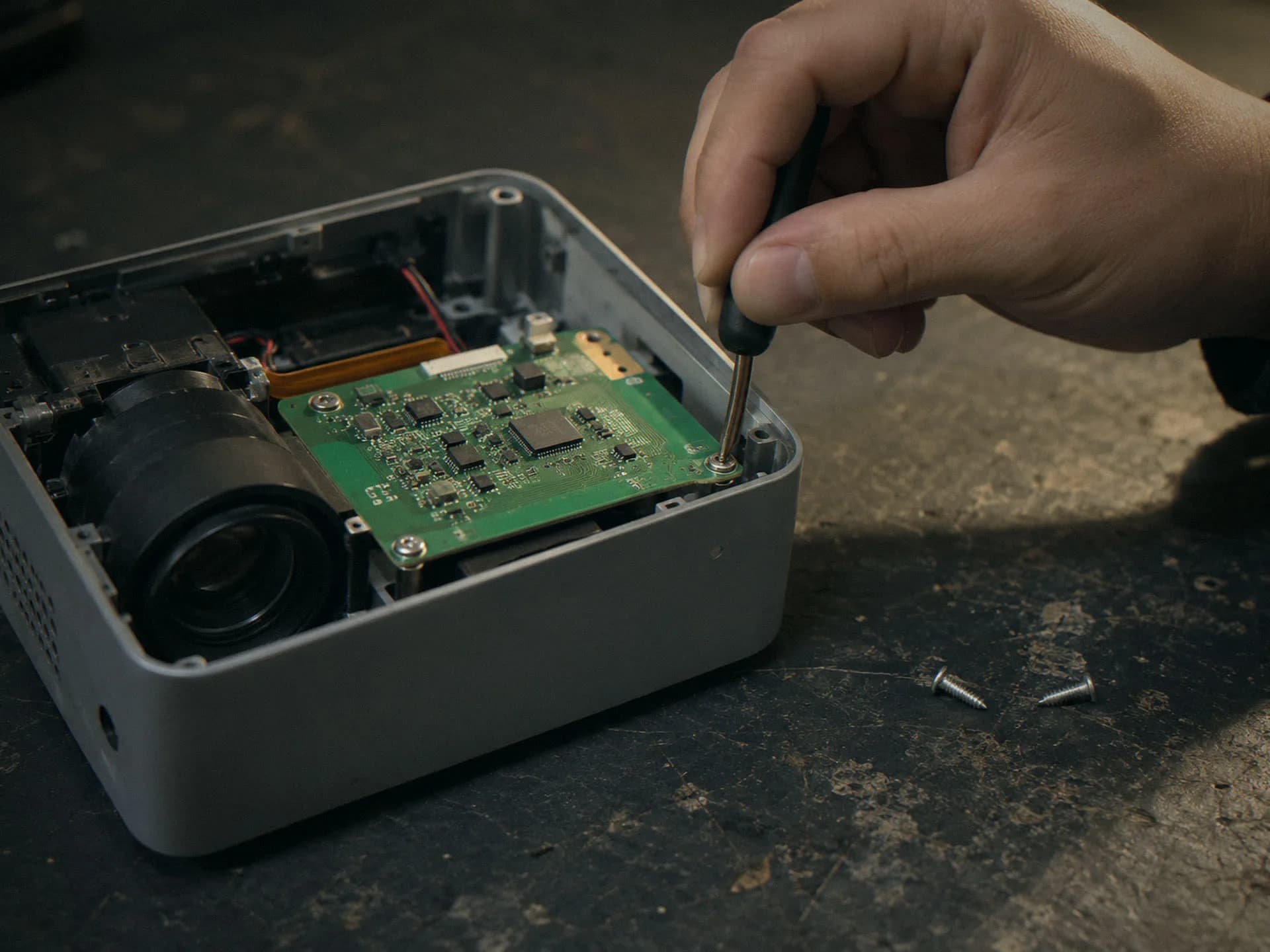
What does a consumer product need that a lab prototype does not?
A cosmetic standard, a cost target and a test plan for real use. The prototype proves the idea. The product must survive drops, sweat and a year in a pocket, look the same on every unit and land at a price people pay. Those limits set the materials, the tooling and the assembly order.
What we engineer for consumer products
Phase gates, not hand-offs. One team takes the product through the DFM review, the demo build, EVT, DVT and PVT. The engineers who draw the schematic stay on the project when it moves to the factory. See transfer to production.
DFM and DFA before tooling. Our engineers in Shenzhen, next to the lines, review your CAD and BOM for part count, material, tolerance stack-up and assembly order. The DFM review is repeated before DVT and before tooling, when changes still cost little. See DFM services.
Cosmetic finish. Injection molding, textures and paint, overmolding and assembly are planned to the cosmetic limits you sign. The questions below explain how those limits are judged, so every batch is checked the same way.
Small boards. Rigid, flex and rigid-flex boards, placement down to 01005 parts, AOI and in-circuit test. See flex PCB.
Sourcing. We source and qualify the parts through a network of 350 audited suppliers and plan buffer stock around your launch.
Reliability testing. Each product gets its own test plan: temperature and humidity, drop tests, radio performance and life tests, run on DVT units.
Packaging and delivery. Retail boxes, e-commerce packaging and U.S. fulfillment for direct-to-consumer orders. Packaging is designed with the product, so drop tests at DVT run on the boxed unit as well as the bare device.
When should cosmetic and battery decisions be made?
Before the enclosure is tooled. Parting lines, textures, light guides and the battery pocket all live in the mold, and a mold is expensive to change. Our engineers settle them in CAD and on the demo build, then repeat the DFM review before DVT. After DVT closes the design, production molds are cut once.
Wearables add their own limits. A ring or a watch puts the battery, the antenna and the sensors within millimeters of each other and of skin. Flex and rigid-flex boards fold the circuit into the shell, and the bend radius sets how long it survives. Read the flex and rigid-flex design guide for wearables, or start the board in the portal with PCB layout.
How a consumer product reaches the shelf
- DFM review and sourcing. A DFM findings report, a costed BOM and the plan for each part.
- Demo build and EVT. The first small batch proves the design, the functions and the firmware. Prototype boards and parts come from the portal, for example Advanced PCB & PCBA and 3D printing.
- DVT. A larger batch from production-intent parts. It goes through environmental and reliability tests and EMC and RF pre-scans before the certification path.
- PVT and golden sample. The first run on the production line proves the process. You sign the golden sample, and production is held to it.
Consumer products we build
The same engineering applies to audio products, personal care devices, gaming peripherals, connected kitchen appliances and portable projectors: acoustic, optical, thermal and motor problems in small, finished housings.
- Wearables. Smart rings, smartwatches and wristbands, smart glasses and wellness wearables. Flex boards, sensors and water-resistant shells; wellness products carry no medical claims.
- Smart home devices. Hubs and controllers with several radios, microphones for voice and processors that run local AI, with RF and acoustic tuning.
- Personal AI devices. Pendants and clips with microphones, an edge AI chip and Wi-Fi in a case people carry all day.
- Battery packs and chargers. Battery packs with BMS, and chargers designed for cost and efficiency. Battery packs we build go through UN38.3 shipping tests.
Recent work: light leaking at the overmold seam
A smart home company had a voice hub with an LED display set inside a soft-touch overmolded shell. Light leaked where the display met the overmold, and the microphone channels needed tuning in the final housing. We molded the light guides into the overmold and kept the board, the molding and the box build with one team. Read the case study.
Questions about consumer hardware
Can you match the finish on our industrial design renders?
Usually, once the finish is turned into numbers. We agree cosmetic limits per surface, judged under set light at a set distance, and texture and color references before tooling. Those limits go into the golden sample record, so production units are checked against what you approved.
Can I start with a small launch batch?
Yes. A demo build or a crowdfunding batch can come from portal orders and soft tooling before production molds are cut. Molds for volume come later, once the design is closed, so you do not pay twice for tooling.
Who handles certification for consumer products?
Your team or your lab files the submission, and the approval belongs to your product. We plan design margin from the first layout, build DVT units for the lab and supply the documents it asks for. FCC, CE and safety tests then run on units built the way production will build them.
Our product is an app. Can you build the device that goes with it?
Yes. App and software teams that add a device are a good fit. We design the hardware and its firmware to work with your app's protocol, test pairing on the demo build and keep the firmware release in the golden sample record, so production units behave like the ones you tested.
Tell us what you are building
- An engineer runs a free engineering review of your files, and nothing is charged when you submit.
- You see the findings first.
- We publish the official quote with an itemized total, lead time and validity window.
- You accept the official quote, and only then does payment open.