U.S. fulfillment, planned when the order is placed
No CAD yet? Our design team can take it from a sketch or a spec.
Walk Shenzhen factories with us, Dec 6–11. See the tour
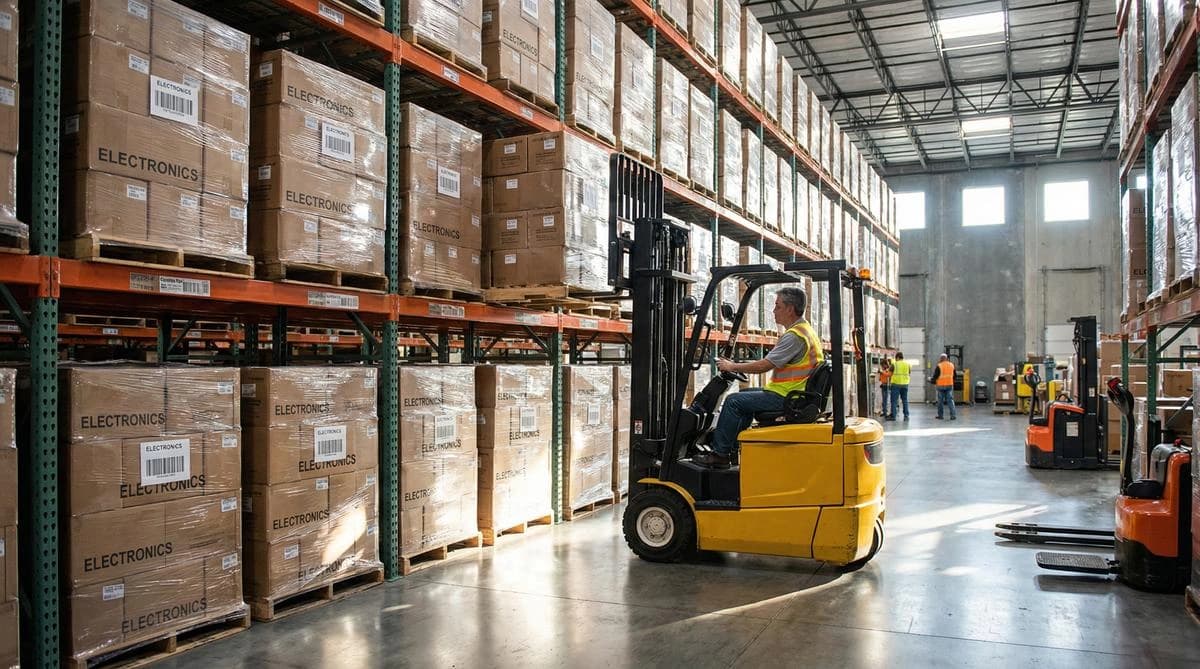
U.S. fulfillment covers the last leg, from a tested unit in the Shenzhen factory to a unit in your customer's hands. Units are packed and marked to the order, shipped to the U.S., received and counted, stored, and shipped to your customers or your channel. Illuminious is a U.S. NPI engineering company, and fulfillment is the part of manufacturing your customer sees: packing, marking and moisture protection are set when the order is configured, not at the loading bay. Engineered in San Francisco. Prototype builds, DFM and mass production in our own factory in Shenzhen. Returns come back through the same process and are graded before restock.
Everything upstream can be right and the experience can still be wrong: a unit that arrives with no mark, a moisture-sensitive assembly packed without protection, a carton that gives no clue what is inside. The decisions that prevent those are fields on the order, so they are part of the reviewed scope instead of a request made after the build.
How a unit reaches your customer
Decide at order time
Packing, marking, traceability and moisture protection are declared with the build.
Build and test
Units are built, tested and recorded per serial number in the Shenzhen factory.
Pack and mark
Units are packed in anti-static packing and custom packaging built in the Shenzhen factory, and marked to the order before they leave.
Ship to the U.S
Cartons travel by courier, air or sea freight, with the paperwork the product class requires.
Receive and count
Inbound units are counted against the shipment notice and stored by SKU and lot.
Pick, pack and ship
Customer orders are picked, packed and shipped with tracking, to one address or several.
Returns
Returned units are logged, inspected and graded before restock.
Why plan fulfillment with the build?
Because the cheap fixes happen at order time. A mark position, a packing insert, a humidity card or a carton label costs little when it is declared with the build. Added later, it means opening cartons, relabeling or repacking in a warehouse, which costs more and risks damage.
It also keeps one record. When packing and marking are on the same order as the build, the unit's serial number, its test results and the carton it ships in are linked. A customer complaint can then be traced from the box to the build to the test the unit passed.
What should be specified about packing before a build starts?
Whether anything in the shipment is moisture-sensitive, and whether the packing is standard or made for your product. A humidity indicator card is a declared packing option, and it is the cheapest way to know whether a moisture-sensitive assembly stayed dry between the factory and your line. A card is evidence; an assurance is not.
Custom packing is one of six declared assembly needs on the mechatronic route, beside fasteners and torque, adhesive, wiring, calibration and functional test. Declaring it with the order puts the materials and the labor into the price instead of into a change. For a retail product, the packing is designed with the enclosure and built in the Shenzhen factory: the insert holds the unit by surfaces that can take the load, and the carton fits the label your channel expects.
What fulfillment includes
| Area | What it covers |
|---|---|
| Packing design | Custom packing declared on the order, designed with the enclosure and built in the Shenzhen factory. Boards and units ship in anti-static packing. |
| Marking | An order number at a position you choose, or a 2D data-matrix code that a scanner can read after assembly. |
| Traceability | Lot and material traceability declared on the mechatronic order, so each mark points at a build record. |
| Moisture protection | A humidity indicator card for moisture-sensitive assemblies. |
| Freight | Courier, air or sea freight from the Shenzhen factory, chosen per shipment from cost and date. |
| Receiving and storage | Inbound units counted and checked against the shipment notice, then stored by SKU and lot. |
| Pick, pack and ship | Orders picked, packed to your specification and shipped with tracking, to one U.S. address or several. |
| Kitting and labels | Units bundled with accessories, inserts and labels into the kit your customer receives. |
| Returns | Returned units logged, inspected and graded before restock or disposal. |
| Order sync | Orders and stock levels kept in step with your store or order system. |
For direct-to-customer brands, the parts of fulfillment people notice are the box, the insert and the delivery time. For channel sales, it is the label, the carton count and the paperwork the buyer requires. Tell us which channel each SKU goes to, and the packing and labels are planned for it before the first carton is packed.
How should units be marked?
With something that can be read after the product is assembled. Board marking is a declared field with four settings. Two matter most: an order number at a position you specify, so the mark does not land under a heatsink or inside the enclosure, and the 2D data-matrix code, which a scanner can read and a database can index.
Marking is only half of it. The other half is the record the mark points to. Lot and material traceability is a separate declared toggle on the mechatronic route, and a marked unit with no record behind it is a serial number that answers no questions. Each unit's test record is kept against its serial number, so a returned unit can be matched to the test it passed.
What does the delivery format change?
How boards arrive and what has to happen to them next. Delivery format is a declared field with three settings: single pieces, a panel to an outline you supply, or a panel we lay out for you. It affects both fabrication and assembly handling, which is why it is declared, not assumed.
If you assemble in-house, a panel suits your line, and supplying your own outline makes sure it matches your line's tooling. If the boards go straight into a product, single pieces save you the depanelling step.
What travels with a regulated product?
The paperwork its product class requires. Product class is a declared field with six settings, and medical, aerospace, military or defense, and other regulated classes send the order to an engineer first. The documentation is planned before the build, so it ships with the goods instead of being rebuilt after a customer asks.
Medical devices are built under the Shenzhen factory's ISO 13485, automotive and EV parts under IATF 16949, and aerospace and drone parts under AS9100. The certificates sit with the factory; the records that prove each unit's build travel with the shipment.
Batteries and products that contain them need extra planning. Lithium cells travel under shipping rules that set the packing and the labels, and can limit the transport mode. Battery packs we build go through UN38.3 shipping tests, and the packing and labels are chosen with the test results in hand, before the cartons are printed.
Packing, marking and delivery options declared with an order
Each setting exists on the order route named in its row.
| Declared option | Settings available | What it decides |
|---|---|---|
| Board marking (standard board route) | None; order number at our position; order number at your position; 2D data-matrix code | Whether a shipped unit can be identified, and where an order number lands |
| Humidity indicator card (standard board route) | Requested or not | Whether moisture exposure in transit is evidenced or assumed |
| Custom packing (mechatronic route) | A declared assembly need | Whether packing materials and labor are in the price |
| Delivery format (standard board route) | Single pieces; panel to your outline; panel we lay out | Whether you depanel, and whose tooling the panel matches |
| Lot and material traceability (mechatronic route) | Requested or not | Whether the mark on a unit points at a record |
| Product class (standard board route) | Consumer or industrial, automotive, medical, aerospace, military or defense, other regulated | Which paperwork must ship with the goods |
| Inspection (part routes) | Standard; dimensional report; first-article report; CMM report | What evidence arrives with the parts |
| Free engineering review | Within 24 hours on business days, or within two business days for the four design services | When the packing and marking scope is confirmed |
Recent work: from printed shells to packed units
A smart-home controller startup had EVT units in 3D-printed shells that could not survive outdoor, condensing conditions or the certification path. The controller moved to a die-cast and overmolded housing with an integrated board, and the finished units were serialized and packed for direct delivery to U.S. fulfillment. Read the case study
Order with packing and marking declared
Declare marking and the humidity card on Standard PCB & PCBA. Declare traceability and custom packing on custom mechatronic parts and assemblies. U.S. receiving, storage and order shipping are scoped with an engineer and priced in an official quote. For the build behind the box, see box build and supply chain management. For the step from pilot units to retail stock, read the prototype-to-production cost traps guide.
Facts and questions
Can you mark units with a scannable code?
Yes. Board marking is a declared field, and a 2D data-matrix code is one of its four settings. The other useful setting is an order number at a position you specify, which stops the mark landing where the assembled product covers it. Pair either one with lot traceability on the mechatronic order, so the code points at a record.
Can lithium battery products go through fulfillment?
Yes, with planning. Battery packs we build go through UN38.3 shipping tests, and the packing, labels and transport mode follow the shipping rules for lithium cells. Tell us at order time which SKUs contain batteries, so the cartons and the freight choice are settled before the first unit ships.
Should boards ship as panels or as single pieces?
Panels if you assemble in-house, because a line is tooled for a panel, and supplying your own panel outline is how you guarantee the match. Single pieces if the boards go straight into a product. Delivery format is a declared field with three settings, and it affects both fabrication and assembly handling.
Can units ship to several U.S. addresses?
Yes. Bulk cartons can go to a warehouse or a channel's distribution center, and single units can ship to customers from U.S. stock. The split is agreed in the official quote, with the packing each destination needs, so a retail carton and a direct-to-customer box are both planned before the build.
Can you handle returns?
Yes. Returned units are logged, inspected and graded before they are restocked, reworked or set aside. Because each unit carries a serial number and its test record, a return can be checked against how it left the factory, which shows whether the fault started in the build, in transit or in use.
When is the packing and marking scope confirmed?
In the free engineering review, before payment: within 24 hours on business days for most services, or within two business days for the four design services. The official quote then lists the packing, marking and delivery choices with their cost, so the last leg is agreed before the first unit is built.
How your official quote is prepared
A specialist prepares the official quote for packing, marking and fulfillment from your files and specifications, after the free engineering review. U.S. receiving, storage and shipping are itemized in the same quote. An engineer reviews every order before payment, and the official quote is the amount you pay.
- An engineer runs a free engineering review of your files, and nothing is charged when you submit.
- You see the findings first.
- We publish the official quote with an itemized total, lead time and validity window.
- You accept the official quote, and only then does payment open.