What NPI engineering involves
No CAD yet? Our design team can take it from a sketch or a spec.
Walk Shenzhen factories with us, Dec 6–11. See the tour
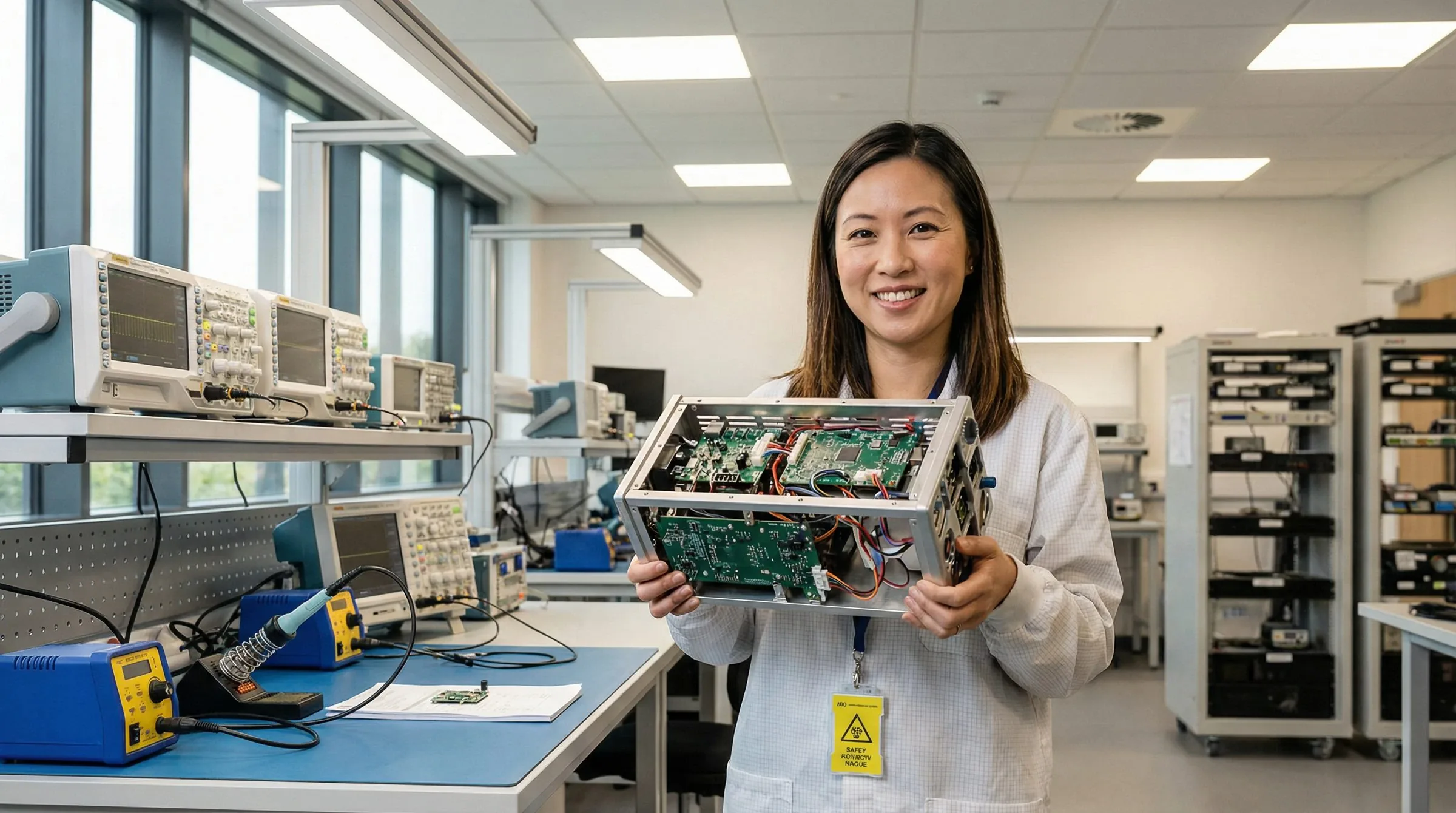
NPI covers four kinds of work that overlap. The design is checked against how it will be built. Builds answer set questions, from the demo build through EVT, DVT and PVT. Test methods and fixtures are written and made. And the files, instructions and limits that production needs are written down before volume starts. Illuminious is a U.S. NPI engineering company, and NPI engineering is the work between a design that runs on the bench and a product the factory builds the same way every time. Engineered in San Francisco. Prototype builds, DFM and mass production in our own factory in Shenzhen.
You choose an NPI program when a problem found in production would cost far more than the same problem found now. That applies to any product with a custom board, a molded part or a battery, and more so when the date cannot move: an investor demo, a retail launch or a pilot customer.
Our engineers run NPI with you, from the first DFM review to the golden sample you sign. In the Shenzhen factory they work next to the lines and attend the EVT, DVT and PVT builds in person. The engineers who draw your schematic stay on the project when it moves into the factory.
What each stage proves, and what ends it
Design
The schematic, layout, enclosure and firmware exist as files. It ends when a second engineer has checked the schematic and layout.
DFM review
The design is read against the factory's processes. It ends with a findings report and changed files.
Demo build
The idea works in a unit you can hold. It ends when the unit does what the demo needs.
EVT
The design works as drawn. It ends with test results and updated files.
DVT
The design meets its specification, and EMC and RF pre-scans start the certification path. It ends with a validation report.
PVT
The process builds it on production fixtures. It ends with the test plan and the fixture definitions.
Golden sample
You sign the reference unit. Production is held to it.
Production
Each batch is compared with the golden sample.
Every stage ends at a stage gate with a written report, and each design choice is recorded there with its reason. You can start at any stage. A team with a finished design and a working demo build can start at EVT.
Who brings us NPI work?
Startups and product teams at any stage. Some have no hardware engineers yet. Some have one generalist who needs a second pair of hands or a review. Others have a team and a gap, such as FPGA, RF and antenna, power electronics and battery/BMS, motor control, embedded Linux or the certification path.
Software and app companies adding their first device fit here too. Our engineers take the roles that are missing on that project: the whole design, one discipline, or one specialty. The NPI work itself stays the same. Only the starting stage changes.
What do you send to start an NPI program?
Whatever exists today. A requirement document, a sketch, a schematic, a layout, a BOM, enclosure CAD or a working demo build are all valid starting points. Add the target volume, the markets you will sell in and the date that cannot move. Those three decide which stage we start at and what each build must prove.
A partial file set is normal. Our engineers read it, tell you which stage your project is really in, and say what the next stage gate needs. That answer comes in the free engineering review on a portal order, or in a scoping call when you talk to an engineer.
What NPI engineering includes
| Work | What it covers |
|---|---|
| DFM and DFA review | The layout, parts, panel and enclosure are read against how the factory will build, test and source them. The review is repeated before DVT and before tooling. |
| Component engineering | Availability and alternates are checked before the schematic is drawn, across our network of 350 audited suppliers. RoHS and REACH status is confirmed in the reviewed scope. |
| Demo build | The first working unit, built from reviewed files, for an investor meeting, a pilot user or a Kickstarter film. Its SMT program, stencil and reflow profile carry into production. |
| EVT | Board bring-up, electrical checks and first mechanical fit. Firmware test results are kept per unit, by serial number. |
| DVT | Testing against the full specification, EMC and RF pre-scans for the certification path, and units for your test lab. |
| PVT | A run on production fixtures, with the production test firmware on the ICT and FCT stations. |
| Test fixtures and stations | Fixtures are designed for your board and built before PVT. The Shenzhen factory has 30+ ICT/FCT test stations. |
| Documentation and hand-off | Work instructions, test limits, the golden-sample sign-off record, and the design source files at each stage gate. |
What is the difference between a prototype build and a pilot build?
A prototype is built to answer questions about the product, and it may be built any way that answers them. A pilot build is made the way production will make it, so the process is under test as much as the product. Mix them up and you pay pilot prices for prototype answers, or learn nothing about the process.
The portal records this as a declared project phase: concept, prototype, pilot or production. In stage terms, the portal's pilot phase is the PVT build. Everyone then knows which kind of build is being paid for.
Concept turns a requirement into something specific enough to price: function, success criteria, envelope, motion and load, duty cycle and environment. Prototype answers the product questions. Pilot answers the process questions. Production is where the design stops changing and the controls take over.
Which approvals should gate an NPI project?
On the layout, two: placement approval and routing approval. Both are declared milestones on a PCB layout order. On the build, one: production-file confirmation, which holds fabrication until you approve the file that will run. Then each stage gate needs your yes, and the golden sample needs your signature.
Placement is where mechanical fit, heat and manufacturability are decided. If you review it only after routing, you review it after the expensive work is done. That is why placement approval sits before routing on the order.
Production-file confirmation is a declared toggle on board and stencil orders. When you request it, fabrication waits for your approval of the exact file. Between these three approvals, the points where a mistake becomes costly are the points where someone has to say yes.
What should be finished before production starts?
The alternates policy, the inspection level, the test definition and the traceability requirement. Each is a declared field on its order route, and each costs less to settle now than to add later. A production run without a defined pass condition for its functional test makes units nobody can accept or reject.
The design should be finished too. Production is where change becomes expensive: new programs, new fixtures, new first articles. The prototype and pilot stages exist so that the changes happen there.
Two pieces of tooling follow a fixed order. Production molds are cut after DVT closes the design. Production test fixtures are built before PVT, so the PVT run tests the fixtures as well as the product. Tooling you pay for, such as molds, fixtures and test stations, belongs to you, and you may move it to another factory.
NPI phases and the milestones the portal records
Each row names the order route that records it.
| Phase or milestone | Declared as | What it settles |
|---|---|---|
| Concept | Project phase, custom mechatronic parts route | Function, success criteria, envelope, environment, make or buy |
| Prototype | Project phase, custom mechatronic parts route | Whether the design does what it should |
| Pilot (PVT) | Project phase, custom mechatronic parts route | Whether the process can build it again and again |
| Production | Project phase, custom mechatronic parts route | Controlled builds; lot and material traceability is a toggle on this route |
| Placement approval | Milestone toggle, PCB layout route | Mechanical fit, heat and manufacturability, before routing |
| Routing approval | Milestone toggle, PCB layout route | Constraint compliance before outputs are made |
| Production-file confirmation | Toggle, board and stencil routes | Fabrication runs from a file you approved |
| Required outputs | Field, PCB layout route | EDA source, Gerbers, BOM and CPL, DXF, PDFs, 3D model, production instructions |
| Free engineering review | Published per service | Within 24 hours on business days for mechatronic parts; within two business days for PCB layout |
Where the work happens, and under which certificates
The Shenzhen factory runs bare-board fabrication, SMT, injection molding, CNC machining, sheet metal, box build and test in-house, so the pilot runs on the same lines as volume. It has 8 automated SMT lines. The factory holds ISO 9001, ISO 13485, IATF 16949, AS9100 and ISO 14001, which covers medical devices, automotive and EV parts, and aerospace and drone parts when your product needs them.
Recent work: field problems found at the pilot
A logistics startup took a LoRa asset tracker from first samples toward volume. Instead of going straight to tooling, it ran pilot units on real job sites. Those units showed two problems no bench test had found: a housing resin that chalked in sunlight and a connector that worked loose under vibration. Both were fixed before volume tooling was cut. Read the case study
Order NPI work online
Three portal services carry NPI work. Project initiation and PCB layout are priced from published tiers, and a specialist confirms the tier in the free engineering review, within two business days. For custom mechatronic parts and assemblies, configure online and get an official quote from a specialist within 24 hours on business days, after the free engineering review. A full EVT, DVT and PVT program is scoped with an engineer and priced in an official quote.
Facts and questions
What is the difference between a demo build and a pilot build?
A demo build is your first working unit, built to show the idea to investors, pilot users or Kickstarter backers. A pilot build is made the way production will make it, with the same process, fixtures and instructions. The demo build tests the product. The pilot build tests the process that will make it.
Do you review the design before you price it?
Yes. Every portal order gets a free engineering review before payment. For PCB layout the review target is within two business days after you submit; for mechatronic parts and assemblies it is within 24 hours on business days. The review reads your files against the configuration you declared and reports what it finds, whether or not you go ahead.
Can you do the PCB layout as well?
Yes. PCB layout is one of the 12 services in the portal. It covers a new layout or a controlled change to an existing one, in three published tiers: 2 to 4 layers, 4 to 6 layers, and 6 or more for RF, high-speed, HDI and BGA work. Placement and routing approval are declared milestones, so you see the board before routing ends.
How is lead time agreed?
In the official quote that follows the free engineering review. Our engineers commit to a date once they have read your files, not before, because the parts, the stage and the build quantity all move it. What we publish in advance is the review target for each service, which the portal shows before you submit.
What do I receive at each stage gate?
A written stage-gate report that records each design choice with its reason, and the design source files for that stage. You approve the gate. Design files and IP are assigned to you at hand-off. Firmware source comes when the order includes it; otherwise you receive binaries. The last gate is the golden sample you sign.
How your official quote is prepared
A specialist confirms the published tier for design work, or prices a mechatronic order from your files and specifications, after the free engineering review. An engineer reviews every order, and the review comes before payment. The official quote it publishes is the amount you pay.
- An engineer runs a free engineering review of your files, and nothing is charged when you submit.
- You see the findings first.
- We publish the official quote with an itemized total, lead time and validity window.
- You accept the official quote, and only then does payment open.