Medical device engineering under ISO 13485
A medical device carries its records with it. Every part, change and test result has to be findable later, and the design must hold still once it is validated. Medical devices are designed by our engineers and built under the Shenzhen factory's ISO 13485. The FDA path runs with your regulatory team, and we supply the build and test records it needs. Engineered in San Francisco. Prototype builds, DFM and mass production in our own factory in Shenzhen.
What does building under ISO 13485 give my device?
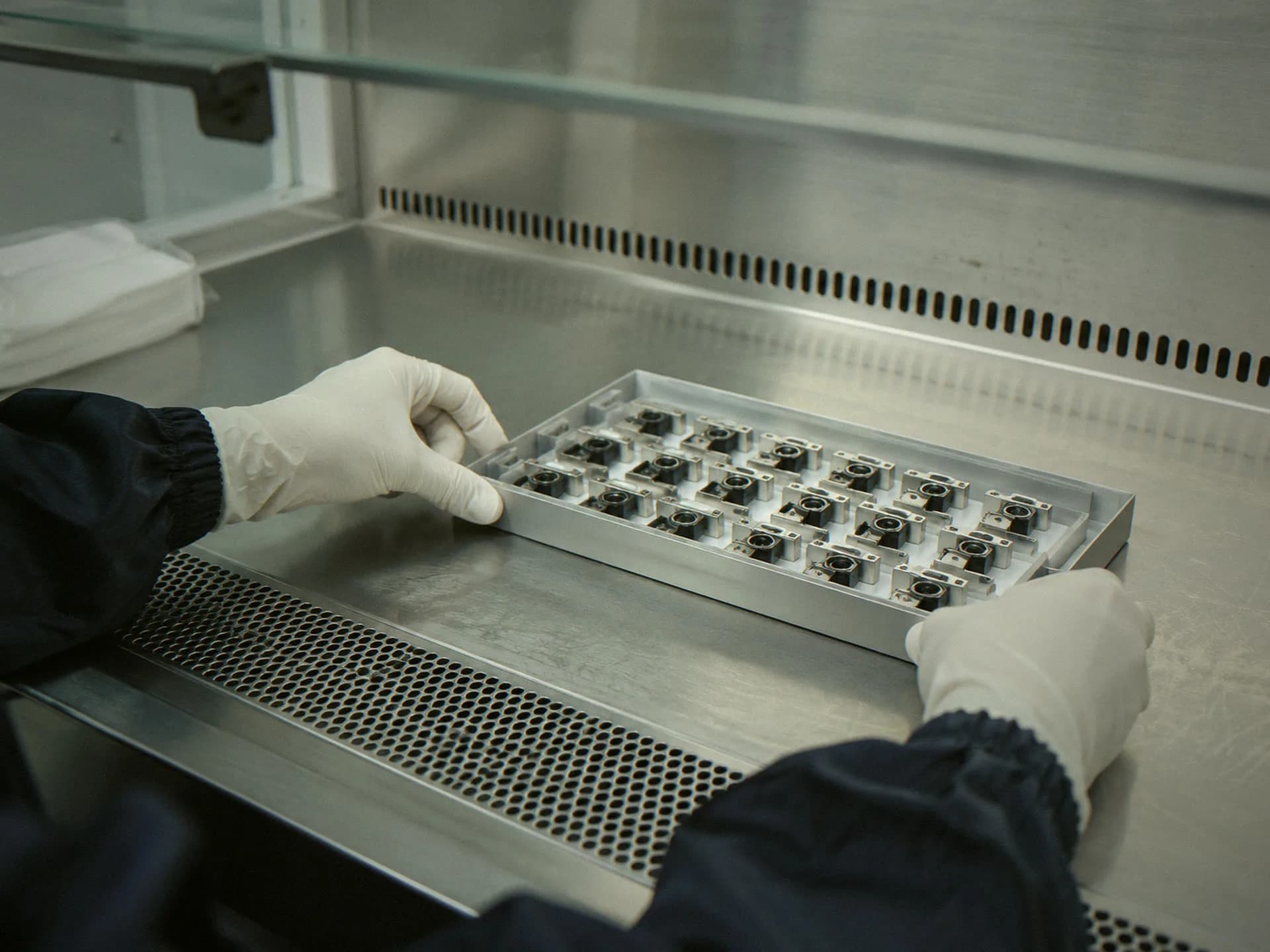
A quality system built for medical devices: controlled documents, risk management, change control and traceability from incoming parts to finished units. The Shenzhen factory holds ISO 13485, so the prototype builds and the production runs for your device happen inside that system. It supports your regulatory submission; it does not replace it.
Medical products we work on
Wellness wearables, such as fitness rings and wristbands, sit with consumer electronics and carry no medical claims. We make no disease, treatment or safety-outcome claims for any product.
- Medical devices. Electronic and electromechanical devices, from patient-worn units to bench equipment, built under ISO 13485.
- Exoskeletons and rehab devices. Actuators, battery packs, motion sensors and careful fit, also under ISO 13485.
- Lab and test instruments. Precise analog front ends, calibration and motion control.
What we engineer for medical devices
Small, dense boards. Placement of 01005 parts at ±25 µm, flex and rigid-flex boards for patient-worn units, and solder paste and optical inspection on each board. See flex PCB.
Skin-contact and enclosure materials. Medical-grade plastics and adhesives chosen for the biocompatibility tests your device needs, such as ISO 10993, with the material records kept per batch. Assembly steps that need clean conditions run in the Shenzhen factory's ISO 7 clean room. Read the medical device enclosure guide.
Firmware with records. Firmware test results are kept per unit, by serial number. Firmware handover includes the toolchain version, the build steps and the programming procedure, so the released build can be rebuilt. See firmware development.
Test fixtures and calibration. Production test fixtures are built before PVT, and the ICT and FCT stations run the production test firmware at PVT. Sensor channels are calibrated against reference values, and each result is stored in the unit's test record. See testing and inspection.
A second check on every design. A second engineer checks every schematic and layout: the power tree, footprints, connector pinouts and parts against the BOM.
Sourcing you can trace. Parts come through a network of 350 audited suppliers, with incoming inspection and counterfeit checks. Our engineers check availability and alternates before the schematic is drawn, so a validated design is not forced into a change by a shortage.
How does the FDA path fit with your work?
Your regulatory team owns the submission and the device classification. We work inside your plan: we build DVT units for testing, keep the records of how each unit was made and tested, and supply documents for your design history and technical file. The FDA path is yours; our part is the evidence from design and production.
Quality practices your auditor will look for
Each stage gate ends with a written report, and the golden sample is signed off in a record both parties keep. That record lists the design revision, the BOM, the firmware release and the measured values. See what a golden sample is and quality and certifications.
- Risk management. FMEAs on the design and the process, written into a risk file that follows ISO 14971.
- Change control. No change goes in without a written evaluation. A design change after sign-off is re-measured against the old reference and the golden sample is re-signed.
- Traceability. Each serialized unit links to component lots, sub-assemblies, the firmware release and its test data.
- Corrective action. When a result drifts or a finding comes in, an engineer reviews it before the next batch runs, and the root cause and fix are recorded.
What should I send for a first review?
Whatever exists: a requirements list, a dev-kit prototype, schematics, CAD or a full design history. Add your intended market and device class if your regulatory team has set them. An engineer reads the files, tells you which stage you are in and which records the next stage must produce, before any build is priced.
If the product is still an idea, project initiation checks feasibility, picks the major parts and estimates the BOM cost. If the design exists, a DFM review checks it against how the factory will build, test and source it. Its findings report sorts each finding by when it must be fixed: before the demo build, before EVT or before production.
What we do not do
We do not classify your device, write your regulatory strategy or sign your submission. We do not make claims about what your device treats or prevents. Our work is the engineering, the builds and the records that show how each unit was made and tested.
From prototype to production with one team
Our U.S. engineers plan test access early, while the design is still in CAD, and the DFM review follows in Shenzhen, next to the lines. Prototype boards and parts come from the portal, for example Standard PCB & PCBA and Custom mechatronic parts, each after a free engineering review. Portal orders record file ownership in the scope you approve. EVT, DVT, PVT and production units carry these records. EVT, DVT and PVT then run in the Shenzhen factory, and our engineers attend each build in person. Production starts from the same files, so the validated design does not move to a new supplier.
Recent work: a flex tail that had to bend every day
A connected-health team built a skin-worn patch with a flex tail. DVT checked the medical-grade adhesive, the waterproof overmold and the stress on the flex tail where it bends, before the move to volume. The patch went into production with flex PCBA, biocompatible encapsulation and unit-level serialization. Read the case study.
Protecting your design
We sign your NDA before the first call, and project files live in private project storage. Contracts are with Illuminious LLC (Wyoming). Design files and IP are assigned to you at hand-off on engineering projects, and tooling you pay for belongs to you.
Questions about medical devices
Does the FDA approve your factory?
No. The FDA clears or approves devices; it does not approve a factory. The Shenzhen factory holds ISO 13485, and your device follows its own FDA path with your regulatory team. We supply the build records, test data and documents that path asks for. For the 2026 quality system rule, read our QMSR guide.
Can you build units for a clinical study?
We build units to your released design and test plan under ISO 13485, with the records of how each unit was made. Whether those units may be used in a study is a decision for your regulatory team and the study sponsor.
Do exoskeletons count as medical devices here?
Yes, in how we build them. Exoskeletons and rehab devices are built under the factory's ISO 13485. Their market claims and approvals stay with you. We engineer the actuators, battery packs, sensors and fit, and make no therapy or outcome claims for them.
Tell us what you are building
- An engineer runs a free engineering review of your files, and nothing is charged when you submit.
- You see the findings first.
- We publish the official quote with an itemized total, lead time and validity window.
- You accept the official quote, and only then does payment open.