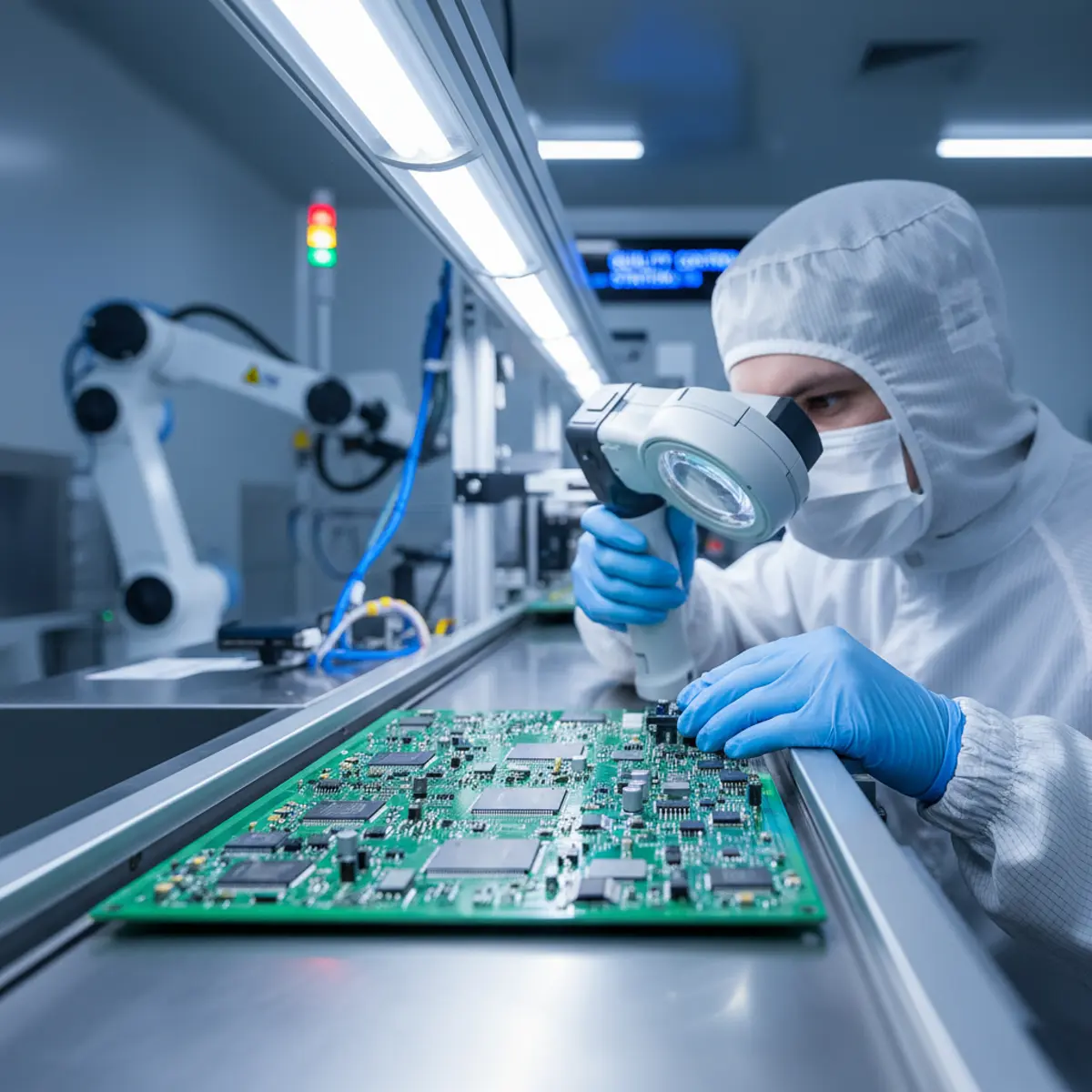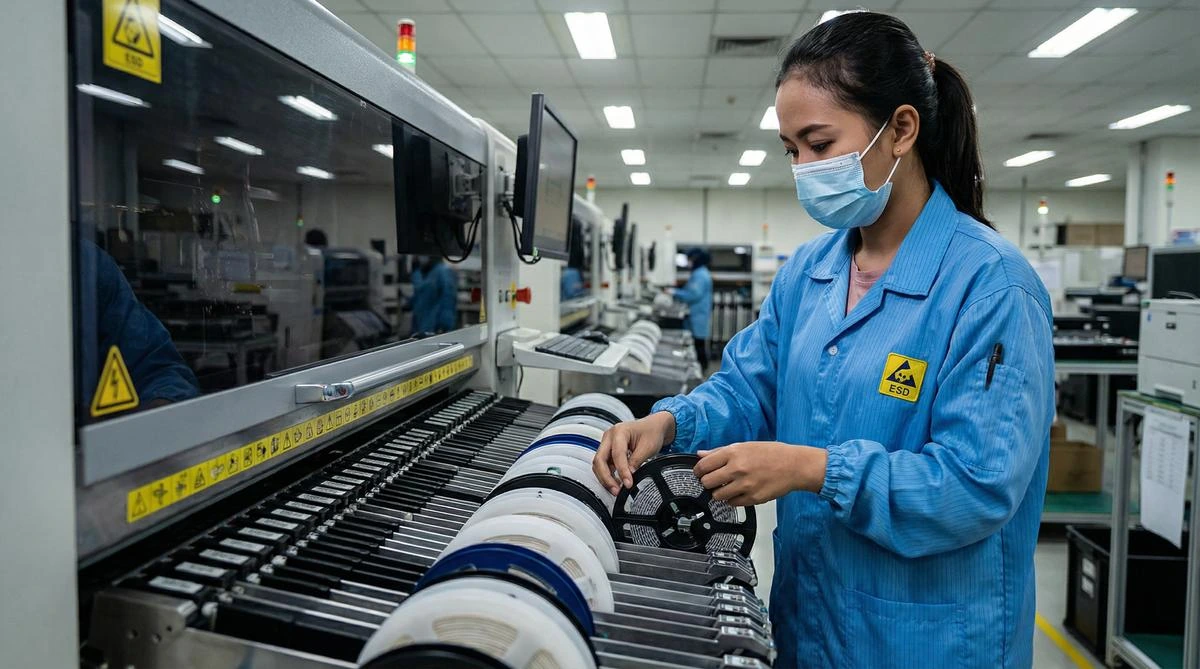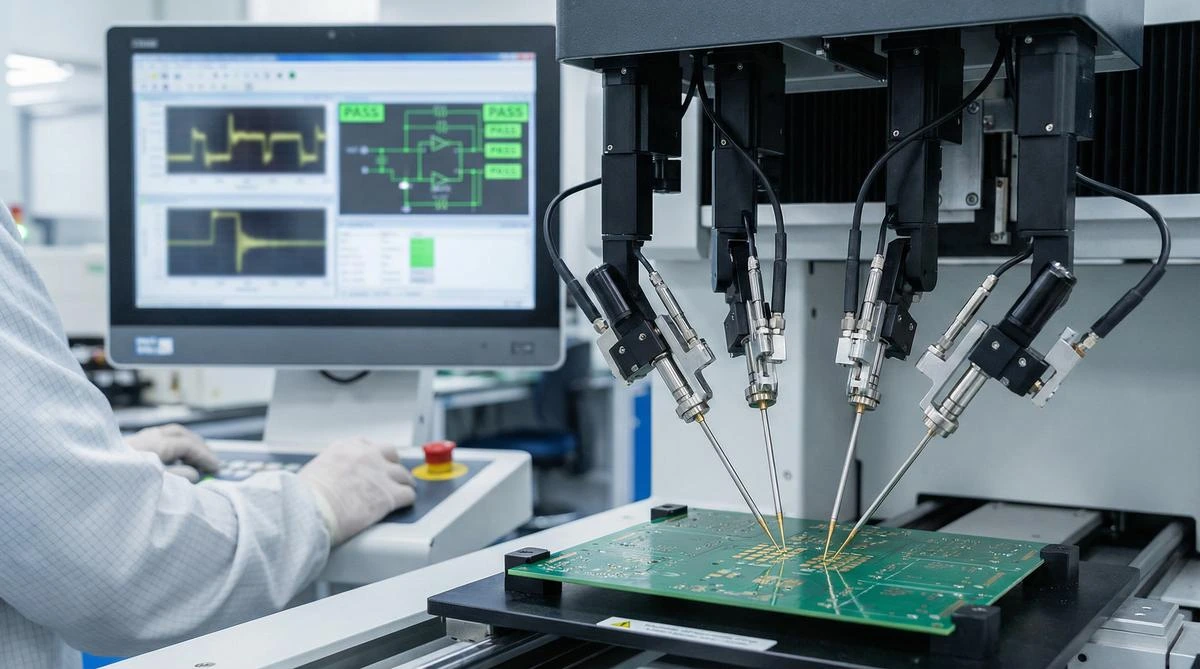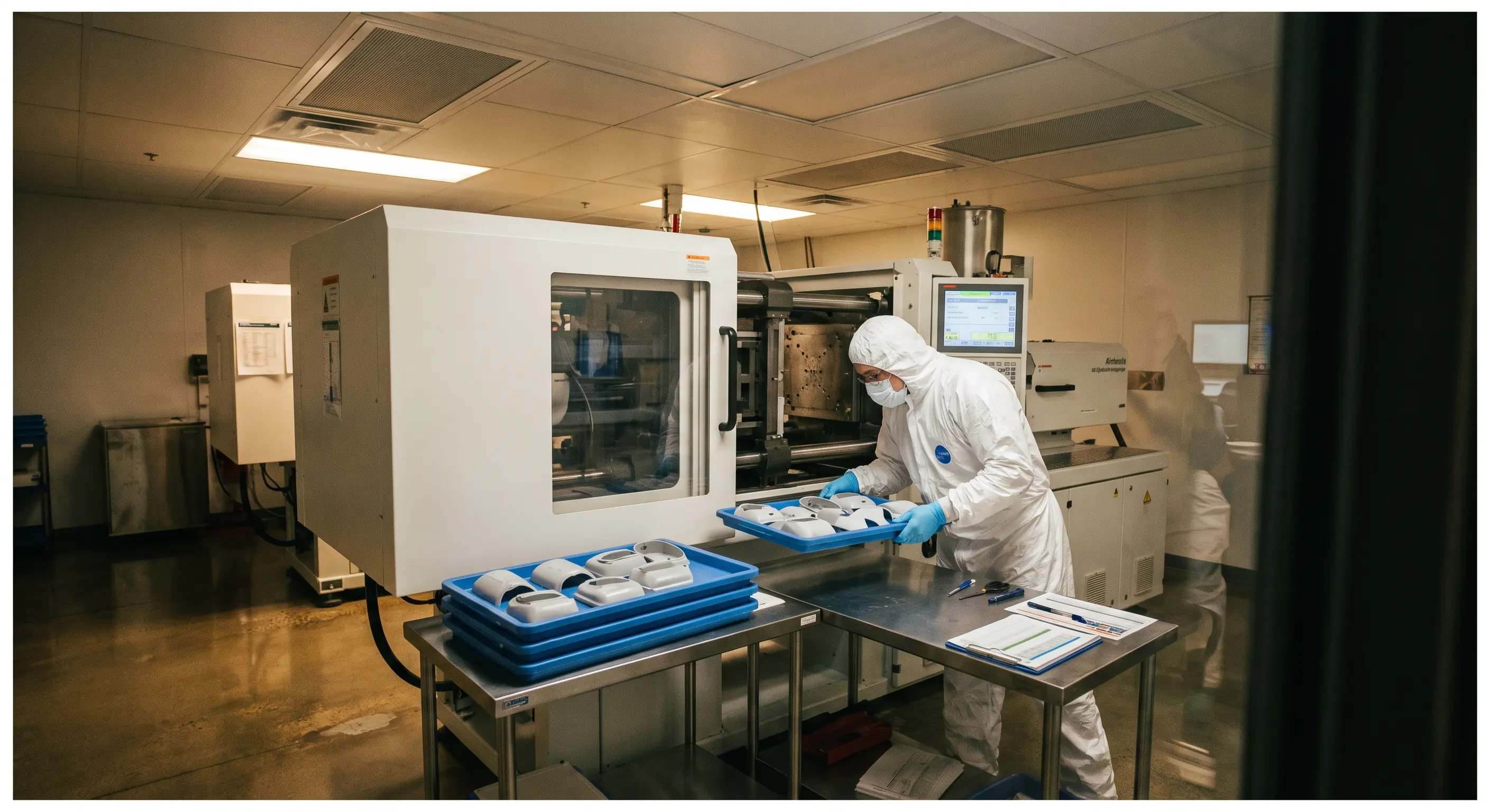
The enclosure is the part of your medical device that touches the patient, the sterilizer, and the FDA inspector — in that order. Since February 2, 2026, the FDA's Quality Management System Regulation (QMSR) has incorporated ISO 13485:2016 by reference, which means enclosure and process decisions that used to be "just manufacturing" now carry direct regulatory weight in every FDA inspection. The market is scaling accordingly: medical device contract manufacturing is projected to grow from $92.9 billion in 2026 to $153.1 billion by 2034 at roughly 6.5% CAGR (Fortune Business Insights), with injection-molded medical plastics alone reaching $28.8 billion this year. This guide walks through the decisions that actually determine whether your enclosure program succeeds: biocompatible material selection, cleanroom molding process control, the enclosure-PCBA integration rules most teams learn the hard way, and the validation documentation an ISO 13485 partner should hand you without being asked.
🏛️ QMSR In Force Since Feb 2, 2026
FDA inspections now run against ISO 13485:2016 incorporated by reference. Your enclosure supplier's process controls and records are inspectable evidence — not background logistics.
📈 $92.9B → $153.1B by 2034
Medical device contract manufacturing is growing at ~6.5% CAGR, with injection-molded medical plastics at $28.8B in 2026. Capacity for validated programs is tightening.
🧪 ISO 10993 Is the Gate
Every patient-contact material needs a biocompatibility position — USP Class VI or ISO 10993 test data — before design freeze. Retrofitting biocompatibility is a requalification program.
🏭 One Partner, One Validation
Consolidating enclosure molding, IPC Class 3 medical PCBA, and box build under a single ISO 13485 roof cuts duplicate validations and DHR assembly across the supply chain.
Why the Enclosure Is a Medical-Critical Decision, Not a Cosmetic One
Consumer hardware teams treat the enclosure as industrial design — the skin that makes the product look finished. In a medical device, the enclosure is a functional, patient-contacting, regulated component that must satisfy five requirements simultaneously:
- Biocompatibility (ISO 10993). Any material contacting patient tissue or fluids needs a documented biological safety position — cytotoxicity, sensitization, irritation at minimum for prolonged contact. The resin you pick determines which ISO 10993 test panel applies and whether your supplier's master file supports it.
- Sterilization compatibility. EtO, gamma, e-beam, and steam autoclave each attack polymers differently. A PC/ABS housing tolerant of EtO cycles may haze, embrittle, or microcrack after gamma sterilization — and requalification after a sterilization change can cost months.
- IP ratings against aggressive cleaning. Hospital disinfection protocols use harsher chemistries every year. IP54 was fine a decade ago; today's portable diagnostics frequently need IP65-IP67 plus resistance to quaternary ammonium wipes, bleach, and alcohol — which rules out amorphous resins that stress-crack under chemical exposure.
- EMI shielding for diagnostic accuracy. An enclosure is an electromagnetic boundary. Vented housings, plastic windows over antennas, and unshielded seams can degrade sensor accuracy and fail IEC 60601-1-2 EMC testing. Shielding strategy — conductive coatings, metal inserts, or enclosure geometry — must be designed in, not sprayed on afterward.
- Clinician ergonomics and use-environment. Devices get dropped, gripped with gloved hands, and operated under surgical lighting. Use-related risk analysis (ISO 14971 → IEC 62366) increasingly covers enclosure features: grip texture, button travel, battery door latching.
Under QMSR, all five of these flow through your supplier's quality system. When the FDA inspects, they can visit your molding partner's facility and audit the process controls — melt temperature records, mold maintenance logs, lot genealogy — as direct extensions of your device master record. This is why choosing an enclosure partner is now a regulatory decision, not a procurement one.
Medical Enclosure Material Selection Matrix
Material choice drives sterilization options, tooling cost, cycle economics, and your biocompatibility file. This matrix covers the resins and metals that carry the majority of medical enclosure programs:
| Material | Best For | Sterilization | Key Trade-offs |
|---|---|---|---|
| ABS | Handheld diagnostic housings, non-patient-contact covers | EtO only | Cheap, easy to mold, good surface finish; poor chemical and gamma resistance — never for patient-fluid contact |
| PC (Polycarbonate) | Transparent windows, impact-loaded housings, infusion device bodies | EtO, limited gamma | Optical clarity and toughness; stress-cracks under some disinfectants and gradually yellows after high gamma doses |
| PC/ABS blend | Large equipment shrouds, monitor housings, workhorse enclosures | EtO | Balance of processability, cost, and impact strength; the default for capital-equipment plastic enclosures |
| PEI / Ultem | Housings and trays facing repeated steam autoclave | EtO, gamma, autoclave (repeated) | Excellent thermal and chemical resistance, flame retardant, and strong biocompatibility documentation; 3-6× the cost of PC/ABS and needs higher processing temperatures |
| PSU / PPSU | Sterilization-tray-grade components, repeated-cycle housings, fluid-path parts | Autoclave (100+ cycles for PPSU) | PPSU is the autoclave champion with high impact strength; PSU is slightly cheaper with lower toughness; both are premium resins |
| PEEK | High-performance structural components, implant-adjacent hardware, sensor carriers | All methods incl. autoclave | Best-in-class mechanical and chemical performance; very expensive, abrasive on molds, narrow processing window |
| Medical silicone / TPE | Seals, gaskets, overmolded grips, soft-touch patient interfaces | EtO, gamma, autoclave (per grade) | Enables IP sealing and ergonomic overmolds; requires two-shot tooling or insert molding and careful durometer selection |
| Titanium | Structural frames, surgical instrument components | All methods | Superior strength-to-weight and biocompatibility; machined or cast, not molded — see our CNC machining services |
| 316L stainless | Instrument trays, sterilization cases, external structural parts | All methods incl. autoclave | Corrosion-proof standard for reprocessable surgical hardware; heavier and costlier than polymers at volume |
📋 USP Class VI vs. ISO 10993 — What Suppliers Actually Mean
Resin datasheets advertise "USP Class VI" or "ISO 10993 tested," but these are tests on the raw pellet, not on your molded part. Processing changes the story: mold temperatures, residence time, colorants, and release agents can all shift extractables. The practical path:
- USP Class VI is a screening-level battery (acute systemic, intracutaneous, implantation) — a good floor for supplier qualification, but FDA expects a risk-based ISO 10993 biological evaluation on the finished device.
- ISO 10993-1 requires a documented evaluation plan based on contact type and duration — cytotoxicity (10993-5), sensitization and irritation (10993-10/-23), plus chemistry characterization (10993-18) for most patient-contact devices.
- Ask for the supplier's master file and resin lot traceability. A supplier who can produce lot-level resin certificates and documented mold-side controls is feeding your 510(k) or technical file; one who can't is generating a gap you'll close during your own biocompatibility testing.
Cleanroom Injection Molding: What the Process Actually Requires
Molding medical enclosures is not standard molding with better housekeeping. Each element below exists because it eliminates a specific contamination or variability failure mode that surfaces during validation or field use:
- ISO 14644-1 Class 7/8 environments. Enclosures for terminally sterilized or cleanroom-assembled devices are molded in classified environments — Class 8 for typical housings, Class 7 for fluid-path and lower-bioburden parts. Particulate control starts at the press, because you cannot wash contamination out of a finished device.
- All-electric presses. Hydraulic machines carry oil mist and leak risk into a classified space. All-electric presses eliminate hydraulic oil contamination, hold shot-to-shot repeatability tighter (critical for validated processes), and cut energy use — the industry standard for medical work. Our lines run 50-1,000T all-electric machines inside an ISO 8 certified molding environment.
- Scientific decoupled molding. Filling, packing, and holding phases are separated and characterized so each variable is independently controlled and monitored. Under IQ/OQ/PQ, this is what makes a molding process validatable — you can demonstrate the process window and alarm limits rather than hoping operator skill holds tolerance.
- Class 101 production tooling. SPI Class 101 molds are built for 1M+ cycles with hardened steel, guided ejection, and interchangeability — the tool class that matches medical device lifecycles. Tooling maintenance records become part of your quality documentation, so tool build quality is a compliance decision. For tooling strategy fundamentals, see our injection mold design guide.
- Micro-molding for wearables and sensors. Drug-delivery wearables, continuous-monitoring patches, and in-vitro diagnostic cartridges push shot weights below a gram with micron-level features. The Neurodose drug-delivery program shows how micro-molded enclosures and tight-tolerance features come together in a regulated wearable.
- Insert molding for hermetic and connector features. Molding around metal inserts, threaded bosses, or electrical feedthroughs creates seals no gasket can match — standard practice for infusion pump bodies and connector housings.
- Two-shot and overmolding for seals and grips. Molding a silicone or TPE gasket directly onto a rigid housing eliminates a bond line (a contamination and leak risk) and produces the compression seals behind IP67 ratings on handheld diagnostics.
Where Enclosure DFM and PCBA DFM Collide — Integration Design Rules
Most medical device hardware teams source the enclosure from a molder and the board from an EMS, then discover at box build that the two DFM processes never talked. The failures are predictable: standoff heights that crush conformal coating, antenna windows that kill RF range, thermal paths that route heat into the battery. When one partner owns both domains, these rules get enforced in one DFM review:
- Board mounting bosses: boss height must clear the tallest conformally-coated component with margin; boss diameter and screw size must be matched so assembly torque doesn't crack solder joints or strip plastic. Register board mounting holes as critical-to-quality dimensions on the mold, not on the PCB fab drawing alone.
- Antenna windows: RF-transparent windows (PC, ABS — never carbon-filled or metal-flake resins) need to be defined before ID freeze. A metalized or glass-filled housing region over a BLE antenna is a 10-15 dB range loss discovered only at final test.
- Thermal paths: for powered devices, enclosure features — rib contact pads, vent patterns, conduction pads to an aluminum sub-chassis — are part of the thermal design. IPC Class 3 medical PCBA process control keeps component placement repeatable; the enclosure must meet it with matching repeatability so the thermal stack-up is consistent across the lot.
- Battery compartments: IEC 60601 and IEC 62133 drive contact design, venting, and door latching. Tool the compartment with draft and radii that allow gasket seating and prevent cell puncture on drop.
- Seal groove design: IP65+ housings need continuous seal grooves with controlled surface finish and parting lines that don't cross the sealing path. This constraint can force gate relocation and affect cosmetic surfaces — a molding decision made cheaper by deciding early.
- Conformal coating clearances: coating adds 30-150 microns per side and changes component standoff; connector exclusion zones must be molded and machined consistently so coating masks align across thousands of units.
🔗 The Cost of Split Supply Chains
When enclosure and PCBA live with different suppliers, every interface dimension becomes a cross-company negotiation at your expense. A misaligned standoff is "in-tolerance" at the molder and "in-tolerance" at the EMS — and out-of-tolerance at box build. Under a single ISO 13485 partner, one combined DFM review catches the collision before steel is cut, and one traceability system ties resin lot, PCBA lot, and test record into a single device history record. Our zero-defect medical PCBA program and box build services show what that integrated record looks like in practice.
Validation Essentials in Plain Language
You do not need to be a quality engineer to hold your supplier accountable. Here is what an ISO 13485 molding and assembly partner should provide essentially out of the box:
- IQ (Installation Qualification): documented evidence the press, mold, and auxiliary equipment are installed and calibrated per specification — machine specs, calibration certificates, mold certification.
- OQ (Operational Qualification): the process window — demonstrated across the operating envelope (melt temp ranges, pack pressures, cycle boundaries) with alarm limits set inside qualified boundaries.
- PQ (Performance Qualification): consecutive production runs proving the process holds dimensional and cosmetic acceptance criteria under real conditions, with capability statistics attached.
- Golden sample discipline: retained reference samples for cosmetic and dimensional comparison, with controlled revision history — the mechanism that keeps unit #40,000 looking like unit #1 passed design freeze.
- Lot traceability: resin lot → molding run → PCBA lot → box build → test record, retrievable per unit serial. Under QMSR this is not optional recordkeeping; it is what makes a field action scoped and survivable.
- DHR readiness: device history record documentation assembled per lot and audit-ready — travelers, inspection records, deviations and CAPA linkage, so your team isn't reconstructing history before a submission.
For the electronics side of this equation — how QMSR reshapes PCBA process controls specifically — our FDA QMSR 2026 PCBA compliance playbook covers the board-level detail.
Injection Molding vs CNC vs 3D Printing for Medical Enclosures
Process selection is a volume, tolerance, and material decision — and in regulated manufacturing, it is also a validation-cost decision:
| Factor | Cleanroom Injection Molding | CNC Machining | 3D Printing |
|---|---|---|---|
| Volume sweet spot | 1K-1M+ units/year | 1-500 units | 1-50 units, plus jigs and fixtures |
| Unit cost at volume | Lowest — amortized tooling dominates early, then material and cycle time | High — every unit pays full machining time | Highest at production volume |
| Tooling investment | $20K-150K+ (Class 101 medical tooling) | None | None |
| Material qualification | Full medical resin portfolio with ISO 10993 support | Metals plus machinable plastics (PEEK, Ultem, acetal) | Limited biocompatible options; layer-based properties complicate qualification |
| Tolerances | ±0.05-0.1 mm typical; tighter with process development | ±0.01-0.025 mm | ±0.1-0.3 mm, anisotropic |
| Regulatory posture | Mature validation pathways, deep industry precedent | Mature — standard for instrument-grade titanium and steel | Growing in 510(k)s but still case-by-case justification |
| Best role in a medical program | Production enclosures at volume | Surgical instruments, structural frames, bridge production, first articles | Design iteration, verification units, assembly fixtures |
The practical pattern for most programs: 3D print during development, CNC machine bridge quantities and metal components while tooling is built, and transition to cleanroom molding for validated production — with all three stages run under the same quality system so the design history file is continuous instead of fragmented across vendors. Explore each capability on our 3D printing, CNC machining, and injection molding service pages.
What Consolidated ISO 13485 Manufacturing Buys You
Medical device outsourcing keeps consolidating because integrated programs simply move faster through validation. When enclosure molding, medical PCBA, and final assembly share one ISO 13485 quality management system:
- One combined DFM review resolves enclosure-electronics collisions before tooling kickoff, instead of at box build.
- One validation package covers the integrated process — no reconciling two suppliers' IQ/OQ/PQ boundaries or transferring documents between quality systems.
- End-to-end lot traceability from resin and component ingestion to serialized finished device, which shrinks the blast radius of any field action.
- One audit surface for your regulatory team — a single supplier to qualify, monitor, and inspect.
Illuminious operates ISO 13485 certified manufacturing including cleanroom injection molding in an ISO Class 8 environment, 50-1,000T all-electric presses, micro-molding, IPC Class 3 medical PCBA, and full box build with lot-level traceability — the integrated scope that regulated hardware programs need under one quality system. Learn how this applies to device categories on our medical device manufacturing page.
✅ Build Your Enclosure Plan on Day One
Bring the enclosure into the regulatory conversation at design freeze, not at tooling kickoff. The decisions that determine validation cost — material biocompatibility position, sterilization method, cleanroom class, enclosure-PCBA interfaces, traceability depth — are all cheapest to make early. Send us your enclosure design and target volumes — our ISO 13485 team will return a DFM review, material recommendation, and validation plan tailored to your device classification.