A prototype that works proves almost nothing about your pilot batch. Five hand-assembled boards can pass every bench check while the stencil, the reflow profile and the pick-and-place program — the things that actually manufacture your product — have never run once. Industry quality data is blunt about what hidden defects cost: the classic 1-10-100 rule puts a defect at 1x cost to catch at inspection, 10x at final assembly, and 100x in the field, and for hardware startups the field multiplier is worse because one bad batch of reviews can end the company. The problem is not whether to test — it is that testing advice is written for high-volume OEMs, not for a team ordering 5-piece PCBA runs on a pre-seed budget. This guide is the volume-threshold decision table: which test methods to pay for at 5 pieces, at 100-500, and at 1,000-plus, what each roughly costs, and what you can never skip. For the fundamentals of each test type, start with our PCBA testing complete guide; this piece assumes you know what ICT is and tells you when to buy it.
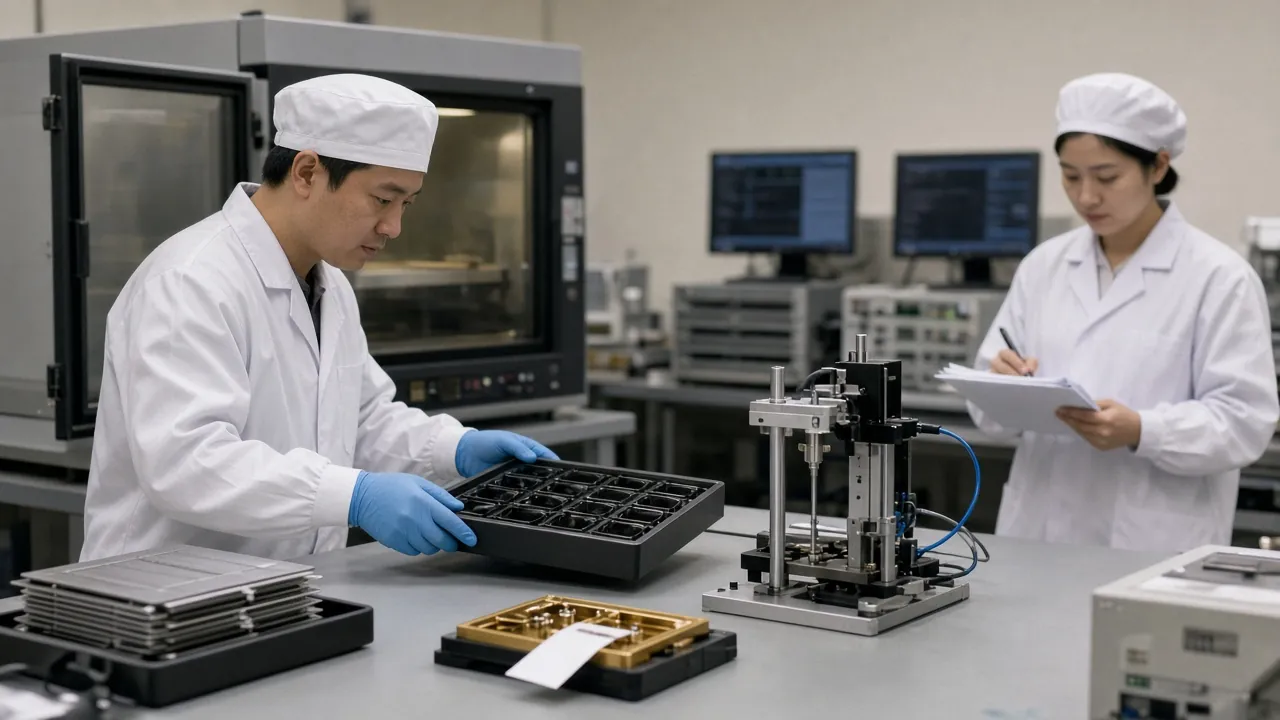
5 Pieces: Fixtureless
AOI + 3D X-ray on hidden joints + flying probe. Zero fixture spend — flying probe programs come straight from your CAD data in hours, not weeks.
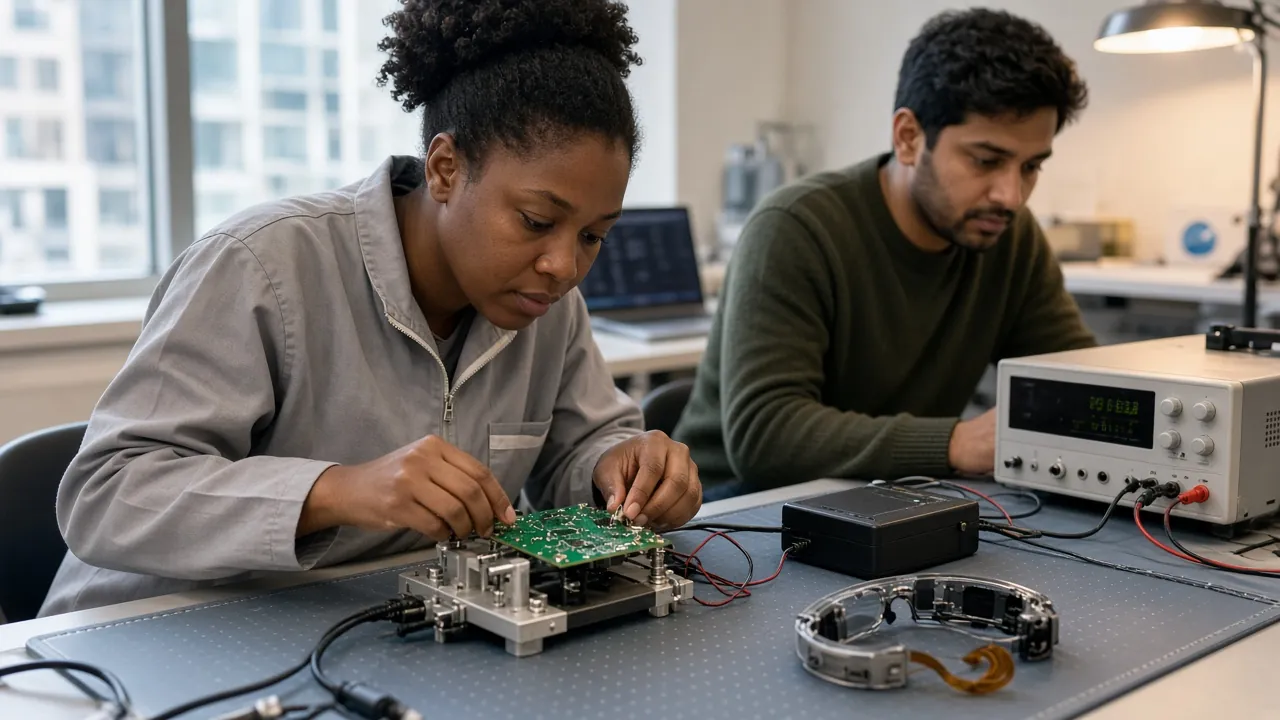
100-500: Add FCT
The pilot is where functional test earns its keep. A simple pogo-pin fixture turns a 10-minute bench checklist into a 60-second repeatable gate.
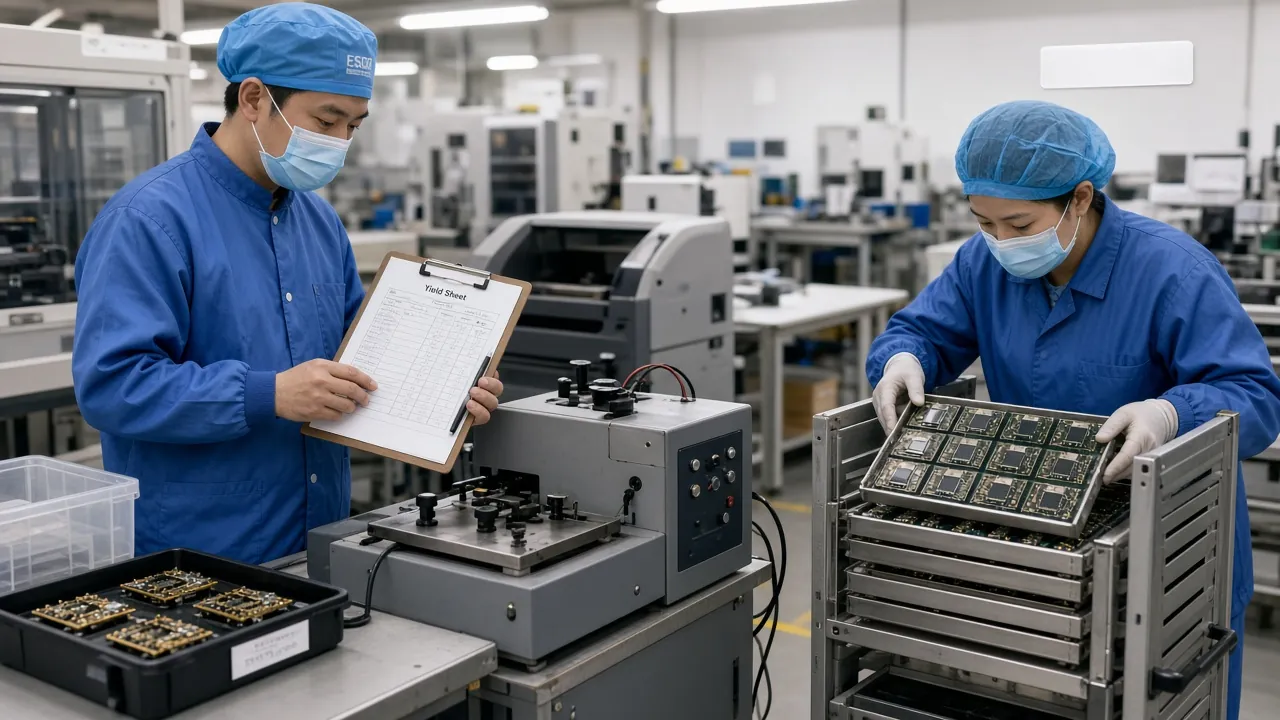
1K-5K: ICT Enters
Dedicated ICT fixture + Cpk sampling on critical nets. At this volume the fixture amortizes below flying probe per-unit cost.
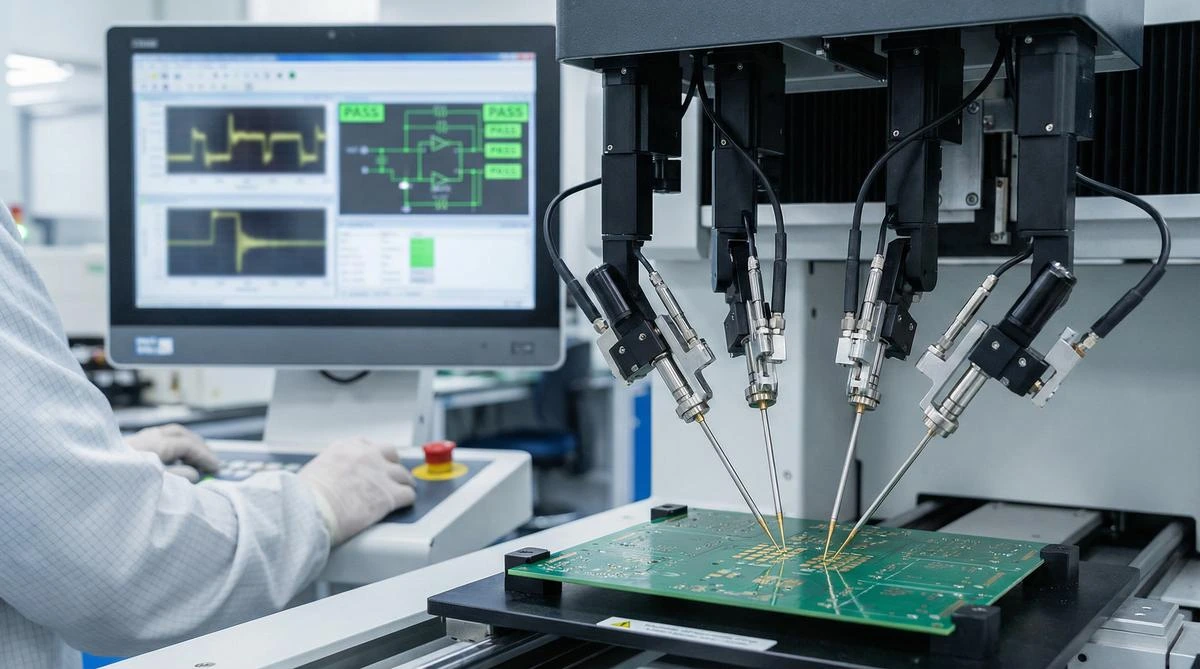
Never Skip List
X-ray on BGA and QFN at every volume, incoming inspection on allocated parts, and yield instrumentation from the very first 5 boards.
The Startup Testing Trap: Why Good Prototypes Hide Bad Batches
The failure pattern repeats across nearly every hardware startup we work with: the EVT boards work beautifully on the bench, the demo lands funding, and then the 100-unit pilot build arrives with a 2-5% functional yield — and nobody can say why. The reason is coverage arithmetic. Your five prototype boards were checked with eyes and a multimeter, which catches gross defects: missing parts, solder bridges you can see, dead ICs. What visual inspection and even AOI cannot see is everything hidden or latent:
- Hidden joints: BGA, QFN and LGA solder joints are underneath the package. AOI cameras see the perimeter, not the ball array. A voided or non-wetted BGA ball passes AOI and fails in the field in week nine.
- Latent solder defects: A cold or contaminated joint can pass a power-on check at room temperature and open up under thermal cycling, vibration, or simply months of operation. This is why 100% visual plus AOI alone systematically misses the failures that generate warranty returns.
- Wrong-value parts: A 10kΩ resistor loaded where a 10Ω belongs, a reel of parts from a diversion event, a wrong firmware build. Assembly-line errors are uncorrelated with your schematic review.
- Process drift: Reflow profiles age, stencil apertures clog, paste viscosity shifts. Pilot builds run on processes that have never been statistically characterized.
The 1-10-100 Rule, Applied to Your Runway
Quality research going back to the IBM Systems Sciences Institute puts defect cost multipliers at roughly 1x at design, 6.5-15x at test and assembly, and up to 100x after release. For a startup shipping its first 500 units, a single systematic solder defect that reaches customers means recall logistics, rework of scattered field units, and a review page you cannot delete. Spending a few hundred dollars on X-ray and flying probe at 5 pieces is not a quality nicety — it is the cheapest insurance you will ever buy against a 100x event.
The Volume-Threshold Decision Table
Here is the core answer, readable in one table. Rough cost figures are typical market ranges for a mid-complexity board (200-600 components, both sides, a BGA or two) and vary with board size and test coverage requirements.
| Batch Size | Test Methods to Pay For | Approximate Cost | What Changes and Why |
|---|---|---|---|
| 5-10 piece samples | 100% AOI + 3D X-ray on BGA/QFN + flying probe + bench functional check on every board | X-ray and flying probe often $50-150 per board as a service; no fixture cost | Every board gets everything — you are proving the process, not producing. Flying probe needs no fixture, so there is nothing to amortize. Catching one defect here pays for the whole test bill. |
| 100-500 piece pilot | 100% AOI + X-ray sampling on hidden-joint packages + flying probe or simple bed-of-nails FCT + 100% functional test with a pogo-pin fixture | Simple FCT fixture roughly $1,000-3,000; flying probe per-unit still practical | Test time becomes the constraint. Functional test moves from an engineer's bench rig to a repeatable fixture any operator can run, and you start logging yield per lot. |
| 1,000-5,000 first production wave | 100% AOI + ICT with dedicated fixture + boundary scan where applicable + X-ray sampling + full FCT rack + Cpk tracking on critical nets | ICT fixture typically $5,000-15,000; per-board test time drops to seconds | Cycle time and statistical control. ICT tests thousands of nets in seconds, and Cpk data on critical parameters tells you the process is drifting before yields fall. |
| 5,000+ steady production | All of the above, plus SPC dashboards, automated yield analytics, and audit sampling to IPC Class 3 criteria where the product must outlive its warranty | Test cost per unit typically falls under $5-10 | The test strategy is now a data system. Fixture maintenance, program version control and yield correlation between ICT and FCT become the engineering work. |
The pattern to internalize: inspection scales down cheaply, electrical test scales up cheaply. AOI and X-ray per-board costs are roughly flat with volume, so they make sense from day one. ICT is the opposite — expensive to start, nearly free per board. Flying probe and FCT fill the gap in between, and the fixture break-even math below tells you when to cross over.
Flying Probe vs ICT: The Break-Even Math
This is the decision startups get wrong most often, in both directions. The economics are a simple race between two cost curves:
- Flying probe: near-zero setup cost — the program is generated from CAD data, typically within a day. Per-unit test time is the penalty: a few minutes per board, sometimes 10 or more for dense designs. Cost scales linearly with quantity.
- ICT: a dedicated bed-of-nails fixture and program typically runs $5,000-15,000 upfront, plus test-point DFM requirements on your layout. Per-board test time is seconds, so cost per unit is minimal once the fixture exists.
Industry experience puts the flying-probe-to-ICT break-even typically somewhere between 200 and 1,000 boards for a mid-complexity design, depending on test time per board and fixture pricing. Run your own numbers with one formula: fixture cost ÷ (flying probe per-unit cost − ICT per-unit cost) = units to break even. If your first production wave is 2,000 units and flying probe costs $12 per board while ICT costs $1.50, a $9,000 fixture pays for itself around board 850 — everything after that is savings and cycle time you can bank.
When a Startup Should Never Buy an ICT Fixture
Do not buy an ICT fixture if any of these are true: your design is still iterating between DVT builds (the fixture dies with each respin); your total projected lifetime volume is under ~1,000 units; your layout has no test-point strategy and adding one would force a respin; or your board's fault spectrum is dominated by functional behaviors ICT cannot see anyway — sensor accuracy, RF performance, firmware logic. ICT finds manufacturing defects, not design weaknesses. If your pilot yield problems are design problems, ICT is expensive theater.
Functional Test on a Startup Budget: From Bench Rig to PVT Rack
FCT is the test that proves your product does its actual job — and it is the one startups consistently under-engineer, because at EVT the founder tests every board personally. That works at 5 pieces and collapses at 500. The evolution that works:
- EVT — the bench rig: A script driving your dev board's interfaces, a USB analyzer, a thermal camera if you have power circuits. Documented as a written checklist, run by an engineer. Fine at this stage; every result gets written down.
- DVT — the pogo-pin fixture: A simple fixture that mates to test points on your board and runs the same checklist automatically in under a minute. This is usually $1,000-3,000 and is the best test dollar a hardware startup spends, because it converts tribal knowledge into a gate any operator can execute.
- PVT — the rack: Multiple fixture stations, fixture self-test with a known-good reference board, and data logging per serial number. Cycle time is now a line-rate decision, and yield data is per-lot, not per-anecdote.
Two disciplines make this ramp compound instead of restart. First, the golden sample: from your first build, reserve a set of known-good units — verified across the full test suite, stored as references. Every fixture station gets calibrated against them, and every test program revision gets validated against them. Second, firmware-test correlation: your test firmware and your production firmware must share version control, and every test result must record both. When a field failure shows up in month ten, the serial-number-level test log is the difference between a targeted recall and a blind one. Our testing and inspection services include FCT fixture engineering as part of NPI precisely so this data spine exists from the first build.
What You Can Skip — and What You Never Skip
Startup budgets force triage. Some triage is safe; some is how companies die. Both lists, plainly:
Safe to Skip Early
ICT below ~500 units — flying probe covers it without the fixture. 100% X-ray on mature boards — sample per lot instead. Burn-in on consumer-grade products with short test histories. Conformal coating inspection before your product faces condensation or salt air. Skipping these at small volume is a rational budget decision, not negligence.
Never Skip, Any Volume
X-ray on BGA/QFN — the joints are invisible and the failure mode is field death. Functional test on every sealed unit — a sealed wearable that fails QA is scrap. Incoming inspection on allocated parts — 2026 allocation pressure keeps gray-market and counterfeit parts flowing; authorized channels plus date-code and X-ray package checks on risk parts. Yield logging from board one — you cannot retroactively create test data.
The counterfeit point deserves emphasis this year. Component allocation for AI-adjacent and high-reliability parts has pushed lead times out and prices up, and the independent-distribution market has grown accordingly — which raises counterfeit exposure for exactly the startups buying 50 MCUs on short notice. The rule is mechanical: buy from authorized or franchised channels wherever possible; where the open market is unavoidable, require date-code and packaging inspection, and X-ray or decap-sample the risk parts before they reach the line. One counterfeit lot inside a 500-unit pilot is a full rework cycle and a missed launch window.
Yield Tracking From Day One: The Data You Cannot Rebuild
The cheapest test infrastructure is a spreadsheet, and it should exist at 5 units. Every board gets a serial number; every test result — AOI flags, X-ray findings, flying probe results, functional pass/fail with the failing step — gets one row. This is not bureaucracy; it is the seed of every quality decision you will make for the next two years:
- Pareto by failure mode at pilot volume tells you whether your problem is paste, placement, or design — three problems with three completely different fixes.
- Lot-level yield trends across DVT builds catch process drift while it is still cheap to correct, and become the objective basis for design freeze.
- Cpk on critical parameters once you pass 1,000 units — a capability index on charge current, sensor offset or RF power tells you the process is centered before defects ship, which is the entire point of statistical control.
- IPC Class 3 criteria for products that must outlive their warranty — connected health devices, industrial sensors, anything with safety exposure. Class 3 workmanship costs more per board and buys a fundamentally different field-failure profile; decide it at NPI, not after the first return.
This data spine is also what makes the EVT-DVT-PVT gates meaningful rather than ceremonial. Our NPI rapid prototyping guide covers the phase-gate structure; yield data is what turns each gate into an actual go/no-go decision instead of a calendar event.
AOI on Every Build
Automated optical inspection on 100% of boards at every volume tier — from a 5-piece sample run to production, no exceptions, no minimums.
3D X-Ray In-House
3D X-ray inspection on BGA, QFN and hidden joints at any quantity, with per-lot reporting your team can actually read.
Flying Probe + ICT + FCT In-House
All three electrical test methods under one roof, so your test strategy scales with volume without changing vendors mid-ramp.
Fixture Engineering in NPI
Test fixture design is part of our NPI process, not an extra line item — golden samples, pogo-pin fixtures and racks engineered alongside your build.
No MOQ, Test Scales With You
No-MOQ runs mean your 5-piece build gets the same process discipline and test coverage as your 50,000-piece wave.
72-Hour DFM Feedback
Free engineering review flags testability gaps — missing test points, unreachable BGA probes — within 72 hours, before they cost a build.
Test Strategy as a Function of Volume, Not Fear
The teams that burn out their runway on quality problems are rarely the ones who tested too little on purpose — they are the ones who applied a high-volume test plan to a 50-unit build, or no plan at all. Test spend should track volume like any other engineering decision: fixtureless and 100%-coverage at 5 pieces, repeatable and operator-proof at 500, statistical and fast at 5,000. Every dollar lands where the 1-10-100 math says it does.
Get a Test Plan, Not Just a Quote
Send us your board files and batch size, and we will return a volume-matched test recommendation — AOI, X-ray, flying probe, ICT or FCT — with a free engineering review inside 72 hours. From 5-piece sample runs with no MOQ to full production waves, with US-based project management and test fixture engineering built into NPI.
Contact Illuminious for a free PCBA test strategy review and a 72-hour quick-turn quote today.