EVT is allowed to break. DVT has to prove. That one difference decides what goes into your test plan, who owns each pass or fail limit, and when you can sign a tooling PO or release PVT. Instrumental puts typical EVT builds at 100 to 1,000 units and DVT at 300 to 2,000. At those volumes a plan written on the back of a napkin turns into a yield problem. This guide gives hardware founders a test plan skeleton, the order to run it in, and the record that closes DVT.
Who this is for
Founders, CTOs and hardware engineers at seed to Series B startups building wearables, IoT, wearable AI or physical-AI products, about to plan EVT and DVT. The wording below is general guidance. Limits, sample sizes and build quantities are always agreed per product, and certification stays with the product owner.
What EVT may break and what DVT must prove
Instrumental defines EVT as the first build that combines looks-like and works-like in one form factor, made with production-intent materials and processes. Its purpose is to select the production-intent design and find every issue that needs fixing. DVT is one production-worthy configuration built from production processes and first hard tools, used to verify mass-production yield. If you are still running side configurations of 20 units at DVT, Instrumental's advice is to call it EVT2.
EVT asks: does it work?
Does the production-intent design boot, connect, charge and run its main functions? Failures are expected, and each one needs a root cause and an owner.
DVT asks: does it hold?
Does one frozen configuration pass the agreed limits across enough units, with every test station present and logging results?
EVT is cheap to fix
Layout, BOM and firmware changes are still low cost. Run the harshest tests early, while a change does not touch tooling.
DVT is expensive to fix
After hard tools are cut, a fail becomes a tool change or a rework loop. Plan the DVT tests so they confirm, not discover.
The Illuminious engineering team repeats the DFM review before DVT and again before tooling, so test findings from EVT turn into layout and BOM changes instead of rework. Read the NPI engineering guide for the stage gates as a whole, and the DFM page for how the review works.
The test plan skeleton
A good plan answers one question per test, names who writes the limit, and says what a fail triggers. The table below is a starting point. The public standards named in it are reference families, and the limits you apply are agreed in your own plan.
| Test | Question at EVT | Question at DVT | Who writes the limit | A fail triggers |
|---|---|---|---|---|
| Functional and boot | Does every block power up and talk? | Does every unit pass the same fixture at the agreed limit? | Product owner with firmware lead | Debug at EVT, ECO at DVT |
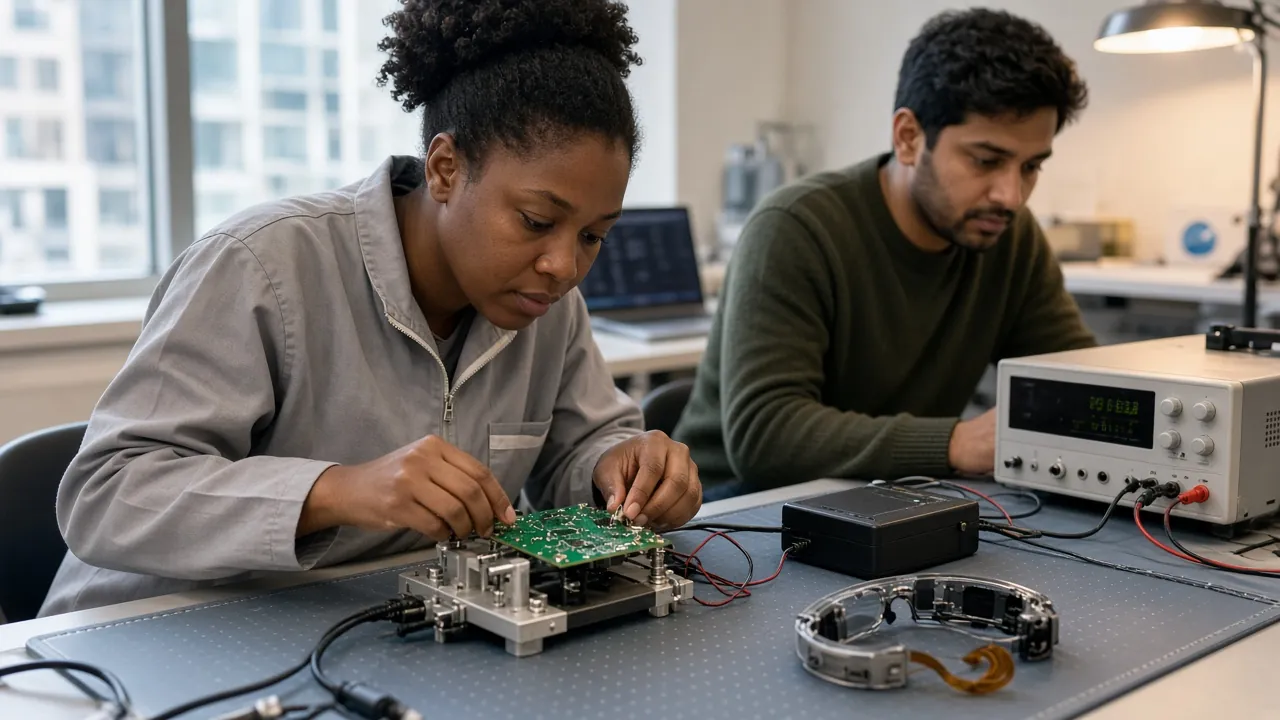
| RF and antenna pre-scan | Is the antenna tuned in the real enclosure? | Do units sit inside the pre-scan margin before the certification path? | Product owner and RF engineer | Antenna or layout change |
| Power, battery and charging | Does charging behave across the full range? | Does behavior hold across units and temperature? | Product owner, cell supplier data | Circuit or firmware change |
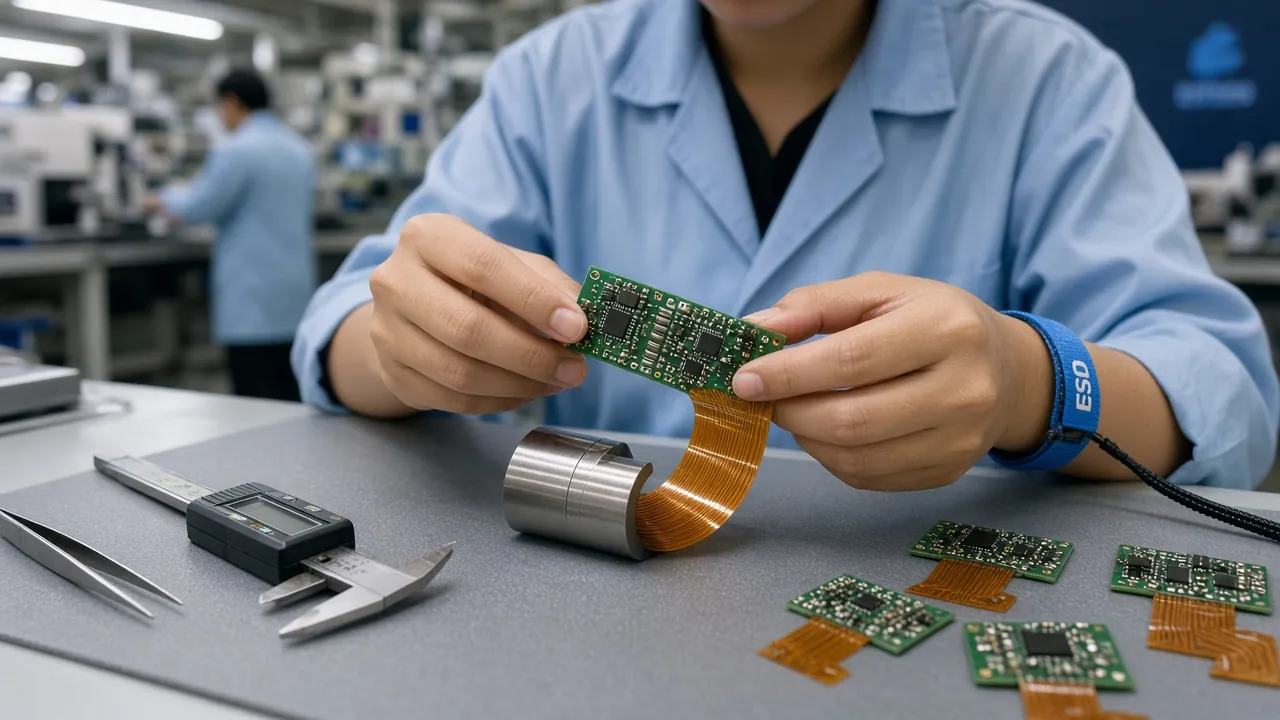
| Thermal soak and cycling | Where are the hot spots? | Does the unit stay in spec through the agreed cycles? | Product owner | Layout, material or enclosure change |
| Ingress | Does the seal design work on a few units? | Does the agreed rating hold across the sample plan? | Product owner against the target IP code | Seal or tool change |
| Drop and handling | Which weak points show up? | Do boxed units meet the agreed height and orientation plan? | Product owner | Mechanical change before tooling |
| ESD | Which ports and seams are sensitive? | Do units pass the agreed contact and air discharge levels? | Product owner and compliance lead | Protection parts or layout change |
| Vibration | Do connectors and joints survive? | Does the agreed profile pass with no new failure modes? | Product owner | Mounting or adhesive change |
| Burn-in | Is early-life failure visible at all? | Does the agreed cycle expose any infant-mortality pattern? | Product owner with factory | Screening change or part swap |
Three public references help you word the limits. IEC 60529 defines the IP code, where the first digit covers solid particles and the second covers water. IEC 61000-4-2 is the common reference for ESD immunity, with contact and air discharge levels. The IEC 60068 series is a family of environmental test methods that includes temperature cycling, damp heat and vibration. People also borrow MIL-STD-810 as a drop and shock reference. We name it only as a reference people borrow, not as something we certify to.
For batteries, UN 38.3 covers lithium battery transport tests and IEC 62133 covers cell and pack safety. Your certification path will reference both. Certification is owned by the product owner. The Illuminious team supports pre-scan work and builds the fixtures, and does not submit FCC, CE or UL on your behalf.
Sample sizes and build quantities
A handful of golden units is not a statistic. Five units that pass a drop test tell you the design can survive a drop, not that your yield will. Agree the DVT quantity and the per-test sample plan in writing before the build, and keep every unit traceable by serial number.
- Destructive tests: reserve a share of the build for them, and decide in advance which tests share units and which need fresh ones.
- Reliability units: keep them separate from the units that will serve as the reference, so no reference unit is stressed.
- Serial numbers: tie each unit to its design revision, BOM, firmware release and every test result.
- Agreed sample plan: write the numbers into the plan with the factory, rather than copying them from another product.
Fixtures and data that travel into PVT
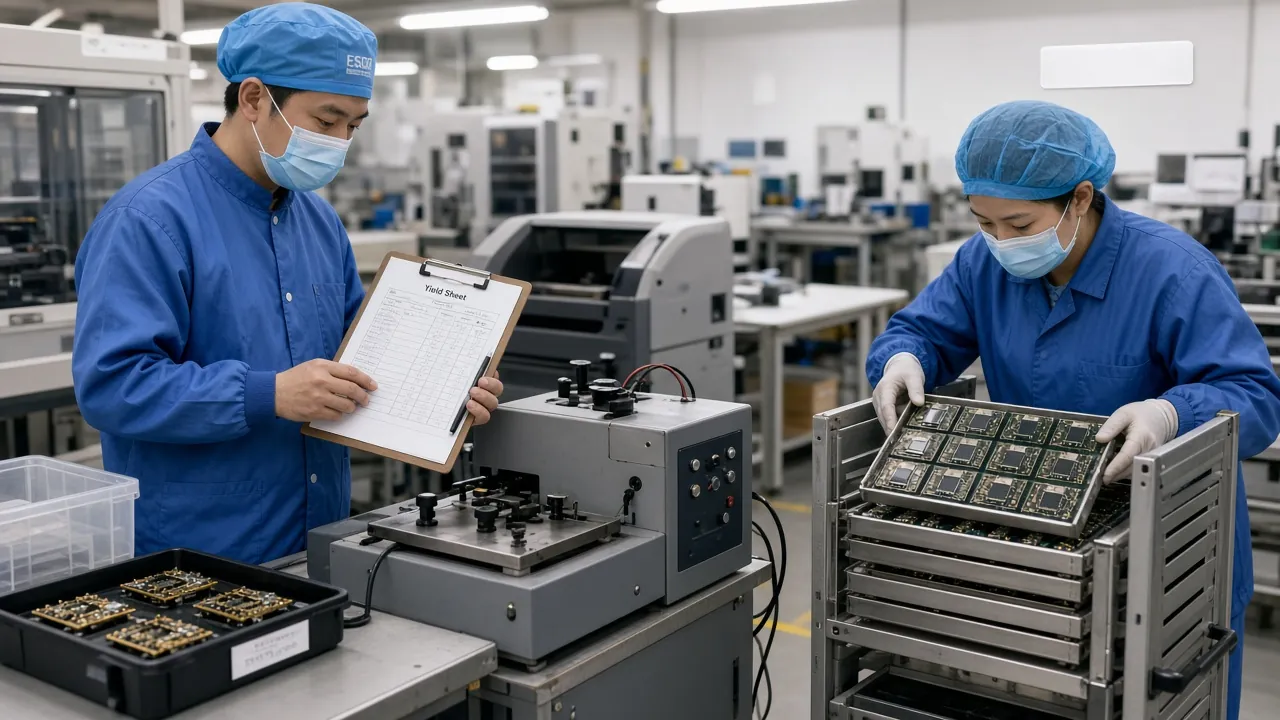
Instrumental requires that functional test stations are present and collecting data at EVT, and present with limits in place at DVT so you see true yield. Build the fixture early. A pogo-pin fixture running production test firmware lets the same boot, RF, power and sensor checks run on every unit, and the results stay in a per-serial record.
EVT: fixture v1
Prove the pogo-pin contact points and the first set of checks. Log every result, even when a limit is still loose.
DVT: limits in place
Tighten limits from EVT data and agree them in writing, so the DVT yield is a real number.
Serial data
Store firmware release and test results per serial, so a field failure traces to a station, a date and a build.
Into PVT
The same fixtures and limits carry into the PVT line. Production units ship with debug ports locked.
The Shenzhen factory runs 30+ ICT and FCT test stations, every assembled board gets AOI, and X-ray covers BGA and QFN packages. Burn-in and accelerated-aging cycles up to 168 hours are offered. For test methods such as ICT, flying probe and AOI, read the PCBA testing guide, and see testing and inspection. For the firmware side of each build, read the firmware bring-up guide from EVT to PVT and the firmware engineering page.
From a DVT fail to a decision
Every fail ends in one of three outcomes: an ECO that changes the design, a layout or BOM revision, or a limit change that is argued and signed. A limit change needs a reason in the record, not a quiet edit at one station. Run the failure analysis on the unit, write the root cause, and check whether the fix touches tooling, firmware or the certification path.
- ECO: names affected parts and revisions, the reason, and the cut-in point by serial number.
- Layout or BOM rev: repeat the DFM review before the next build, and again before tooling.
- Limit change: only with data, a named owner and a signature from the product owner.
- Re-test: run the failed test again on the new revision, plus any test the change could affect.
Boards built through PCB assembly and SMT assembly that fail should be sorted by defect type. Solder and placement defects point to process. Repeated functional failures across units point to design or a part lot. Early units from rapid prototyping help you find these before the DVT quantity is committed.
The DVT exit: what gets signed
DVT is done when one configuration passes the agreed plan and the record exists. The golden-sample sign-off lists the design revision, the BOM, the firmware release and the measured values. After that, the design is frozen, and any later change goes through change control.
Design revision
Matches the released files and the ECO log.
BOM
Lists approved parts and alternates only.
Firmware release
A signed image, with test and shipping builds clearly separated.
Measured values
Recorded against the agreed limits for the reference unit.
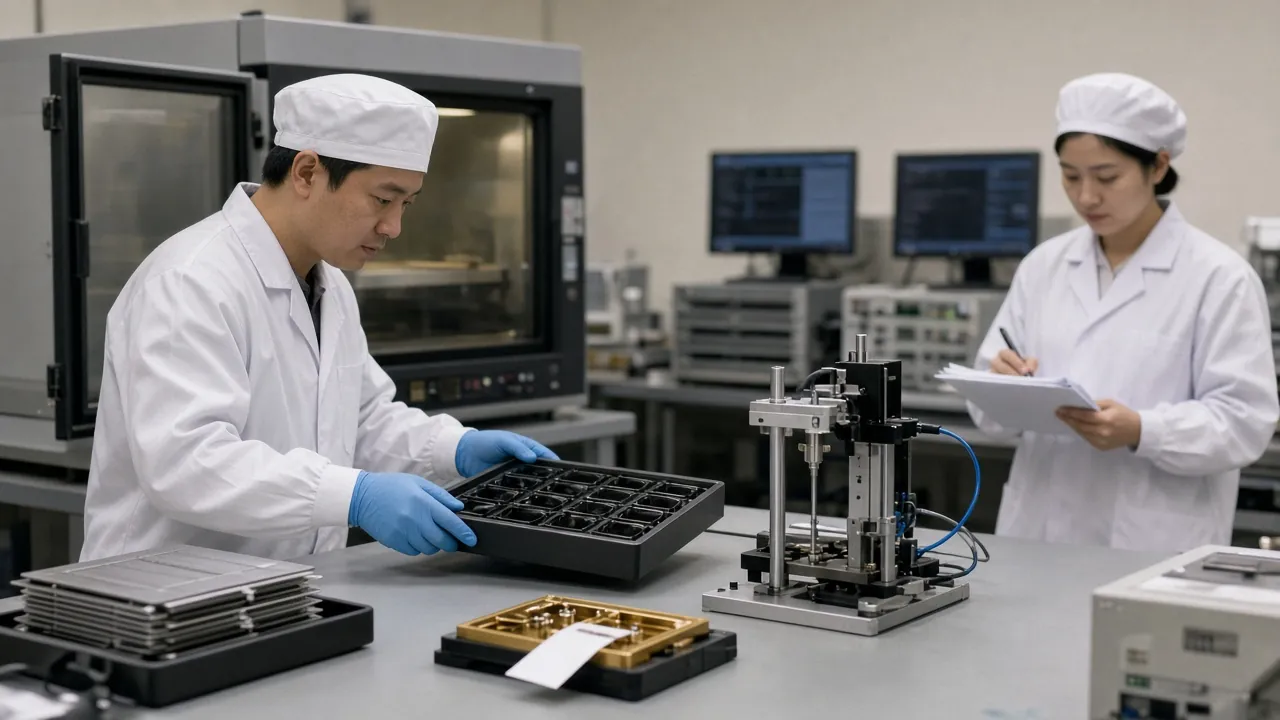
Production molds are cut after DVT closes the design. That is why the plan front-loads the tests that could change a tool: drop, ingress, thermal and ESD. Once the record is signed, it becomes the handover into PVT and tooling. See NPI transfer for how that handover works, and read From PVT to the first mass-production lot for what happens next.
Shenzhen Founder Tour
Want to see a reliability lab and a golden-sample bench in person? The Shenzhen Founder Tour runs Dec 6–11, 2026, for up to 20 founders. It is a Future Factory program. Illuminious hosts the factory stop and handles applications and payments. Apply at /startups.
A DVT readiness checklist
- Plan: every test has a question, an owner for the limit and a defined fail action.
- Quantity: DVT build size and per-test samples agreed in writing.
- Fixtures: stations present, limits in place, results stored per serial.
- Configuration: one frozen design for each shipping SKU, no side builds.
- Record: golden-sample sign-off drafted with revision, BOM, firmware and measured values.
Engineered in San Francisco, and built in our own factory in Shenzhen, the Illuminious flow keeps the plan, the DFM repeats and the records in one project. US-based project managers coordinate each build, our engineers attend EVT, DVT and PVT in Shenzhen, and NDA comes before the first call. Design files and IP are assigned to the customer. The Shenzhen factory holds ISO 9001, ISO 13485, IATF 16949, AS9100 and ISO 14001.
Ready to write your EVT and DVT test plan?
Walk through your test list, limits, sample plan and sign-off record with the Illuminious engineering team. For a real project example, see the AI projector prototype-to-production case study.
Talk to an engineer — Instant price for configurable services · Free engineering review in 1–2 business days · Official quote within 24 hours