SMT assembly, step by step
No CAD yet? Our design team can take it from a sketch or a spec.
Walk Shenzhen factories with us, Dec 6–11. See the tour
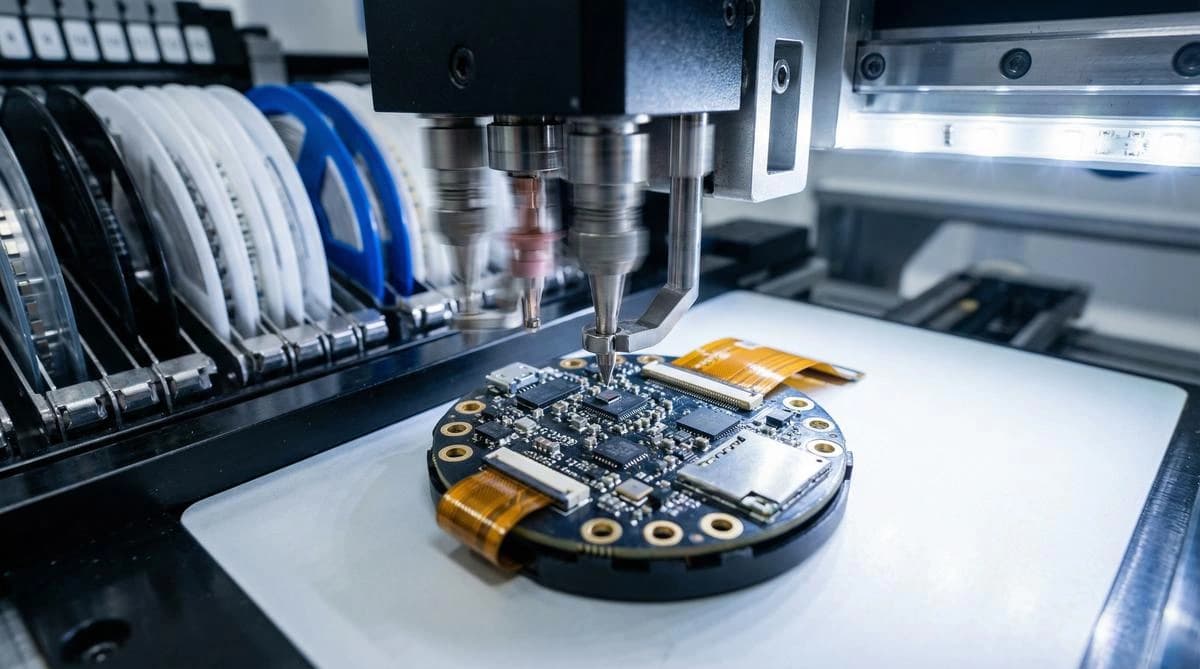
SMT assembly has four steps, and a defect can start in any of them. Solder paste is printed through a stencil onto the pads. Parts are placed into the wet paste. The board passes through a reflow oven whose profile melts the paste and forms the joints. Illuminious is a U.S. NPI engineering company, and our engineers check the pads, the stencil and the paste before a part is placed, because that is where surface-mount defects start. Engineered in San Francisco. Prototype builds, DFM and mass production in our own factory in Shenzhen. Then the result is inspected and tested.
Surface-mount is the default assembly technology on a modern board, because its packages are smaller, cheaper and available in shapes leaded packages cannot take. In the portal, surface-mount assembly is declared on the board order, not bought separately, and the stencil that prints the paste can be added to the same order. Boards with connectors or heavy parts add a through-hole step after reflow.
Why does the stencil matter more than the placement machine?
Because a paste defect becomes a joint defect. Too little paste starves the joint; too much bridges neighboring pads; paste in the wrong place lets a part tombstone as its two ends wet at different times. The stencil apertures decide how much paste lands on each pad, and they are the one part of the process made only for your board.
Foil thickness is declared per stencil, from 0.08 to 0.18 mm in the configurator, or left to an engineer to select from your aperture set. A board that mixes fine-pitch parts with large thermal pads is exactly the case where one thickness is wrong. Declare a step stencil there, with thinner foil for the fine pitch and thicker foil where the pads need more paste.
What our engineers check before an SMT build
- Apertures against pads. Aperture size and shape for each package, with reductions under thermal pads to stop parts floating.
- Paste for mixed pitch. Whether one foil thickness suits every part, or a step stencil is needed.
- Fiducials and panel. Global and local fiducials where the vision system needs them, and a panel that sits flat on the line.
- Spacing. Room between parts for the nozzle, for optical inspection and for rework.
- Via-in-pad and BGA. Filled and plated vias under BGAs, so paste does not drain away from the joint.
- Polarity. Marks on the silkscreen, the BOM and the placement file that agree.
On an engineering project these choices are made during layout, as part of our DFM services, so the demo build is already assembled the way production will be.
SMT capability in the Shenzhen factory
CapabilityWhat it covers
- Lines
- 8 automated SMT lines, with Fuji, Panasonic and Siemens equipment. A high-speed line places 150,000 components per hour.
- Smallest parts
- The 01005 package (0.4 mm × 0.2 mm).
- Fine pitch
- BGA pitch down to 0.25 mm, with placement accuracy of ±25 µm.
- Packages
- Fine-pitch BGAs, package-on-package, wafer-level chip-scale packages, and QFN and DFN parts.
- Paste and print
- Laser-cut stainless stencils, with paste deposits inspected after printing.
- Inspection
- Automated optical inspection after reflow. On the advanced route, X-ray for joints under bottom-terminated packages.
- Board types
- Single- and double-sided rigid boards, flexible circuits on carriers, rigid-flex boards and metal-core boards.
- Protection
- Conformal coating and potting where the product sees moisture, dust or vibration.
- Marking
- Board marking declared on the order: an order number at our position or yours, or a 2D data-matrix code.
Demo builds and small runs go through NPI lines set up for short jobs and short changeovers. Production runs go to lines set up for volume. Both use the same paste, profiles and inspection rules. The SMT program, the stencil and the reflow profile from the demo build carry into production, so a board that passed as a demo build behaves the same way in volume.
What should I declare for a first SMT build?
The placement count, the number of unique parts, the sides populated, who supplies the parts, and the inspection and test you need. Add the stencil to the same order. If you are unsure about any of them, declare a careful guess: the free engineering review checks each against your files before you pay.
Accurate declarations keep the price stable. A placement count that is half the real number gives a price that has to move after review. A missing stencil delays the build while one is made. A board full of BGAs ordered on the standard route has no X-ray level to declare, so order it on the advanced route. Each is easy to fix before the order is accepted, and costly after.
How an SMT board is assembled
DFM and materials
The free engineering review checks pads, apertures and parts. Moisture-sensitive parts are baked when their floor life has run out.
Paste printing
Paste is printed through the stencil onto every pad.
Paste inspection
Each deposit is measured for volume, height and position before any part goes on it.
Placement
Vision-guided machines place every part, from the smallest passives to large BGAs.
Pre-reflow check
Placement and polarity are confirmed on each run, so an error is corrected before it is soldered.
Reflow
The board passes through an oven profiled for its mass and its most sensitive parts.
Optical inspection
AOI checks presence, polarity, offset and the visible joints. The first board of each run is checked against the BOM.
X-ray (advanced route)
Joints under BGAs, QFNs and other leadless packages are checked where the order declares it.
Test and programming
Electrical test, firmware loading and functional test, as declared.
What does reflow profiling actually control?
The rate at which the board heats, how long it soaks below melting while the flux works, how far above melting it goes, and how long it stays there. Get the soak wrong and the flux is spent too early or still outgassing during melt. Too hot damages parts; too cool leaves joints that never fully wet.
The profile is set per board. A large aluminum-core board and a small two-layer FR-4 board absorb heat completely differently. Board construction and assembly are priced on one record here for that reason: the property that makes a board good at cooling parts in service makes it harder to solder, and the assembly plan needs to know which board it is soldering.
How is a surface-mount board inspected?
Automated optical inspection compares the populated board with what it should look like: presence, polarity, offset and the visible part of each joint. It runs inline. It cannot see under a part, so joints under BGAs, QFNs and other bottom-terminated packages need X-ray, which is a declared level on the advanced route.
The advanced route offers standard AOI, AOI with X-ray, or an advanced report with X-ray. The right depth follows from what is on your board, not from a default. When a board carries three BGAs, optical inspection alone is a decision not to look at the joints that are hardest to solder.
Which SMT defects should I expect, and how are they fixed?
Five account for the rework: bridges, starved joints, tombstoned passives, voids under thermal pads and head-in-pillow joints under BGAs. Each traces to a cause: aperture size, foil thickness, pad design, profile or part moisture. The fix belongs at the cause, which is why the stencil and the pads are reviewed before the first board.
When a defect appears in production, an engineer reviews it before the next batch runs, and the change is made in the process, not by rework alone. For causes and fixes in detail, read the SMT soldering defects guide.
The four steps, and what each one declares
A summary across the stencil, standard and advanced board routes; each row names where its setting lives.
| Step | What it does | Declared with the order |
|---|---|---|
| Paste printing | Deposits paste through a laser-cut stencil onto the pads | Stencil route: foil 0.08 to 0.18 mm or engineer selected; step regions; nano coating; aperture side |
| Placement | Positions parts into the wet paste | Standard route: placements 0 to 5,000, unique part numbers 0 to 1,000, sides; advanced route: placements up to 10,000 |
| Reflow | Melts the paste and forms every joint at once | Board construction, material and thickness, which set the profile |
| Inspection and test | Confirms the board was built as drawn, then that it works | Standard route: AOI, electrical or flying-probe test, programming, functional test; advanced route: AOI with X-ray levels |
| Parts | Where the parts come from | Standard route: Illuminious sources, customer consigned, or mixed |
| Marking and packing | How the board is identified and protected | Standard route: order number or 2D data-matrix marking; humidity indicator card |
| Free engineering review | Checks the files before payment | Within 24 hours on business days after you submit |
Quality on the SMT lines
The Shenzhen factory holds ISO 9001, ISO 13485, IATF 16949, AS9100 and ISO 14001. Assemblies are judged to IPC-A-610, with Class 3 acceptance when the order states it. In production, each batch is compared with the golden sample you signed, and finished boards ship in anti-static packing.
Recent work: pendant boards for an investor demo
An AI hardware startup building a pendant device needed working board samples for an investor demo sooner than its first suppliers could offer. Our engineers ran the DFM review alongside parts planning from stock already on hand, and the factory assembled and tested the samples on its NPI lines in Shenzhen. Read the case study
Order SMT assembly online
Declare assembly on Standard PCB & PCBA, which returns a live supplier price when suppliers can price the build. BGA, QFN and fine-pitch assembly on the standard route, and every assembly on Advanced PCB & PCBA for HDI, rigid-flex and boards with up to 10,000 placements, go to a specialist, who prices it within 24 hours on business days. Add an SMT stencil to the same order. For the whole assembly service, see PCB assembly.
Facts and questions
Do I need a stencil for every surface-mount build?
Yes, because the stencil is what puts paste on the pads. Add it to the same board order as a declared option. That keeps the paste-layer source under the same revision history as the fabrication data, so the stencil always matches the board revision it prints.
What is a step stencil, and when do I need one?
A stencil with areas of different foil thickness, so fine-pitch parts get less paste and large thermal pads get more. Declare one when a single thickness would starve one part of the board while flooding another. Step regions are a declared option on the stencil order, confirmed in the aperture review.
Can you place parts on both sides of the board?
Yes. Sides populated is a declared option on the standard route: top side only, or both sides. A double-sided board goes through printing, placement and reflow twice, with the heavier parts on the second side where the design allows, so it is declared on the order rather than guessed from the placement file.
How many placements can a board have?
On the standard route, 0 to 5,000 placements per board and 0 to 1,000 unique part numbers. The advanced route accepts up to 10,000 placements per board. Both figures are declared in the configurator and checked against your centroid file in the free engineering review before payment.
How are moisture-sensitive parts handled on the SMT line?
They stay sealed until the line needs them. Exposure time is tracked once a pack is opened, and parts are baked before placement when their floor life runs out. That keeps moisture from expanding during reflow, which is what cracks packages and lifts BGA joints.
Do you check placement before reflow?
Yes. A pre-reflow check runs on each run and confirms placement and polarity while the parts still sit in wet paste. An error found there is corrected by moving a part, not by desoldering one. After reflow, AOI checks the joints, and the first board of the run is compared with the BOM.
Which equipment do the SMT lines use?
The 8 automated SMT lines run Fuji, Panasonic and Siemens equipment, with laser-cut stainless stencils, inline paste inspection and automated optical inspection after reflow. One high-speed line places 150,000 components per hour, and the NPI lines are set up for short jobs and short changeovers.
How your official quote is prepared
On the standard route the portal shows a live supplier price where suppliers can price the build. A specialist prices fine-pitch and advanced-route assembly, and every stencil, within 24 hours on business days. An engineer reviews every order before payment, and the official quote is the amount you pay.
- An engineer runs a free engineering review of your files, and nothing is charged when you submit.
- You see the findings first.
- We publish the official quote with an itemized total, lead time and validity window.
- You accept the official quote, and only then does payment open.