
Automotive
Automotive Electronics Supplier
AutomotiveQualitySupply Chain
Automotive
DriveTech Motors, an EV startup developing next-generation electronic control units (ECUs), faced critical prototyping delays that threatened their ve...
Upload Your Files for a Quotation
Gerber, BOM, CAD, PDF — drag & drop or click

DriveTech Motors, an EV startup developing next-generation electronic control units (ECUs), faced critical prototyping delays that threatened their vehicle testing schedule. Traditional ECU prototyping took 14-16 weeks, blocking their path to production. Strict automotive standards (AEC-Q100, ISO 26262) limited supplier options, while thermal management and EMI compliance required multiple design iterations. With limited budget for dedicated automotive manufacturing partners, they needed a solution that would accelerate development without compromising safety or quality.
Illuminious deployed our Automotive-Certified NPI Process specifically designed for ECU development: AEC-Q100 compliant manufacturing with Grade 1 (-40°C to +125°C) validation, dedicated thermal simulation and testing lab support to identify thermal issues before prototyping, parallel prototyping tracks enabling 3 design variants simultaneously, and automated DFM analysis optimized for automotive-grade PCB requirements including high-reliability solder joints and conformal coating.
The Challenge: DriveTech Motors, an innovative automotive startup developing electronic control units (ECUs) for electric vehicles, faced a critical timeline crisis. Traditional ECU prototyping cycles of 14-16 weeks were blocking their vehicle testing schedule and threatening their product launch timeline. The stringent requirements of automotive-grade electronics—including AEC-Q100 qualification and ISO 26262 functional safety standards—severely limited their manufacturing partner options. Multiple design iterations were required to address thermal management challenges and achieve EMI compliance, while their startup budget couldn't accommodate the premium costs of dedicated automotive manufacturing partners.
Illuminious provided DriveTech Motors with our Automotive-Certified NPI Process, a comprehensive rapid prototyping solution specifically engineered for automotive electronics development:
Reduced from 16 weeks industry standard—60% faster ECU development cycle.
Significantly exceeded 78% automotive industry average through optimized DFM.
Saved in mold and tooling costs through DFM optimization and parallel track efficiency.
Defects in first 10,000 units deployed, demonstrating AEC-Q100 quality compliance.
Our automotive engineering team conducted comprehensive CFD thermal analysis on DriveTech's initial ECU design, identifying 3 critical hotspots that would have caused thermal throttling under peak load. Simultaneously, we performed AEC-Q100 component qualification review and identified alternative components with better thermal characteristics and automotive-grade reliability ratings. Thermal simulation reduced physical prototype iterations from an estimated 5 to 2.
Launched three parallel prototyping tracks with different thermal management approaches: passive cooling with optimized PCB layout, active cooling with integrated fan controller, and hybrid approach with thermal vias and heat spreader. Each track progressed through PCB fabrication, SMT assembly, and initial functional testing simultaneously. Parallel execution compressed 12 weeks of sequential prototyping into 3 weeks.
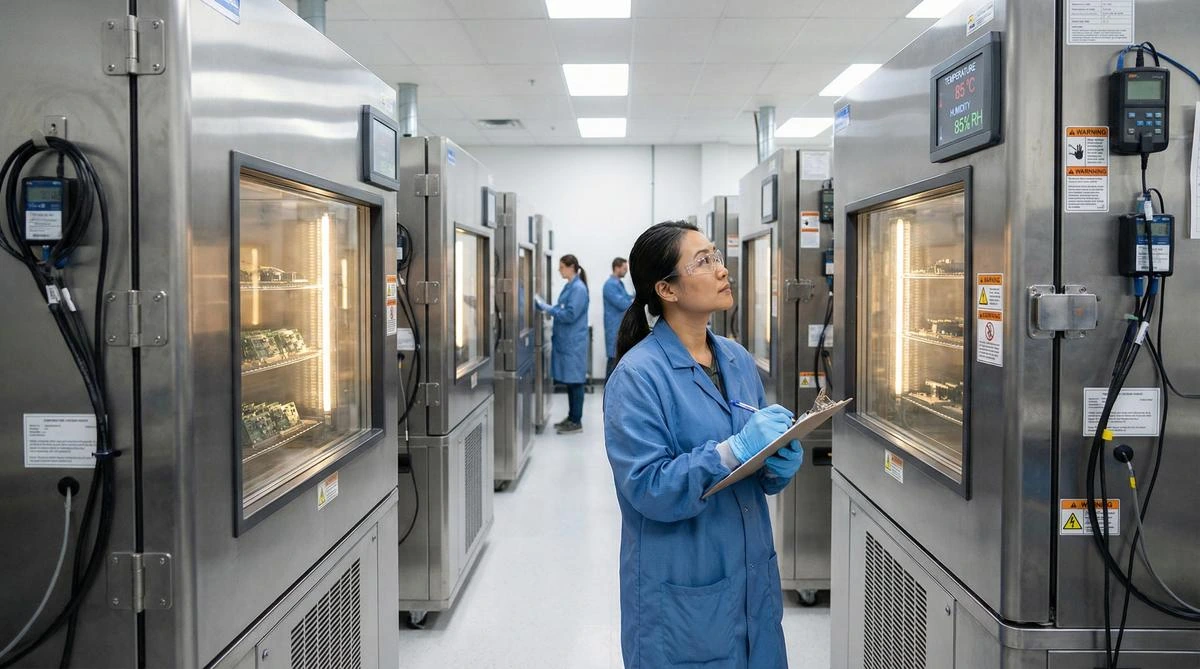
The selected hybrid thermal design underwent comprehensive AEC-Q100 Grade 1 qualification testing including temperature cycling (-40°C to +125°C), high-temperature operating life (HTOL), and electrostatic discharge (ESD) testing. In-house EMI pre-compliance testing identified and resolved two radiated emissions issues before formal certification. AEC-Q100 compliance achieved on first submission.
With validated prototypes, production tooling was finalized and the first production batch of 1,000 units was manufactured. Comprehensive functional testing and burn-in screening ensured each unit met automotive reliability standards. DriveTech received production-quality ECUs ready for vehicle integration testing. First 10,000 field-deployed units achieved zero failure rate.
High-power MCU and motor drivers generated significant heat in compact ECU enclosure. Solution: Optimized thermal vias, copper pour areas, and strategic component placement reduced operating temperature by 18°C under peak load.
Switching power supplies and high-speed communication created electromagnetic interference risks. Solution: Shielded enclosure design, ferrite filtering, and careful PCB layer stackup achieved CISPR 25 Class 5 compliance.
Harsh automotive environment demanded extreme temperature and vibration tolerance. Solution: AEC-Q100 Grade 1 component selection, conformal coating, and vibration-resistant mounting achieved automotive-grade durability.
ISO 26262 ASIL-B requirements for safety-critical ECU functions. Solution: Redundant monitoring circuits, watchdog timers, and comprehensive fault detection mechanisms implemented.
Three-track development: Simultaneous exploration of multiple design approaches enabled data-driven optimization and reduced overall timeline by 67%.
Virtual prototyping: CFD analysis identified thermal issues before physical builds, eliminating 3-4 hardware iterations and saving 6+ weeks.
Automotive-grade quality: Deep understanding of automotive qualification requirements ensured first-pass compliance without costly redesigns.
Manufacturing optimization: Specialized DFM analysis for automotive requirements improved first-pass yield from 78% industry average to 94%.
In-house capabilities: Thermal, EMI, and reliability testing conducted internally eliminated external lab delays and coordination overhead.
"Illuminious' automotive expertise accelerated our ECU development significantly. Their parallel prototyping approach and thermal management insights were game-changers for our EV platform launch. The 60% reduction in prototyping time allowed us to hit critical vehicle testing milestones that would have been impossible with traditional manufacturing partners. Their AEC-Q100 knowledge ensured we achieved automotive-grade quality without the typical learning curve. The $120K in tooling savings was crucial for our startup budget, and the zero field failure rate in our first 10,000 units proves the quality is real. They've become an integral part of our supply chain."
The global automotive ECU market is experiencing unprecedented growth, projected to exceed $99.84 billion by 2026 with a CAGR of 6.2%. This growth is driven by:
In this competitive landscape, prototyping speed is a critical competitive advantage. The traditional 14-16 week ECU development cycle can make the difference between leading and following in the rapidly evolving automotive market.
Beyond the immediate prototyping success, this engagement established DriveTech Motors for sustained growth:
This engagement demonstrates Illuminious' deep expertise in automotive electronics manufacturing. Our Automotive-Certified NPI Process combines AEC-Q100 compliance, parallel prototyping capabilities, and integrated testing to deliver automotive-grade ECUs in a fraction of traditional timelines. Whether you're developing EV power electronics, ADAS controllers, or body control modules, we provide the expertise and execution to accelerate your path to market.
Ready to accelerate your automotive electronics development? Let's discuss how our Automotive-Certified NPI Process can reduce your prototyping timeline and achieve automotive-grade quality from day one.
"Illuminious' automotive expertise accelerated our ECU development significantly. Their parallel prototyping approach and thermal management insights were game-changers for our EV platform launch."
Let's discuss how we can help your project succeed with our end-to-end manufacturing capabilities.
Start Your Project