Component sourcing decides your build date more often than your schematic does. Once the BOM is frozen, hardware founders hit the same three questions: should I buy the parts myself or let the factory buy them, why am I paying for thousands of resistors to build a handful of boards, and how do I know the chips are real? This guide answers each one for seed to Series B teams, with the Q4 2026 lead-time picture you need for 2027 planning. Our engineers read every BOM line for part numbers, alternates and lifecycle risk before a build, and that habit shapes the advice below.
The short answer
Let the factory source the long tail of passives and common parts, consign only the lines where you hold better stock or allocation, and lock long-lead ICs before EVT. Buy from authorized distributors or the original manufacturer first. Treat any broker part as suspect until it passes traceability review, X-ray and electrical checks. Plan overage into every small build, because feeders waste parts on every setup.
Full sourcing vs kitted vs consigned PCBA
Electronic component procurement for a board build follows one of three models, and the labels vary by factory. When founders compare consigned vs kitted PCB assembly, they are really choosing who carries the availability risk. Full sourcing means the assembler buys every part on your BOM. Consigned means you buy everything and ship a complete kit. Kitted or partial sourcing, which we call the mixed model, means you ship the lines you control and the factory buys the rest. On an Illuminious board order, parts supply is a declared field with exactly these settings: Illuminious sources parts, customer consigned, or mixed.
| Model | Cost | Control | Main risk | Usually fits |
|---|---|---|---|---|
| Full sourcing | Parts plus a procurement margin; no kitting labor on your side | You set the alternates rule; the factory buys | Paying for distributor minimums on low-volume lines | Seed and Series A teams with long BOMs and no procurement hire |
| Kitted or mixed | You pay for the lines you buy; the factory prices the rest | You keep the hero chip, sensor or allocated memory | Two partial kits that do not match on build day | Teams holding allocation on one or two constrained ICs |
| Consigned | Lowest visible line price, highest hidden labor | Full control of every part and lot | One missing reel stops the line, and the shortage is yours | Pre-seed teams with parts already on the shelf, or a part unique to you |
Consigning moves both the availability risk and the kitting work onto your team. A shortage in your kit stops the line as surely as a shortage in the factory's. For a pre-seed founder building ten demo boards from parts already in a drawer, that trade is fine. For a seed-stage team with 180 unique part numbers and a DVT date, it usually is not, because managing those parts becomes a job in itself.
Pre-seed
Consign what you already hold for the first demo build. Spend your time on firmware bring-up, not on chasing reels.
Seed
Move to full sourcing or mixed at EVT. Keep only the hero IC or sensor you have allocation on.
Series A
Full sourcing with an approved vendor list, lot traceability and buffer stock on your two or three long-lead lines.
Regulated products
Medical and automotive builds need documentation and traceability settled before the build, whichever model you choose.
BOM hygiene: what has to be true before anyone buys
A factory cannot source what it has to guess. "10k resistor 0402" describes a family of parts, so someone must interpret your intent. Good BOM management for hardware startups starts with turning descriptions into exact manufacturer part numbers.
- MPN on every line: manufacturer and full part number, including packaging suffix, plus reference designators and quantity per board.
- Approved alternates: an AVL with at least one form-fit-function alternate for every passive and every IC that has a pin-compatible second source.
- Lifecycle status: flag every line marked NRND, last-time-buy or obsolete before layout is locked, not after DVT.
- Long-lead flag at EVT: mark any line with a factory lead time beyond 16 weeks and decide now whether to buy ahead.
- Notes where the maker matters: a crystal, an RF part or a battery protection IC may have no acceptable alternate. Say so on the line.
- An alternates rule you chose on purpose: decide how strict substitution should be before the first purchase order goes out.
That last point is where most surprises start. At Illuminious the alternates policy is a declared field with three settings: no alternates without approval, form and fit alternates with approval, or an engineer may propose alternates. Under every setting, a proposed alternate reaches you as an itemized change you approve, question or decline. "No alternates without approval" fits a regulated product or a design under change control. "Engineer may propose" fits a prototype where speed matters more than an exact part. Our BOM strategy guide for AI hardware covers how to design for availability upstream, and the complete DFM guide for hardware startups shows where the BOM check sits in each DFM pass.
Small-run economics: cut tape vs reels vs trays
This is the question founders ask most: why does a build of 10 boards need hundreds of 0402 capacitors? The answer is packaging and attrition.
Cut tape
A strip cut from a full reel. Distributors sell it in small quantities, which suits prototypes. Feeders need a leader of blank tape, so short strips waste parts at load.
Full reels
A passive reel often holds thousands of parts and can cost less than a few cut strips. Machines load them fastest, and the leftovers become stock for the next build.
Trays and tubes
Common for QFPs, BGAs and larger ICs. Trays protect leads and suit low counts of expensive parts placed on a tray feeder.
Loose parts
Bulk or loose small parts often cannot be machine-placed at all. Many assemblers refuse loose 0402 and smaller parts.
Attrition is the second cost. Every feeder setup loses parts, and the smallest packages lose the most. Published kitting guides from U.S. assemblers show how large the overage gets:
| Package | Typical overage asked for in published kitting guides |
|---|---|
| 01005 and 0201 passives | 50% to 100% extra, with minimums of 100 to 150 extra pieces |
| 0402 passives | 25% to 50% extra, with minimums of 50 to 150 extra pieces |
| 0603 passives | 15% to 20% extra, with minimums of 30 to 75 extra pieces |
| 0805 and larger passives | About 10% extra |
| BGAs and costly ICs | About 1% to 5% extra, or a few pieces, often hand-managed |
The ranges come from the public kitting requirements of PCB Fab Express, PCB Prime and Bay Area Circuits; your assembler's numbers will differ. The lesson holds anyway: a small prototype build still needs a sourcing plan. If you consign exact counts, a dropped part mid-run turns into a no-pop or a rework. If the factory sources, you pay for distributor minimums on lines you barely use. The fix is to buy reels for cheap passives that recur across EVT, DVT and PVT, buy cut tape for single-build parts, and mark expensive ICs so the line handles them by hand.
Authenticity and incoming inspection
Counterfeit risk is not limited to obsolete parts. ERAI's 2025 annual report logged 748 suspect counterfeit and nonconforming parts, down 29.1% from 2024, and found that 36.15% of reported parts were active rather than obsolete. ERAI also notes that counterfeiters keep targeting parts that are readily available through authorized channels. Programmable logic ICs were the most reported type, at more than 15% of reports, with analog, microprocessor and memory ICs also among the largest groups: the same families found on most IoT and wearable AI boards.
Authorized distribution first. Buy from the original manufacturer or its franchised distributors. SAE AS6496 covers counterfeit mitigation for authorized distributors.
Open market only with traceability. If a part is only available from an independent distributor, ask for the chain of custody and a supplier working to SAE AS6081, the counterfeit-avoidance standard for distributors. AS5553 sets the equivalent expectations for the companies that design and build the product.
Visual, X-ray and electrical checks. Compare markings, date codes and lead finish against a known-good part, X-ray the die and bond wires, and test a sample electrically before the lot is released.
Respect moisture sensitivity. Under IPC/JEDEC J-STD-033, an MSL 3 part has a floor life of 168 hours once its dry pack is opened, at 30 °C and 60% RH or below. Past that, it must be baked before reflow or it can crack.
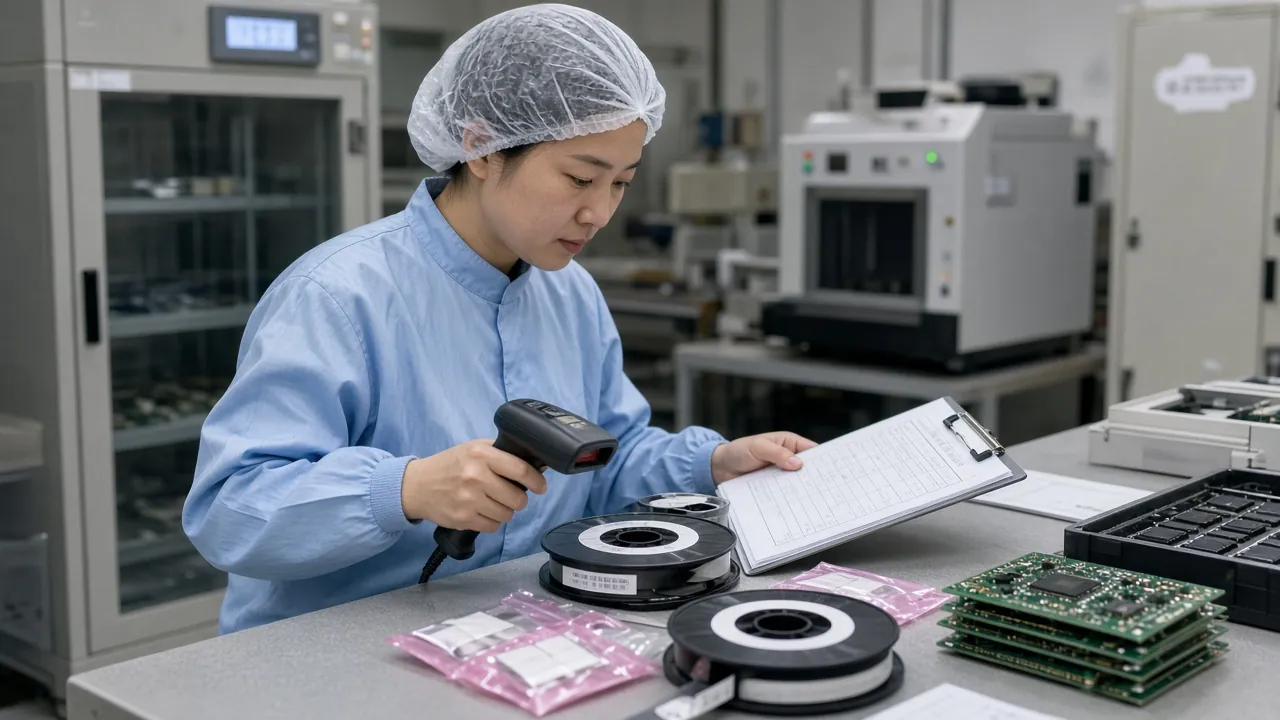
In our Shenzhen factory, parts come from authorized distributors or the original manufacturer, drawn from a network of 350+ audited suppliers, and each source is qualified before use. Parts are inspected on receipt for quantity, condition and authenticity before they enter stock. X-ray and XRF counterfeit checks are available, moisture-sensitive parts are baked when needed, and lot traceability is a declared option for products where a field failure must be traced to a batch. After placement on our 8 automated SMT lines, boards go through AOI and X-ray for BGA and QFN joints. The testing and inspection page lists each method.
Lead-time planning for 2027
Lead times in late 2026 are uneven rather than uniformly bad. Emerald Technologies' Q4 2026 supply chain update, published October 23, 2026, puts the main categories here:
Standard passives
Resistors and standard ceramic capacitors hold at 8 to 12 weeks with healthy distributor stock.
Legacy-node MCUs
Standard microcontrollers have stabilized at 14 to 18 weeks.
High-performance MCUs and PMICs
Specialized parts face 22 to 28+ weeks, driven by edge-AI and automotive demand.
High-capacitance MLCCs
0201 and 0402 high-capacitance and high-voltage parts are on localized allocation at 18 to 24 weeks.
Flash memory
Standard NOR and NAND flash runs 12 to 16 weeks.
Power discretes
MOSFETs and high-voltage power discretes are stretching toward 26 weeks.
Memory pricing adds a second pressure. TrendForce projected on September 30, 2026 that conventional DRAM contract prices will rise 10% to 15% quarter over quarter in Q4 2026 and NAND flash contract prices 15% to 20%, as suppliers keep shifting capacity to server products. TrendForce also expects tight DRAM supply to continue into 2027. If your wearable or AI companion carries LPDDR or eMMC, your BOM cost will move between EVT and PVT. Our coverage of the 2026 DRAM and MCU shortage tracks how this began.
1. Rank lines by lead time at EVT
Pull the factory lead time and stock for every IC. Anything over 16 weeks goes on a watch list with a named owner.
2. Buy ahead for the long-lead ICs
Buy enough of the hero chip, PMIC and memory to cover DVT, PVT and your first production lot. Holding a few hundred dollars of parts is cheaper than a slipped launch.
3. Watch for last-time-buy notices
Subscribe to product change notifications for every critical part. A last-time-buy notice during DVT gives you months to buy or redesign; one found at PVT gives you weeks.
4. Agree a price-validity window
Ask how long a component price holds and what happens if a part goes on allocation afterward. You want an itemized revision to approve, never a silent change.
5. Keep buffer stock on single-source lines
For the two or three parts with no alternate, agree buffer stock with your manufacturer before production volumes start.
How sourcing fits the Illuminious build flow
Our engineers read the BOM for manufacturer part numbers, critical and long-lead parts, and lifecycle risk, then return a list of lines that need your decision. Where a part is at risk, we propose an alternate under the policy you declared. We place purchase orders with qualified sources, consigned parts arrive from you on an agreed date, and everything sits on one project record. A US-based project manager is your one point of contact, and the DFM review is repeated before DVT and before tooling, so the parts check repeats too. Once parts are in hand, 72-hour prototype builds run via the portal. The Shenzhen factory holds ISO 9001, ISO 13485 and IATF 16949 for products that need them.
See the component sourcing services page for the declared supply and substitution settings, the supply chain page for buffer stock and planning, and the PCB assembly page for the SMT side. If you want to see an IQC bench and an SMT line in person, the Shenzhen Founder Tour runs Dec 6–11, 2026, a licensed Future Factory program, hosted by Illuminious; early bird USD 3,000 until Nov 15, and up to 20 founders. Apply on the startups page.
Get your BOM read before you buy a single reel
Most sourcing problems are visible on the BOM months before they stop a build: a missing MPN, a part with no alternate, an IC going NRND, a memory line about to reprice. Send the BOM with your Gerbers, choose your supply model and alternates rule, and know which lines to buy ahead for 2027.
Instant price for configurable services · Free engineering review in 1–2 business days · Official quote within 24 hours