Shenzhen tour · Dec 6–11

Apply
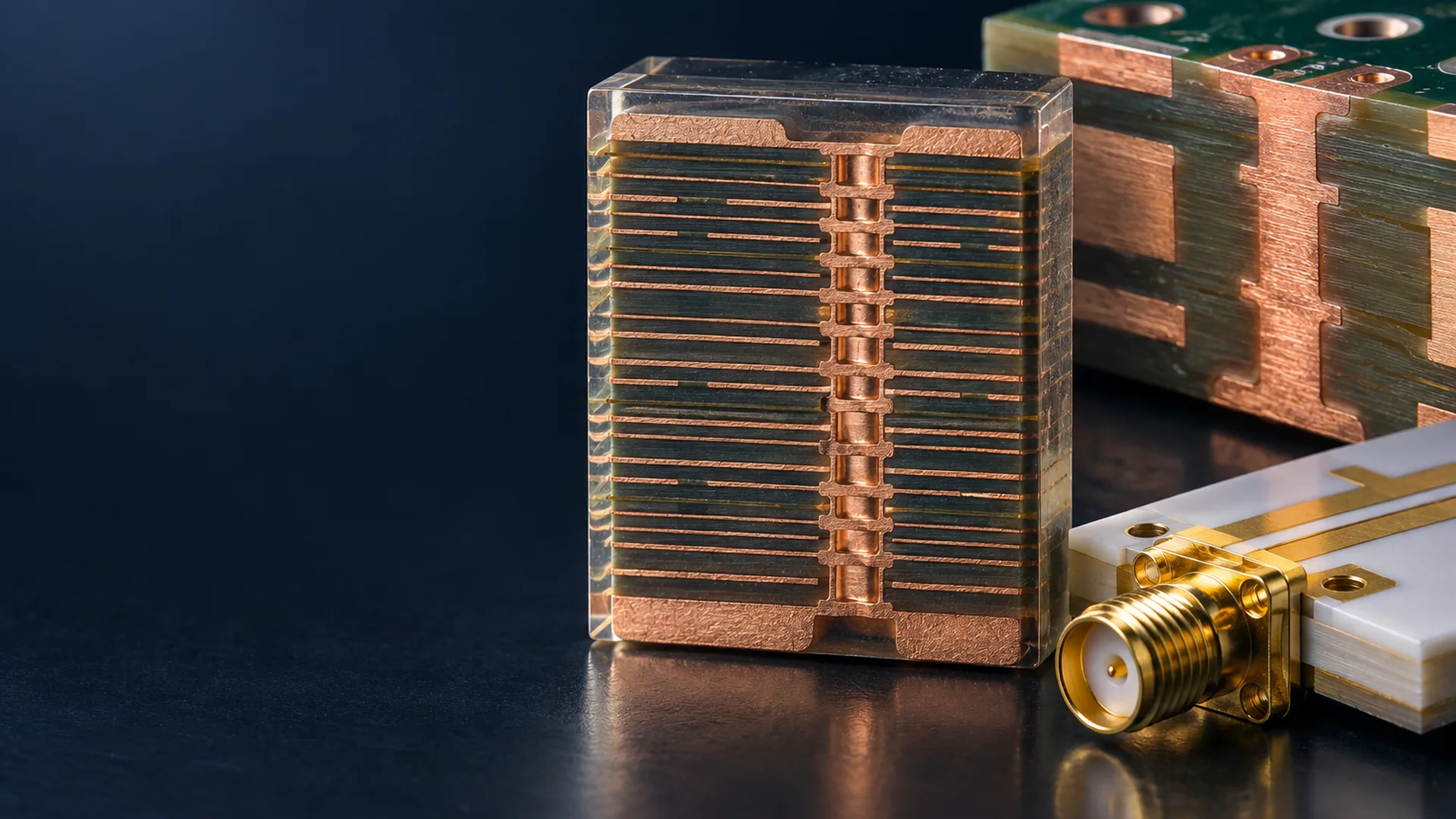
Cross-section of a multilayer HDI board with stacked copper microvias, beside a heavy-copper board and a PTFE RF board

Where a board stops being a configuration and starts being a process plan.

Illuminious is a U.S. NPI engineering company. Advanced PCB fabrication covers HDI, microvia, controlled-impedance, rigid-flex and heavy-copper construction, where a board stops being a configuration and becomes a process plan. Engineered in San Francisco. Prototype builds, DFM and mass production in our own factory in Shenzhen. Upload your files, get a free engineering review, and pay only the official quote that review publishes.

Microvias, sequential lamination, controlled impedance and 30-layer stack-ups are different builds, not harder versions of a standard board. How they are built decides whether they work. Below is the list of which ones the configurator accepts, and which an engineer settles before a price becomes official.

Configure it online, or send the job to an engineer. Online, you get a live supplier price, a published tier, or an official quote prepared by a specialist within 24 hours on business days, depending on the service. Engineering review is free either way and comes before you pay.

Payment
Official price after free review
Review target
Within 24 hours on business days after you submit

The configurator opens with this configuration preselected. An engineer reviews every order. Account required; engineering review is free and comes before payment.

When does a board need the advanced route?

  • HDI and microvia boards that need a stack-up decided, not assumed
  • Controlled-impedance and RF designs with named critical nets
  • High-layer-count or heavy-copper constructions beyond the standard route
  • Rigid-flex and dense assembly where inspection depth is part of the scope
Typical orders
Engineering-led prototypes through controlled production, 1 to 50,000 boards. Capacity and schedule for a given construction are confirmed in review.
Accepted files
A Gerber archive is required. Add stack-up and impedance information for builds that depend on them, and a BOM and placement file when assembly is selected. Drawings, test instructions, and reference material upload to the same project.
Payment basis
Official price after free review
Preparation workbook
Download the intake workbook

The choices that decide the part.

Each of these is a real configuration decision with a cost and a consequence, not a feature list. Where one of them constrains another, engineering review is the step that resolves it.

Stack-up and material

High-Tg FR-4, low-loss, Rogers or equivalent RF, or polyimide, in eleven layer counts from 4 to 30, 5–600 mm per side, with outer copper of 1, 2, 3, 4, or 6 oz. Rogers and polyimide route to engineering review, as do 4 and 6 oz copper.

Signal integrity

Controlled impedance is on by default, and the impedance targets and critical nets are recorded as text rather than as a checkbox — because the stack-up that satisfies them is the answer review has to produce.

Interconnect

Through, blind and buried, laser microvia, or stacked microvia, down to a 0.05 mm smallest via, with sequential lamination, backdrill, and press-fit declared per project. Every via technology except through-hole routes to review.

Assembly and inspection

No assembly, SMT, or mixed SMT and through-hole, up to 10,000 placements per board, inspected by standard AOI, AOI with X-ray, or an advanced report with X-ray. The advanced report routes to review.

What the configurator prices, and where review takes over.

Advanced PCB capabilities capability bounds
ParameterSupported range
Board classHDI, RF / high frequency, power / heavy copper, high layer count, or rigid-flex. HDI, RF, and rigid-flex route to engineering review.
Layer count4, 6, 8, 10, 12, 14, 16, 18, 20, 24, or 30 layers.
Board size and quantity5–600 mm per side, 1–50,000 boards.
Laminate familyHigh-Tg FR-4, low-loss, Rogers or equivalent RF, or polyimide. Rogers and polyimide route to review.
Maximum copper weight1, 2, 3, 4, or 6 oz. Four and six ounces route to review.
Controlled impedanceRequested by default, with impedance targets and critical nets recorded per project.
Via technologyThrough, blind and buried, laser microvia, or stacked microvia. Everything but through-hole routes to review.
Smallest via diameter0.05–0.50 mm, declared per project.
Declared process featuresSequential lamination, backdrill, press-fit holes, and a supplied stack-up.
Assembly and inspectionNone, SMT, or mixed, up to 10,000 placements per board, with standard AOI, AOI plus X-ray, or an advanced report and X-ray.
Inside these boundsFR-4 or aluminum core up to 12 layers with through-hole vias is the Standard PCB & PCBA route.

Almost every row here has a value that routes to engineering review, and that is the point rather than a caveat. An advanced board's cost and its feasibility are decided by the same judgment, so the route is built to reach that judgment before you are asked to pay for anything.

Boundaries

  • Selecting an advanced construction in the configurator is not a stack-up approval. Review confirms the layer structure, the material, and the impedance approach together
  • Material equivalents are never assumed silently; any substitution is proposed and approved
  • Boards inside the standard bounds (FR-4 or aluminum core, through-hole vias, up to 12 layers) belong to the Standard PCB & PCBA route, which is a shorter path, not a lesser one
  • Layout design is a separate service: this route fabricates and assembles a design you supply

How is an advanced fabrication price built?

Priced live. Engineering review is free and happens before payment, so nothing is charged to reach this figure. Priced live from supplier quotes when suppliers can price the build, including power, heavy-copper and high-layer boards of up to 14 layers, and HDI boards of 4 to 14 layers with up to 3 oz copper, 50 to 300 mm on the longer side and 50 to 200 mm on the shorter side, and up to 100 boards. On HDI boards, laminate Tg, impedance control and a supplied stack-up are confirmed at engineering review and are not included in the preview. Other HDI builds, rigid-flex, blind, buried or laser-drilled microvias, backdrill, sequential lamination, custom stack-ups on other boards, RF, low-loss or polyimide laminates, more than 14 layers, assembly, and anything a supplier does not price at the moment are quoted by a specialist within 24 hours on business days. Engineering review confirms the vendor quote before payment.
  • Layer count, board area, laminate family, and copper construction
  • Via technology, lamination cycles, backdrill, press-fit, and controlled impedance
  • Assembly density, inspection depth, test, and documentation
  • Quantity, material availability, yield risk, and requested lead time

What engineering reviews

Customer approvals may include

  • The official stack-up and the interpretation of every controlled feature
  • Any material equivalent or yield-driven geometry change
  • The production file, before it is released
  • Any itemized price or lead-time revision
  • Stack-up completeness and material availability against the declared laminate family
  • Impedance targets and critical nets against the layer structure that has to carry them
  • Microvia, sequential-lamination, backdrill, and press-fit feasibility as one construction
  • Copper balance, drill structure, registration, and yield risk
  • Assembly access, BGA and QFN inspection scope, and production-file requirements

Free review first. Keep every later decision explicit.

The fabrication package you upload is the revision that gets priced and reviewed. Replacing it creates a new revision rather than editing the paid one, so the stack-up that was approved and the stack-up that was built are always the same document.

  1. Create your account

    Verify your email before the persistent quote workspace opens. Every file, estimate, message, and payment stays attached to that account.

  2. Configure and upload

    Provide service-specific inputs and place technical files in private project storage. Saved drafts remain available across sessions.

  3. Free engineering review

    Submit the configured cart at no charge. A reviewer checks the exact file and specification revision, then prices it or opens a documented question or correction request.

  4. Official quote

    Review publishes an itemized quote with lead time and a validity window. That is the binding figure; anything shown earlier was a preliminary estimate.

  5. Accept and pay

    Accepting opens payment rather than charging you. Lead time is counted from settled payment, and any later itemized revision needs your approval first.

  6. Produce and deliver

    After all commercial, technical, and customer gates are complete, the project moves through the service-specific production or design milestones.

Commitments the order system actually enforces.

Price, then engineering review

The online figure prices the construction you declared. A reviewer then reads the actual package (stack-up, impedance intent, via structure) and either confirms it or sends an itemized revision to approve.

Fabrication data stays private

Gerbers, stack-up documents, BOMs, and placement files live in per-project storage reached through short-lived authenticated links, tied to your account rather than an email thread.

Review target

Advanced board projects are targeted for review one business day after you submit them. Review is free and precedes the official price.

Answers before you upload anything.

When is a board Advanced rather than Standard?

When the construction itself needs process planning: HDI, blind or buried vias, microvias, RF or low-loss laminate, polyimide, copper beyond 3 oz, more than 12 layers, rigid-flex, backdrill, or press-fit. Anything inside FR-4 or aluminum core, through-hole vias, and 12 layers is Standard, which is a shorter path rather than a lesser one.

Does the online price approve my stack-up?

No. The online price covers the configuration you declared. Engineering review confirms the stack-up, the material, the impedance approach, and the production file, and proposes any revision as an itemized change you approve before it is charged.

What if I do not have a stack-up yet?

Say so — the configurator has a field for whether one is supplied, and leaving it unchecked is a real answer rather than a gap. Record your impedance targets and critical nets instead, and review proposes a stack-up against them for your approval.

Can you assemble an advanced board as well as fabricate it?

Yes. Select SMT or mixed SMT and through-hole, declare the placements per board, and choose the inspection depth — standard AOI, AOI with X-ray, or an advanced report with X-ray. Advanced reporting routes to review so the inspection evidence is agreed as part of the scope.

Is the amount at checkout final?

The free engineering review comes first. Depending on the service you see a live supplier price, a published fixed price, or a price from a specialist within 24 hours on business days, and nothing is charged when you submit. After the review we publish an official quote with an itemized total, lead time and a validity window, and that is the amount you are asked to pay. Accepting the official quote opens payment rather than charging you. If a later correction changes scope or price, you see an itemized revision and can approve, question or decline it. We never silently charge an increase.

How is my fabrication data protected?

Your technical files are stored in private project storage and accessed through short-lived authenticated links. Files, prices, replacements and approvals stay tied to your account and keep their revision history.

Price an advanced board against these capabilities.

Declare the stack-up, the impedance targets, and the interconnect features, upload the package, and an engineer confirms the construction before you are asked for an official price.

Three lead-time tiers, each with its trade on the line: Economy lengthens the quoted target range and takes a discount line; Standard is the quoted target range at the quoted price; Express shortens it and adds an expedite line. You see the line before you commit, and every range is a target, not a promise.

  1. An engineer runs a free engineering review of your files, and nothing is charged when you submit.
  2. You see the findings first.
  3. We publish the official quote with an itemized total, lead time and validity window.
  4. You accept the official quote, and only then does payment open.