Shenzhen tour · Dec 6–11

Apply
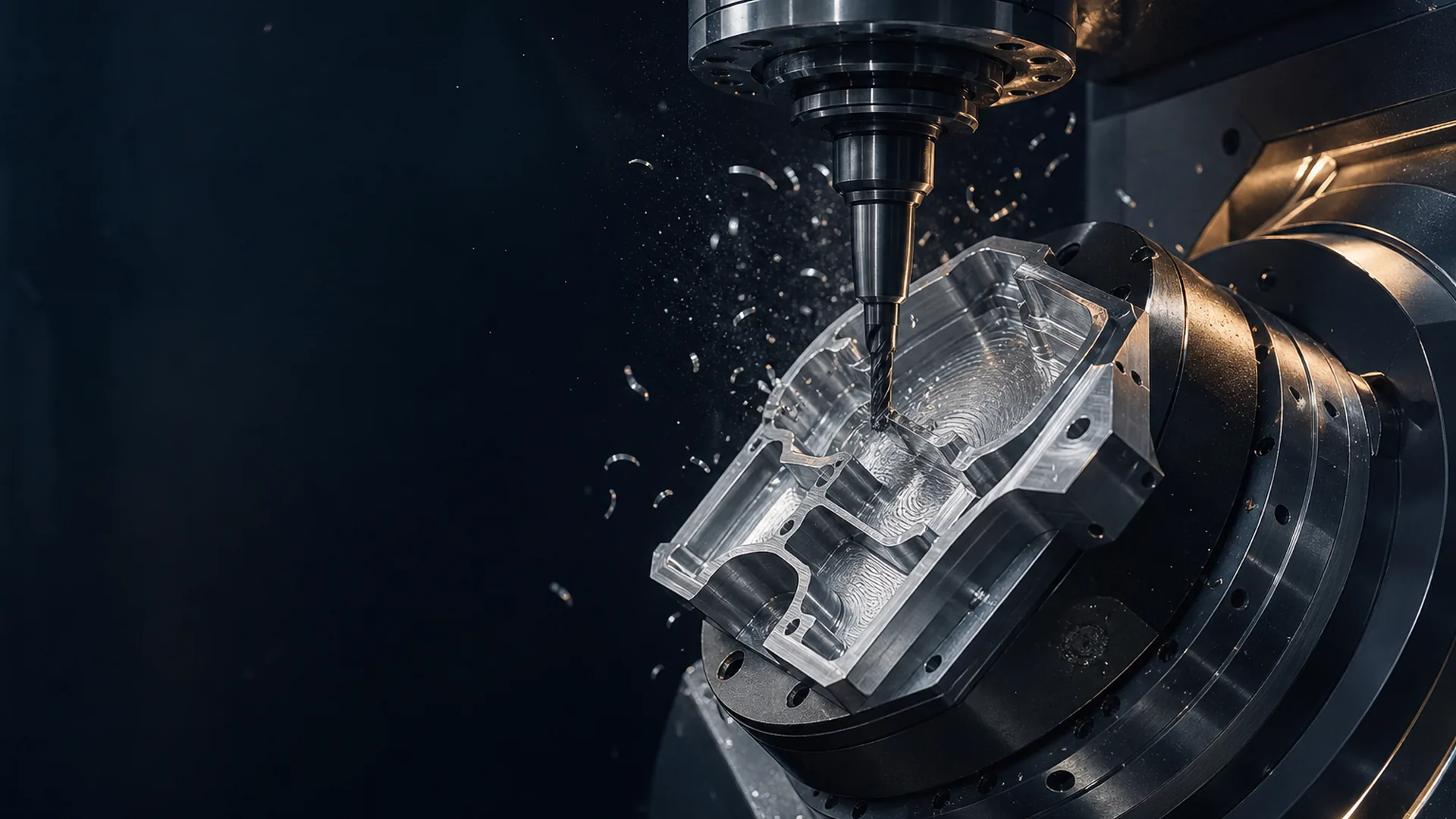
Five-axis CNC machining center cutting a complex aluminum block with coolant mist

CNC milling for prismatic parts, housings, and machined datums.

Illuminious is a U.S. NPI engineering company. CNC milling removes material with a rotating cutter across 3-axis and 5-axis setups, and it is the machining route for prismatic parts, housings and machined datums. Engineered in San Francisco. Prototype builds, DFM and mass production in our own factory in Shenzhen. Upload your files, get a free engineering review, and pay only the official quote that review publishes.

Milling removes material with a rotating cutter while the part stays fixtured. Typical parts are brackets, plates, manifolds and the enclosure of a demo build. Cost depends less on the shape than on the number of setups, the pocket depth and how tight the tolerance must be.

Two ways in: configure it online and a specialist prepares your official quote within 24 hours on business days, or send the job to an engineer. Engineering review is free either way and comes before you pay.

Payment
Official price after free review
Review target
Within 24 hours on business days after you submit

The configurator opens with this configuration preselected. An engineer reviews every order. Account required; engineering review is free and comes before payment.

Milling or turning: which suits your geometry?

  • Prismatic parts, brackets, plates, and manifolds
  • Machined enclosures and mounting interfaces
  • Parts with datums, sealing faces, or bores that must be true
  • Metal parts that need a tighter tolerance than any additive route can hold
Typical orders
Single prototypes through production batches. Quantity changes the fixturing strategy, which review confirms.
Accepted files
STEP or STP geometry, plus a dimensioned drawing (PDF or DXF/DWG) whenever tolerances, threads, finishes, or datums matter. IGES, STL, and native SolidWorks files upload as supporting references.
Payment basis
Official price after free review
Not ready to configure?
How CNC machining works
Preparation workbook
Download the intake workbook

The choices that decide the part.

Each of these is a real configuration decision with a cost and a consequence, not a feature list. Where one of them constrains another, engineering review is the step that resolves it.

3-axis milling

The economical baseline for parts that can be cut from one or two directions. Most brackets and plates never need more.

5-axis milling

Used when the part has features on compound faces, when one fixturing pass protects a datum relationship, or when tool access demands it. Declared as complex setup in the configurator.

Materials

Aluminum 6061 and 7075, stainless 304 and 316, mild steel, brass, titanium, and engineering plastic. Titanium always routes to review for tooling and feasibility.

Finish and appearance

As machined, anodized, hard anodized, bead blast, powder coat, or plating, each with standard, strict, or cosmetic appearance grade — three quite different amounts of work.

What the configurator accepts, and where review takes over.

CNC milling capability bounds
ParameterSupported range
ProcessCNC milling, declared as simple (1–2 setups), moderate (3–4 setups), or complex/5-axis.
Materials in the configuratorAluminum 6061 and 7075, stainless 304 and 316, mild steel, brass, titanium, and engineering plastic. Titanium routes to review.
Configurator envelope0.1–2500 mm per axis with declared finished volume up to 1,000,000 cm³. Larger stock is quoted through review.
Quantity1–100,000 parts per line. Where quantity changes the sensible process, review says so.
Tolerance bands in the configuratorGeneral ISO 2768, ±0.10 mm, ±0.05 mm, and ±0.02 mm or tighter. The two tightest bands always route to engineering review.
Precision featuresThreads, threaded inserts, thin walls, deep pockets, and critical datums are declared per line and read individually in review.
FinishesAs machined, anodized, hard anodized, bead blast, powder coat, or plating, with standard, strict, or cosmetic appearance grade.
InspectionStandard inspection, dimensional report, or CMM report. CMM routes to review. Material certificates are a per-line option.

These are the bounds the configurator accepts. A part that is larger, tighter, or certified beyond them is still quoted: a specialist prepares the official quote within 24 hours on business days.

Boundaries

  • Internal corners carry a radius because a cutter is round; sharp internal corners need a declared secondary operation
  • Deep, narrow pockets need long tools and slow feeds, and review will flag where the depth-to-width ratio drives cost
  • Cosmetic appearance grade is a declared requirement, not the default outcome of machining

What drives the price of a milled part?

Quotation by a specialist. Quotation within 24 hours on business days. A specialist prices your exact CNC Machining scope from your files and specifications. You submit your request online, and the quotation arrives in your account and by email. Review is free. Nothing is charged until you accept a quotation.
  • Stock envelope, finished volume, and how much material is removed
  • Setup complexity — the single largest driver on most machined parts
  • Material and its machinability
  • Tolerance band, threads, inserts, and critical datums
  • Finish, appearance grade, inspection level, certificates, and requested lead time

What engineering reviews

Customer approvals may include

  • Any material substitution proposed in review
  • Any geometry or tolerance change needed to make the part manufacturable
  • Any itemized price or lead-time revision
  • Tool access to every declared feature and the setups implied by it
  • Internal corner radii and whether the mating part tolerates them
  • Depth-to-width ratio on pockets and slots
  • Thin walls and how they will behave under cutting load
  • Whether the drawing's tolerances and datums are consistent and achievable
  • Whether the declared finish is compatible with the material and appearance grade

Free review first. Keep every later decision explicit.

The model and the drawing are read together. Where they disagree, review asks rather than guessing — and the version that was priced stays in your project history when a corrected file creates a new revision.

  1. Create your account

    Verify your email before the persistent quote workspace opens. Every file, estimate, message, and payment stays attached to that account.

  2. Configure and upload

    Provide service-specific inputs and place technical files in private project storage. Saved drafts remain available across sessions.

  3. Free engineering review

    Submit the configured cart at no charge. A reviewer checks the exact file and specification revision, then prices it or opens a documented question or correction request.

  4. Official quote

    Review publishes an itemized quote with lead time and a validity window. That is the binding figure; anything shown earlier was a preliminary estimate.

  5. Accept and pay

    Accepting opens payment rather than charging you. Lead time is counted from settled payment, and any later itemized revision needs your approval first.

  6. Produce and deliver

    After all commercial, technical, and customer gates are complete, the project moves through the service-specific production or design milestones.

Commitments the order system actually enforces.

Official quote prepared by a specialist, engineering review

A specialist prepares your official quote within 24 hours on business days from the declared envelope, material, setups, and tolerance. An engineer reads the model and drawing for tool access, corner radii, and datum consistency, and confirms or itemizes a revision before the official price.

Drawings and models stay private

Geometry, drawings, and revisions live in per-project storage reached through short-lived authenticated links, tied to your account rather than an email thread.

Review target

Machining projects are targeted for review one business day after you submit them. Review is free and precedes the official price.

Answers before you upload anything.

Do I need a drawing as well as a STEP file?

For a plain part with general tolerances, the model is usually enough. As soon as a dimension is critical, a thread is called out, a datum matters, or a finish is specified, send the drawing — a model alone cannot express any of those, and review will ask for it before production.

What drives the price more, the material or the shape?

Usually the number of setups. Re-fixturing a part costs machine time and adds tolerance stack-up, so a simple shape reachable in one setup often beats a slightly simpler shape that needs four.

Is the amount at checkout final?

The free engineering review comes first. Depending on the service you see a live supplier price, a published fixed price, or a price from a specialist within 24 hours on business days, and nothing is charged when you submit. After the review we publish an official quote with an itemized total, lead time and a validity window, and that is the amount you are asked to pay. Accepting the official quote opens payment rather than charging you. If a later correction changes scope or price, you see an itemized revision and can approve, question or decline it. We never silently charge an increase.

How are my drawings protected?

Your technical files are stored in private project storage and accessed through short-lived authenticated links. Files, prices, replacements and approvals stay tied to your account and keep their revision history.

Get an official quote for milling with the process already selected.

The configurator opens on milling. Upload the model and drawing, declare material, tolerance, and finish, and review confirms access and setups before the official price.

Three lead-time tiers, each with its trade on the line: Economy lengthens the quoted target range and takes a discount line; Standard is the quoted target range at the quoted price; Express shortens it and adds an expedite line. You see the line before you commit, and every range is a target, not a promise.

  1. An engineer runs a free engineering review of your files, and nothing is charged when you submit.
  2. You see the findings first.
  3. We publish the official quote with an itemized total, lead time and validity window.
  4. You accept the official quote, and only then does payment open.