Last reviewed: October 17, 2026. This guide describes visit types, not named companies. Hosts of any organized visit are shared only with accepted participants.
A factory type is a kind of site where one stage of a hardware product is made: a robotics lab, an actuator line, an electronics assembly plant, a plastics floor, a prototyping studio. Shenzhen has all of them within driving distance, so a founder can see the whole chain from idea to shipped unit in one week.
How to use this guide
Read each section as a field note. For every factory type you get what you will see, the questions worth asking and what the visit tells you about your own product. Take the questions with you on any visit, organized or not.
Why do hardware founders visit different factory types?
Most founders arrive with one question: who can build my product? The better question is how each part of it gets made, and by whom. A connected device is a stack of supply chains. The circuit board, the enclosure, the motor, the cable, the sensor and the final assembly can each come from a different site. Seeing several types in a row shows you where cost, lead time and risk really sit.
Shenzhen is a good place to do this because the types sit close together. The city has grown into a dense electronics and robotics cluster, and the city government has set out plans to grow its robotics industry further, as the Shenzhen government reported on March 10, 2025. For the bigger picture of how to start a supplier search, read our guide to finding a manufacturer in Shenzhen.
What do you see at a humanoid robotics lab?
A robotics lab is where a robot is still being designed and tested. Expect test rigs, half-built robots on stands, motion-capture areas and engineers running walking or grasping trials. It is closer to an R&D office than to a production floor.
- Ask: which parts do you make in house, and which do you buy?
- Ask: what broke most often in your last test cycle?
- What it tells you: where the hard engineering problems are, and which component suppliers a mature robotics team relies on.
What happens on an actuator or motor line?
Actuators turn electrical power into motion. A rotary-actuator line combines motors, gearboxes, encoders and drive electronics into one module. You will see winding, gear assembly, balancing and end-of-line testing on load benches.
- Ask: how do you test torque and backlash on every unit?
- Ask: what volume does a custom actuator need before it makes sense?
- What it tells you: whether you should design your own drive module or buy a standard one and adapt your mechanics.
What should you look for at a sensor factory?
Sensor factories build the parts that let a product see, hear or feel: cameras, lidar, force sensors, IMUs and similar modules. Calibration is the core skill. Look for calibration stations, clean areas and test fixtures that check each unit against a reference.
- Ask: how is each unit calibrated, and is the calibration data stored per serial number?
- Ask: what changes when a customer needs a custom field of view or connector?
- What it tells you: how much of your product's accuracy depends on a supplier's process rather than on your own firmware.
What does a plastics and injection molding floor show you?
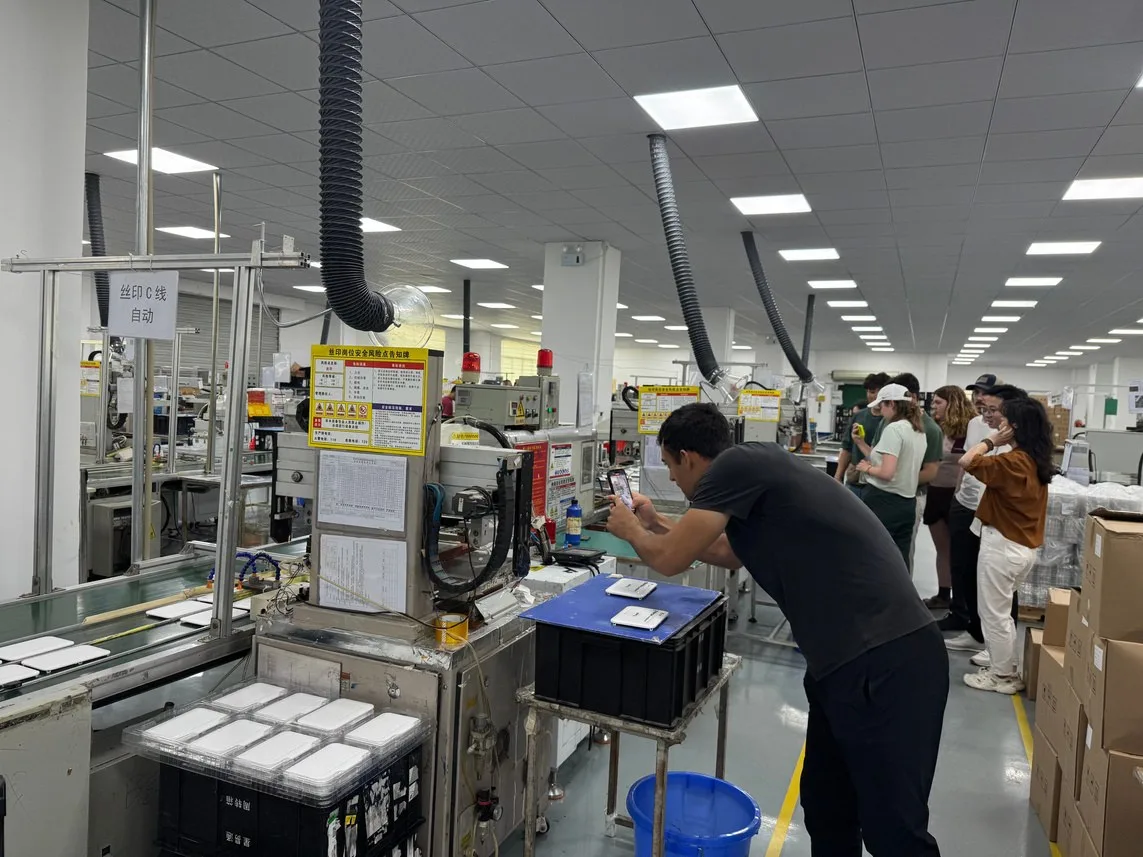
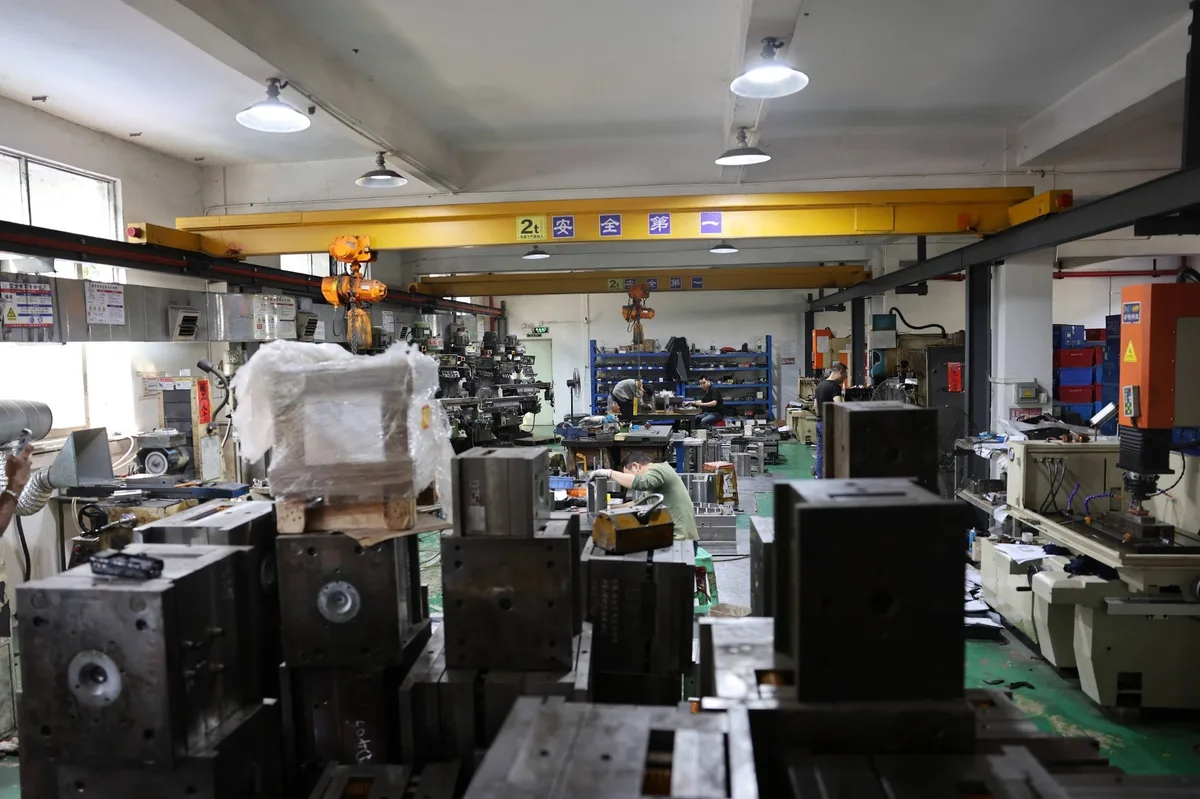
Most enclosures, housings and toy-like parts are injection molded. On the floor you see rows of molding presses, molds on racks, robots that pull parts out, and operators trimming and checking parts. Many plants also run secondary steps such as painting, pad printing and ultrasonic welding.
- Ask: who owns the mold, and where is that written down?
- Ask: what design changes do you see most often after the first shots?
- What it tells you: how early your industrial design must be frozen, and why draft angles and wall thickness matter. Our guide to injection molding for electronics housings goes deeper.
How does an electronics assembly plant work?
An electronics assembly plant, often called an EMS or OEM plant, turns bare circuit boards into working boards and then into finished products. The core is the SMT line: solder paste printing, pick-and-place machines, a reflow oven and automated optical inspection. Downstream you see testing, firmware loading and box build.
- Ask: what tests does every board pass before it leaves the line?
- Ask: how do you handle a part shortage in the middle of a run?
- What it tells you: what a factory needs from you to quote properly: a clean BOM, Gerber files, test specs and an assembly drawing.
What is different at a wearables or AI-glasses factory?
Wearables are small, dense and close to the body. Their factories focus on miniature assembly, optical alignment, battery handling and cosmetic quality. Expect magnification at every station and strict handling rules for lenses and displays.
- Ask: what is your most common cosmetic defect, and how do you catch it?
- Ask: how do you test battery safety and charging?
- What it tells you: how much yield loss a small consumer device carries, and why cosmetic specs belong in your first quote request.
What can a robotics or mobility hardware company teach a small hardware team?
Robotics and mobility hardware companies integrate many subsystems at scale: motors, batteries, controllers, sensors and software. A visit shows what mature system integration looks like, including test areas, traceability and change control.
- Ask: how do you manage an engineering change once a product is in production?
- Ask: what do you require from a new component supplier before you approve it?
- What it tells you: the standard your own supplier qualification will be measured against when you sell to larger customers.
Why visit an electronics market such as Huaqiangbei?
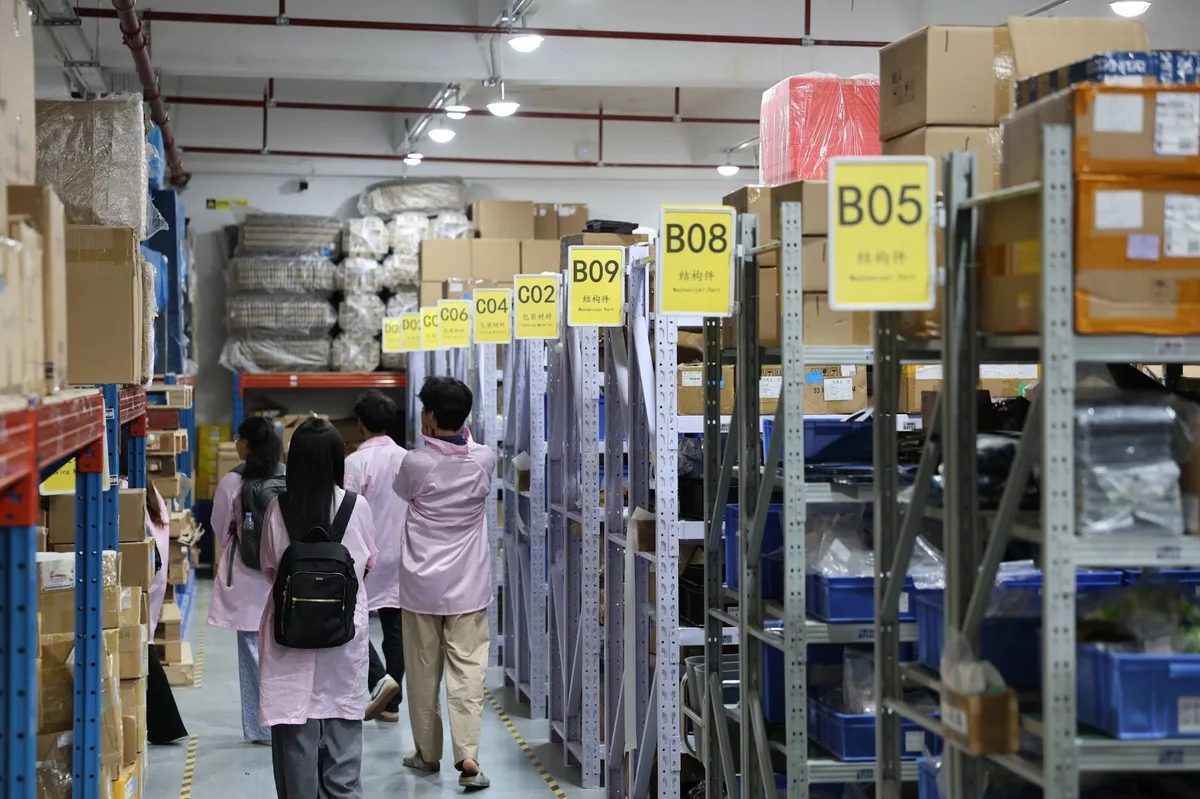
Huaqiangbei is the electronics market district in central Shenzhen. It is not a factory, but it shows the supply chain from the other side: a very wide range of components, modules and finished gadgets for sale in small quantities. Founders use it to buy samples, see what competitors ship and meet distributors. Our Huaqiangbei market guide covers how to pay and how to avoid counterfeit parts.
What do incubators, prototyping studios and makerspaces add?
Hardware incubators and prototyping studios work at the earliest stage. They turn sketches into works-like and looks-like prototypes with CNC machining, 3D printing, laser cutting and hand assembly. Makerspaces are community workshops where local founders build and share tools.
- Ask: what do you need from a founder to start a prototype?
- Ask: when do you hand a project over to a production factory?
- What it tells you: how to plan the bridge from prototype to pilot run, which is where many startups lose time. See prototype-to-production cost traps.
How should you prepare before each visit?
Prepare one short brief per visit. It should say who you are, what you are building, the stage you are at and what you want to learn. Bring samples or photos, a BOM if you have one, and a list of open questions. Read our first Shenzhen factory trip checklist and our note on NDAs, IP and DFM before a visit. Respect each site's photo rules, and ask before you take any picture.
For a longer guide that covers entry rules, costs and vetting in one place, read the Shenzhen Hardware Founder Playbook 2026.
See the factory types in one week
The Future Factory × Illuminious: Shenzhen Founder Tour runs December 6–11, 2026, for max 20 founders, with 10+ factory and lab visits across robotics, electronics and prototyping, plus the Huaqiangbei electronics market. A licensed Future Factory program, hosted by Illuminious.
Frequently asked questions
Which factory type should a first-time founder visit first?
Start with the type that makes the most expensive or riskiest part of your product. For most connected devices that is electronics assembly, then plastics.
Can I take photos inside a factory?
Only with permission. Many sites forbid photos near customer products. Ask your host at the start of each visit and follow the answer.
Do I need a finished design to visit?
No. Early visits are about learning how parts are made. Bring what you have, even sketches, and say clearly what stage you are at.
Are company names shared before an organized tour?
For the Future Factory × Illuminious tour, visit types are public and company names are shared after acceptance.