Shenzhen tour · Dec 6–11

Apply
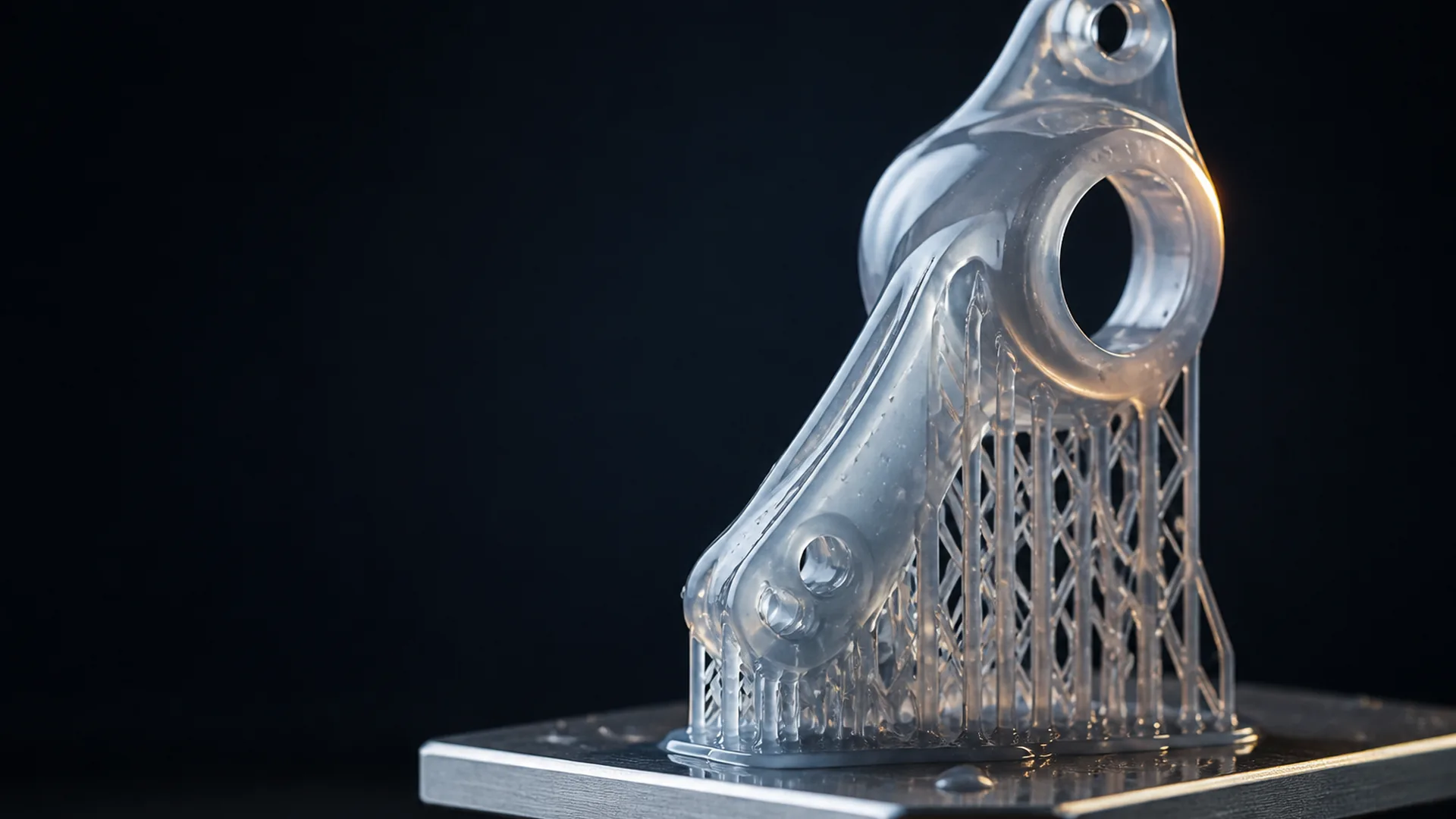
Translucent SLA resin part with lattice supports on a stainless build platform

SLA resin parts when surface finish and fine detail decide the part.

Illuminious is a U.S. NPI engineering company. SLA resin printing cures liquid photopolymer layer by layer, and it is the additive route to choose when surface finish and fine detail decide whether the part is acceptable. Engineered in San Francisco. Prototype builds, DFM and mass production in our own factory in Shenzhen. Upload your files, get a free engineering review, and pay only the official quote that review publishes.

Stereolithography cures liquid photopolymer with a UV laser, so it holds crisper features and a smoother wall than powder or filament. Choose it for the visible housings of a demo build. Pick the resin, finish and tolerance, and the review checks supports and wall thickness.

Two ways in: configure it online and a specialist prepares your official quote within 24 hours on business days, or send the job to an engineer. Engineering review is free either way and comes before you pay.

Payment
Official price after free review
Review target
Within 24 hours on business days after you submit

The configurator opens with this configuration preselected. An engineer reviews every order. Account required; engineering review is free and comes before payment.

Is SLA resin the right process for your part?

  • Appearance models and design reviews
  • Fine features, thin walls, and crisp text-free detail
  • Master patterns for casting and vacuum forming
  • Fit-check housings where surface finish matters more than toughness
Typical orders
One-off appearance parts through low-volume batches; larger runs are confirmed for capacity in review.
Accepted files
STL, STEP/STP, OBJ, or 3MF geometry. Drawings (PDF, DXF, DWG) and reference images upload to the same project as supporting files.
Payment basis
Official price after free review
Not ready to configure?
How 3D printing works
Preparation workbook
Download the intake workbook

The choices that decide the part.

Each of these is a real configuration decision with a cost and a consequence, not a feature list. Where one of them constrains another, engineering review is the step that resolves it.

Standard resin

The general-purpose choice for appearance parts, fit checks, and visual prototypes. It holds the finest detail of the resin options and sands and paints predictably.

Engineering resin

Selected when the part must survive handling, assembly load, or elevated temperature rather than sit on a desk. Specific grade and its trade-offs are confirmed in review.

Finish path

As printed, sanded or polished, painted or dyed, bead blast, or secondary machining. Each step is priced as declared work, not assumed.

Secondary operations

Tapped threads, heat-set or threaded inserts, assembly, and critical-surface control are separate declared operations on the same line.

What the configurator accepts, and where review takes over.

SLA resin capability bounds
ParameterSupported range
ProcessSLA — UV laser vat photopolymerization.
Materials in the configuratorStandard resin and engineering resin. Other chemistries are a review request.
Configurator envelope0.1–2000 mm per axis and 0.01–1,000,000 cm³ declared volume. Parts outside that range are still quoted: a specialist prepares the official quote within 24 hours on business days.
Quantity1–100,000 parts per line. Batch pricing and repeat-order handling are confirmed in review.
Minimum wall and feature sizeDeclared per part as standard, thin, or unknown. The usable minimum for your geometry and resin is confirmed in review; we do not publish a single number that would be wrong for half of the parts we see.
Surface finishAs printed, sanded/polished, painted/dyed, bead blast, or secondary machining.
Tolerance classesProcess standard, controlled dimensions, or critical tolerance. Critical always routes to engineering review before production.
InspectionStandard visual, dimensional report, or advanced inspection, selected per line in the configurator.

These are the bounds the configurator accepts. A part outside them is still quoted: a specialist prepares the official quote within 24 hours on business days.

Boundaries

  • Cured photopolymer is comparatively brittle and UV-sensitive; long-term outdoor or load-bearing use is a review conversation
  • Support witness marks on down-facing surfaces are inherent to the process and are removed to the finish level you select
  • Declared thin features route to review rather than being printed on an assumption

What drives the price of an SLA resin part?

Quotation by a specialist. Quotation within 24 hours on business days. A specialist prices your exact 3D Printing scope from your files and specifications. You submit your request online, and the quotation arrives in your account and by email. Review is free. Nothing is charged until you accept a quotation.
  • Bounding envelope and declared model volume
  • Resin family and color requirement
  • Quantity and nesting efficiency across the build
  • Finish level, secondary operations, and inserts
  • Tolerance class, inspection depth, and requested lead time

What engineering reviews

Customer approvals may include

  • Any process or material change proposed after review
  • Any geometry change we ask for to make the part manufacturable
  • Any itemized price or lead-time revision
  • Wall thickness, unsupported spans, and features at the edge of resolution
  • Support strategy and which faces carry witness marks
  • Trapped volumes and drain paths that would cup uncured resin
  • Resin choice against the stated end use, temperature, and UV exposure
  • Whether the declared tolerance is achievable in the chosen resin

Free review first. Keep every later decision explicit.

Geometry drives the official quote, so the model you upload is the model that gets priced. Replacing it creates a new revision rather than editing the paid one, and the previous revision stays readable in your project history.

  1. Create your account

    Verify your email before the persistent quote workspace opens. Every file, estimate, message, and payment stays attached to that account.

  2. Configure and upload

    Provide service-specific inputs and place technical files in private project storage. Saved drafts remain available across sessions.

  3. Free engineering review

    Submit the configured cart at no charge. A reviewer checks the exact file and specification revision, then prices it or opens a documented question or correction request.

  4. Official quote

    Review publishes an itemized quote with lead time and a validity window. That is the binding figure; anything shown earlier was a preliminary estimate.

  5. Accept and pay

    Accepting opens payment rather than charging you. Lead time is counted from settled payment, and any later itemized revision needs your approval first.

  6. Produce and deliver

    After all commercial, technical, and customer gates are complete, the project moves through the service-specific production or design milestones.

Commitments the order system actually enforces.

Official quote prepared by a specialist, then geometry review

A specialist prepares your official quote within 24 hours on business days from the geometry and options you declared. An engineer reads the actual model — thin walls, drain paths, supports — and either confirms the price or sends you an itemized revision to approve.

Files stay private

Models, drawings, and revisions live in per-project storage reached through short-lived authenticated links, tied to your account rather than an email thread.

Review target

3D printing projects are targeted for review one business day after you submit them. Review is free and happens before you are asked for an official price.

Answers before you upload anything.

When is SLA the right choice over MJF or SLS?

Choose SLA when the surface and the fine detail are the deliverable: appearance models, master patterns, and parts that will be painted. Choose MJF or SLS when the part has to be tough, take repeated handling, or work as a functional end-use component.

How thin can a wall be?

It depends on the span, the orientation, and the resin, so we do not publish one number. Declare the wall as standard, thin, or unknown in the configurator and review confirms what is printable, including a suggested change if the geometry needs one.

Is the amount at checkout final?

The free engineering review comes first. Depending on the service you see a live supplier price, a published fixed price, or a price from a specialist within 24 hours on business days, and nothing is charged when you submit. After the review we publish an official quote with an itemized total, lead time and a validity window, and that is the amount you are asked to pay. Accepting the official quote opens payment rather than charging you. If a later correction changes scope or price, you see an itemized revision and can approve, question or decline it. We never silently charge an increase.

How are my models protected?

Your technical files are stored in private project storage and accessed through short-lived authenticated links. Files, prices, replacements and approvals stay tied to your account and keep their revision history.

Get an official quote for SLA with the resin and finish already selected.

The configurator opens with SLA and a standard resin preselected. Upload the model, set finish and tolerance, and review reads the geometry before you are asked for an official price.

Three lead-time tiers, each with its trade on the line: Economy lengthens the quoted target range and takes a discount line; Standard is the quoted target range at the quoted price; Express shortens it and adds an expedite line. You see the line before you commit, and every range is a target, not a promise.

  1. An engineer runs a free engineering review of your files, and nothing is charged when you submit.
  2. You see the findings first.
  3. We publish the official quote with an itemized total, lead time and validity window.
  4. You accept the official quote, and only then does payment open.