Physical AI / Warehouse Robotics / Edge-AI Perception Module + Quick-Turn PCBA + NPI
Do you trust a factory you've never met? Go meet them.
Shenzhen tour · Dec 6–11
Consumer IoT / Pet Wearables / Smart Collar PCBA + Overmolding + NPI
PawLink Labs, a 6-person pre-seed pet-tech startup, had a working smart-collar prototype built from dev boards and a 3D-printed shell, a waitlist of d...
Walk Shenzhen factories with us, Dec 6–11. See the tour
PawLink Labs, a 6-person pre-seed pet-tech startup, had a working smart-collar prototype built from dev boards and a 3D-printed shell, a waitlist of dog owners, and a retail buyer asking for shelf-ready units. The prototype was not waterproof, its GPS fix degraded once the electronics sat inside a curved collar module, and nobody on the team had ever taken an overmolded wearable into production.
Illuminious ran a free engineering review that caught an antenna keep-out problem and an overmold gate placed where injection pressure would load the battery, then built 5-piece no-MOQ samples of a GPS+BLE+IMU PCBA with a flex interconnect into the strap. A soft bridge tool for the silicone and TPU overmold came before any hardened steel, and DVT added soak and chew test fixtures before a pilot, box build and US fulfillment for the first retail and D2C launch.
The Challenge: PawLink Labs had a smart collar that worked on a desk and a retail buyer who wanted it on a shelf. Company name and individuals have been anonymized for confidentiality. The 6-person pre-seed pet-tech startup builds a pet health tracker: a collar module that combines GPS location, Bluetooth Low Energy pairing to the owner's phone, and an IMU that turns movement into activity, rest and scratching data. The prototype was a stack of dev boards inside a 3D-printed shell. It was not waterproof, it lost GPS fix quality once it was folded into a curved collar module, and it would not survive a dog that likes to chew. The founders needed real hardware in weeks, not a 1,000-unit minimum order.
The market pull is real. Grand View Research values the global pet wearable market at about $3.4 billion in 2025, growing to $11.4 billion by 2033 at a 16.8% compound annual rate, with smart collars as the largest product segment and North America holding 37% of revenue. The smart collar segment alone was worth about $1.4 billion in 2025. Underneath that sits a large and stable customer base: according to the American Pet Products Association, 95 million US households owned a pet in 2025, dog ownership reached 53% of households, and US pet industry spending hit $158 billion, with $165 billion projected for 2026. For a hardware startup, that demand only matters if the first units ship on time and survive the first week on a real dog.
PawLink sent schematics, a draft layout, a BOM and its 3D-printed shell. Illuminious treated it as a full path to production, not a one-off prototype quote: free engineering review first, then 5-piece samples with no MOQ, bridge tooling before steel, and a pilot with real test fixtures, all under one US-based program manager. Key elements include:
From the first 5-piece sample run to the first retail and D2C shipment, under one US-based program manager.
An antenna keep-out violation and an overmold gate that would have loaded the battery, both found before any tool was cut.
Every DVT unit passed a 30-minute, 1-meter immersion test and a repeated bite-load chew fixture with no water ingress.
A first retail and D2C run after a pilot lot, on bridge tooling that cost well under half of a hardened steel tool.
The first catch was RF. On the dev boards, GPS and BLE looked fine because the antennas sat in open air. In PawLink's draft layout, the GNSS chip antenna sat beside the battery connector, a ground pour crept into its keep-out on an inner layer, and the planned housing put the antenna against the curved inner wall closest to the dog's neck. A body, a wet coat and a lithium cell are all bad neighbors for a 1.5 GHz antenna. Our engineers moved the antenna to the outer edge of the board, cleared copper on every layer under it, kept the matching network pads so it could be tuned in the final housing, and moved the BLE antenna to the opposite end so the two radios were not fighting for the same corner.
The second catch was mechanical, and it is one of the most common mistakes in an overmolded wearable housing. The housing concept placed the overmold gate directly above the battery pocket. Silicone and TPU go in hot and under pressure, and a gate over the cell pushes that pressure straight onto the battery and its tabs. The fix was a rigid inner frame that carries the PCBA and cell, a gate moved to the strap end where the flow could wrap the frame, and a short pre-mold check with a dummy cell to confirm the frame did not shift. For a deeper look at these trade-offs, our guide to injection molding for electronics housings covers gate placement, wall thickness and inserts.
A pre-seed startup cannot afford to learn about gate placement, shrink and flash on a hardened steel tool. PawLink's first housings were 3D printed to check fit on real collars and real dogs, then the overmold was shot on a soft bridge tool for EVT and DVT. That let the team change the strap transition twice and add a chew-resistant rib along the top edge without paying for a new steel tool each time. Soft silicone flash at the parting line on early shots told us where the tool needed a tighter shut-off, and those fixes went into the bridge tool before any volume parts were made. The steel tool decision moved to after DVT, when the geometry was locked and the first production quantity was known. If you are earlier in that path, see our 3D printing and injection molding services for how prototype shells turn into molded parts.
The US-based PM held a kickoff call with the founders, signed an NDA, and our NPI engineers reviewed the layout, BOM and housing concept. Sourcing checked every BOM line, and a GNSS module with a long lead time was swapped for an in-stock, pin-compatible option the client approved. Two DFM catches landed before PawLink paid anything.
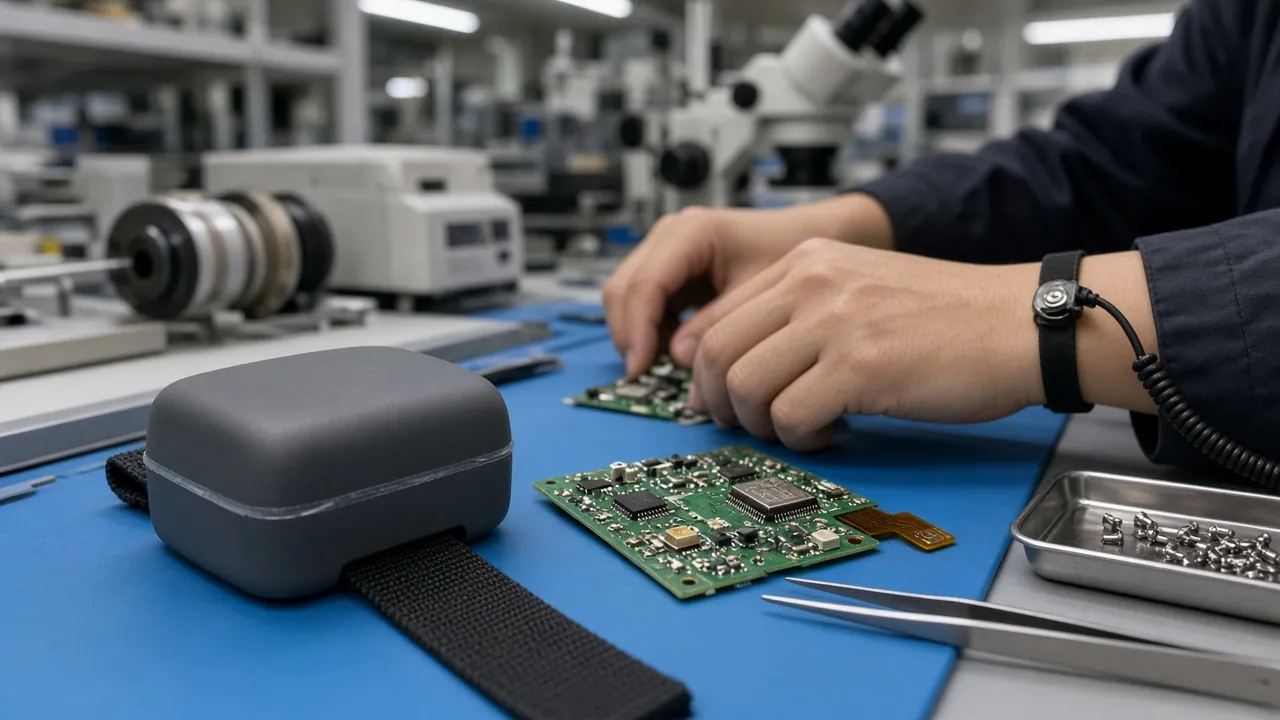
Five GPS+BLE+IMU boards with flex tails went through SMT, AOI, X-ray and a functional test of GNSS fix time, BLE pairing, IMU output and charge current, then into 3D-printed shells for walk tests on real dogs. No MOQ, and real data on fix quality and battery life in the first month.
The soft bridge tool produced the first overmolded housings over the rigid inner frame. Two strap-transition changes and a chew rib were added on the same tool. Geometry locked without a single steel tool change.
A DVT lot ran through a 30-minute, 1-meter immersion test in line with IEC 60529 IPX7 conditions, a repeated bite-load chew fixture on the module and strap, drop tests, and charge-contact corrosion checks after salt-water exposure. Zero housing breaches and zero water ingress across the DVT lot.
A pilot lot used a pogo-pin fixture for power, radios and IMU, plus a pressure-decay leak check on every overmolded module, so test coverage at small volume matched what the production line would run. Yield and test data were ready before the retail order was confirmed.
The first production run was box-built with charger, packaging and retail cartons, then shipped to US fulfillment for the retail order and D2C customers. 2,400 units shipped about seven months after the first five samples.
"We thought waterproofing was our hardest problem. The review showed us our antenna and our gate were the real risks, and the bridge tool let us fix the housing twice without betting the company on steel. By the time a retail buyer asked about returns, we had chew and soak data on every DVT unit."
A smart collar is a wearable with a harsher user. Dogs swim, roll, chew and scratch, and owners judge the product on whether it still works after a muddy weekend. That makes pet wearable PCBA and housing decisions inseparable: antenna placement depends on the housing, the overmold process depends on the battery, and the test plan depends on what the animal does. Many of the same checks apply to other small wearables, which is why our smart ring manufacturing checklist is a useful companion read. For validation on a startup budget, our guide to testing strategy for small-batch PCBA explains what to test at 5, 50 and 500 units.
Free engineering review first: The antenna and gate problems were cheap to fix on paper and expensive to fix in steel.
5-piece samples with real process controls: Machine SMT, AOI and functional test from the first run, so EVT data reflected production boards.
Soft tooling for EVT and DVT: Two housing changes and a chew rib cost a tool tweak, not a new tool.
Chew, soak and drop fixtures at small batch: DVT tested what dogs do to collars, not just what a bench power supply does.
A US-based PM from review to fulfillment: A 6-person team did not have to manage a factory, a tool shop and a 3PL separately.
Building a smart collar or another rugged wearable? Start with PCB assembly for no MOQ wearable prototype runs and pilot builds, NPI engineering for DFM review and EVT to PVT planning, injection molding for overmolded housings, box build for retail-ready final assembly, and the Startup Bridge Program for 5-piece runs with no MOQ, 72-hour quick-turn PCBA and a free engineering review before you pay. Illuminious is headquartered in San Francisco, with manufacturing in Shenzhen, and runs an ISO 9001 and ISO 13485 certified quality system.
Illuminious helps pet-tech and wearable hardware startups go from dev boards to retail shelves: free engineering review, 5-piece no-MOQ PCBA samples, bridge-tooled overmolded housings, chew and soak validation, box build and US fulfillment, all run by a US-based program manager. Send us your schematic, BOM and housing concept for a free engineering review.
"We thought waterproofing was our hardest problem. The review showed us our antenna and our gate were the real risks, and the bridge tool let us fix the housing twice without betting the company on steel. By the time a retail buyer asked about returns, we had chew and soak data on every DVT unit."
Physical AI / Warehouse Robotics / Edge-AI Perception Module + Quick-Turn PCBA + NPI
Logistics / Asset Tracking IoT / Overmolded Enclosure + LoRa PCBA + NPI
Medical Wearable / Connected Health / Flex PCBA + Biocompatible Encapsulation + NPI
Let's discuss how we can help your project succeed with our end-to-end manufacturing capabilities.