Consumer IoT / Pet Wearables / Smart Collar PCBA + Overmolding + NPI
Do you trust a factory you've never met? Go meet them.
Shenzhen tour · Dec 6–11
Consumer AI / Desktop AI Companion / Box Build Assembly + PCBA + Injection Molding
Pebblewick Labs, a 5-person seed-stage U.S. consumer AI startup, had five hand-built desktop AI companions with a mic array, speaker, round display an...
Walk Shenzhen factories with us, Dec 6–11. See the tour
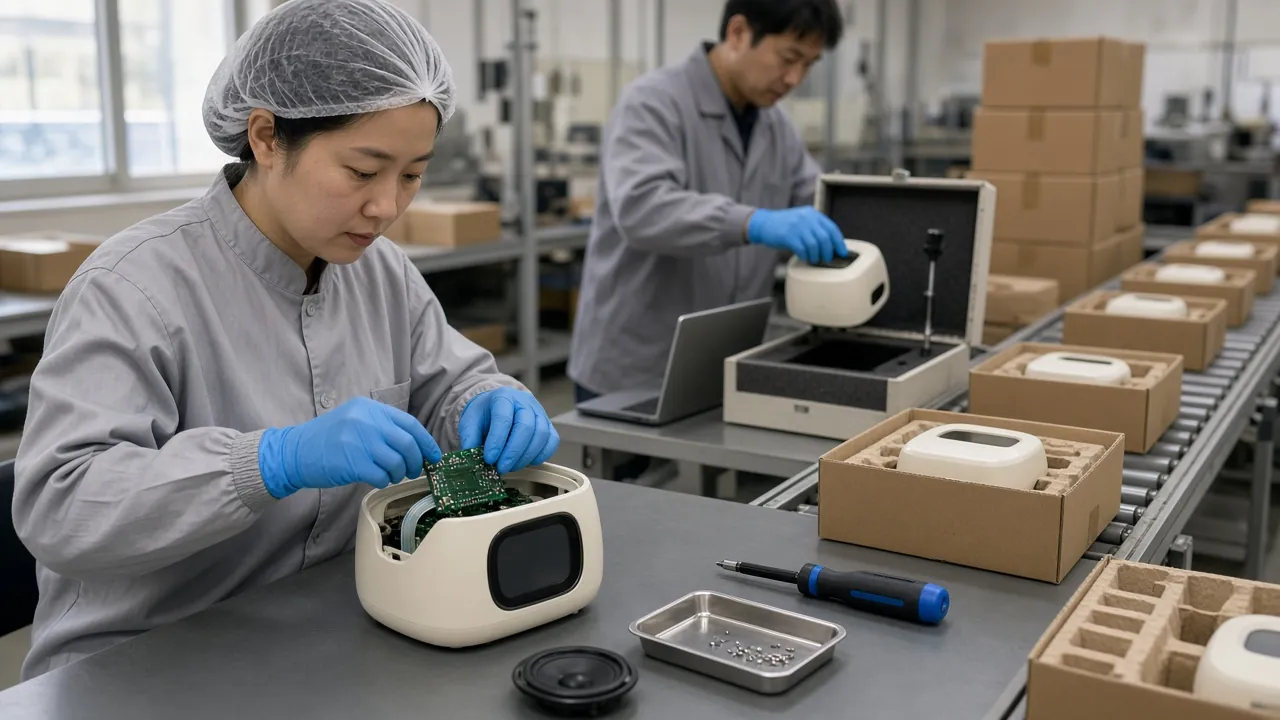
Pebblewick Labs, a 5-person seed-stage U.S. consumer AI startup, had five hand-built desktop AI companions with a mic array, speaker, round display and touch pads, a campaign video and crowdfunding backers waiting for units. The samples shared one open acoustic cavity, the display flex ran over the speaker magnet, the touch pads drifted with humidity, and the team had never taken a device through EVT, DVT and PVT.
The Illuminious engineering team ran a DFM review that fixed acoustic isolation, display FPC routing and touch-pad grounding before EVT, then built EVT boards in our Shenzhen factory with 3D-printed shells and a first audio test fixture. DVT moved the housing to a soft tool before steel, added functional and audio test plus EMC and RF pre-scans, and closed with a signed golden sample. A PVT pilot with production test fixtures fed fixes back to the line before box build of the first production batch.
The challenge: Pebblewick Labs had five hand-built desktop AI companions, a campaign video and a list of crowdfunding backers waiting for a ship date. Company name and individuals have been anonymized for confidentiality. The 5-person, seed-stage U.S. consumer AI startup designs a small desk device that listens through a mic array, answers through a speaker, shows expressions on a round display and reacts to touch pads on its shell. The samples worked on a desk. Nobody on the team had taken a product with a microphone, a speaker and a radio in the same small housing through EVT, DVT and PVT, and every backer was counting on the first production batch.
The category is growing from a real base. QY Research estimates the desktop AI robot companion market at US$523 million in 2025, reaching US$840 million by 2032 at a 7.1% compound annual rate, with about 2 million units sold worldwide in 2024 at an average price near US$250. At that price, there is little margin for a re-cut mold or a late batch. AI companion device manufacturing is mostly an audio and assembly problem: the speaker, the mics and the housing have to be designed together, then built and tested the same way on every unit.
Pebblewick sent its schematic, layout, BOM, firmware build and the CAD for its 3D-printed shell. We signed the client's NDA before the first call. The Illuminious engineering team planned the work as a stage path, from DFM to a first production batch in our own factory in Shenzhen, with a written report at every gate:
Mic-to-speaker isolation, display FPC routing and touch-pad grounding, all closed on paper before the first EVT boards.
Housing changes landed on the soft tool at DVT. The production mold was cut once, after the design closed.
A signed record of design revision, BOM, firmware release, measured audio values and cosmetic limits that every batch is held to.
The first batch for backers left the Shenzhen factory for the client's own logistics provider.
The first finding was acoustic. On the hand-built samples, the speaker and the mic array shared one open cavity. Any always-listening device has to hear a wake word while its own speaker is playing, and echo cancellation in firmware can only remove so much of what leaks through the shell. Our engineers proposed a sealed back volume for the speaker, a gasketed port for each mic and a rib in the housing that kept speaker vibration away from the mic board. Those changes cost nothing at the drawing stage and would have meant a new mold after tooling.
The second finding was the display. The round display's FPC ran around a sharp internal corner and over the speaker magnet, which risked cracked traces and noise on the display lines. The fix was a wider bend radius, a shorter route and a stiffener at the connector. The third was touch. The capacitive pads on the shell had no clear ground reference, so readings drifted with humidity and with how the device sat on a desk. The layout gained a ground hatch under the touch controller and a defined path from each pad to the board. The DFM review is repeated before DVT and before tooling, so all three fixes were checked again before any money went into a mold. Our NPI engineering guide explains how those gates fit together.
Decision: keep the campaign samples for the video and do not ship them as a design baseline. Gate: intake of schematic, layout, BOM, firmware and shell CAD. What changed: the team stopped tuning hand-built units and moved to a buildable design.
Decision: fix acoustic isolation, display FPC routing and touch grounding before EVT. Gate: a DFM findings report with changed files. What changed: a sealed speaker volume, gasketed mic ports, a new FPC route and a touch ground reference.
Decision: build a small PCBA lot in our Shenzhen factory and fit it into 3D-printed shells. Gate: firmware bring-up of audio, display, touch, Wi-Fi and BLE, plus a first audio test fixture with a written pass definition. What changed: the speaker port was enlarged and one mic moved after the fixture showed echo leakage at high volume.
Decision: shoot the housing on a soft tool instead of committing to steel. Gate: functional and audio test on DVT units, EMC and RF pre-scans ahead of the client's own FCC certification path, and drop tests on boxed units. What changed: a snap-fit and the touch-pad wall were adjusted on the soft tool, then the golden sample was signed off in a record both parties keep.
Decision: cut the production mold after DVT closed the design and build production test fixtures before PVT. Gate: FCT stations running the production test firmware, with yield tracked by failure mode and results kept per serial number. What changed: a speaker gasket seating step and a cable dress fixture were added at the line after pilot failures traced back to assembly.
Decision: run box build in the same factory as the PCBA and molding. Gate: each batch compared with the golden sample, units joined to the client's staging network before packing, and debug ports locked. What changed: the first production batch, in the low thousands, left the Shenzhen factory in custom retail packaging for the client's own logistics provider.
A desktop companion's housing is part of its acoustic system. Wall thickness, port size and how tightly the speaker sits against its gasket all change what the mics hear. Pebblewick's EVT shells were 3D printed so the team could change ports and ribs between builds. At DVT, the housing moved to a soft tool on our injection molding presses, which run from 50 to 1000 t. Molded parts behave differently from printed ones, and the soft tool showed it: one snap-fit was too stiff and the wall behind the touch pads was thicker than the touch controller liked. Both changes went into the soft tool. The production mold was cut only after DVT closed the design, and T1 samples were measured against CAD. Our guide to injection molding for electronics housings covers wall thickness, ribs and gate placement in more detail.
The audio fixture started small. At EVT it was a closed box with a reference speaker, a reference mic and a script that checked speaker response, mic sensitivity and echo leakage on each unit. By PVT it had become the production test station, running the production test firmware and saving results per serial number. Our engineers attended the EVT, DVT and PVT builds in person in Shenzhen, so each failure was looked at on the line, not in a spreadsheet a week later. Every assembled board went through AOI, and final units went through functional test before packing. See testing and inspection for the fixtures and stations we build, and the golden sample page for what the sign-off record holds.
"Our samples sounded fine on a desk, so we assumed the hard part was done. The review showed us the speaker was talking straight into our own mics. Fixing that in a drawing instead of in a steel mold is the reason our backers got their units."
Box build assembly is where every earlier decision shows up at once. On this line, each unit took a tested PCBA, a speaker seated on its gasket, a round display on its FPC, a molded housing, a cable, a retail box and a molded pulp insert. Operators worked under ESD controls with calibrated tools at each station, and finished units were packed in anti-static packing inside the retail box. Because the PCBA ran on our 8 automated SMT lines with 01005 placement, the housings came off presses in the same factory and the custom packaging was built there too, a fix found at pilot could go back to the right station before the next batch. Our box build assembly services page and PCB assembly page describe the processes in more detail, and the Shenzhen factory runs under ISO 9001.
"The pilot found two assembly problems we would never have caught with five hand-built units. Each one came back with a fix at the station, and the next batch matched the golden sample."
Planning a desktop companion, smart speaker or other personal AI device? Start with NPI engineering for the DFM review and EVT to PVT planning. Founders who want to see a box-build line before they commit can join the Shenzhen Founder Tour, Dec 6–11, 2026, a licensed Future Factory program, hosted by Illuminious, with an early-bird price of USD 3,000 until Nov 15.
Illuminious is a U.S. NPI engineering company. Engineered in San Francisco. Prototype builds, DFM and mass production in our own factory in Shenzhen. Send your schematic, BOM and housing CAD, and our engineers will walk through DFM, EVT, DVT and PVT with you. Instant price for configurable services · Free engineering review in 1–2 business days · Official quote within 24 hours.
"Our samples sounded fine on a desk, so we assumed the hard part was done. The review showed us the speaker was talking straight into our own mics. Fixing that in a drawing instead of in a steel mold is the reason our backers got their units."
Consumer IoT / Pet Wearables / Smart Collar PCBA + Overmolding + NPI
Physical AI / Warehouse Robotics / Edge-AI Perception Module + Quick-Turn PCBA + NPI
Logistics / Asset Tracking IoT / Overmolded Enclosure + LoRa PCBA + NPI
Let's discuss how we can help your project succeed with our end-to-end manufacturing capabilities.