The global additive manufacturing market has reached $37.64 billion in 2026, up from $30.55 billion in 2025, and the story is no longer about prototyping — it is about production. Metal 3D printing technologies like DMLS and SLM are now producing batches of thousands of parts for aerospace, medical, and automotive applications. With AI-driven print optimization reducing failure rates and material waste by over 40%, hardware startups are increasingly using 3D printing as a bridge manufacturing strategy — producing their first 100 to 1,000 units while waiting for injection mold tooling to be completed.
Key Details
- Market size: The global additive manufacturing market reached $37.64 billion in 2026, growing 23% year-over-year from $30.55 billion in 2025, according to Grand View Research. The market is projected to exceed $140 billion by 2035.
- Production shift: VoxelMatters 2026 reporting confirms that additive manufacturing is increasingly used for batches of thousands of production parts, not just one-off prototypes. LPBF technology leads this transition with improved throughput and reliability.
- AI optimization: Carnegie Mellon researchers demonstrated LLM-based multi-agent systems that detect and correct 3D printing defects in real time, reducing failure rates by over 40%. The AI in 3D printing market alone is valued at $4.62 billion in 2026, growing at 39.5% CAGR.
- Cost economics: For low-volume production under 1,000 units, 3D printing delivers 60-90% cost savings over traditional tooling, which typically requires $5,000-$50,000+ in upfront mold investments before a single part is produced.
Metal LPBF Goes Mainstream
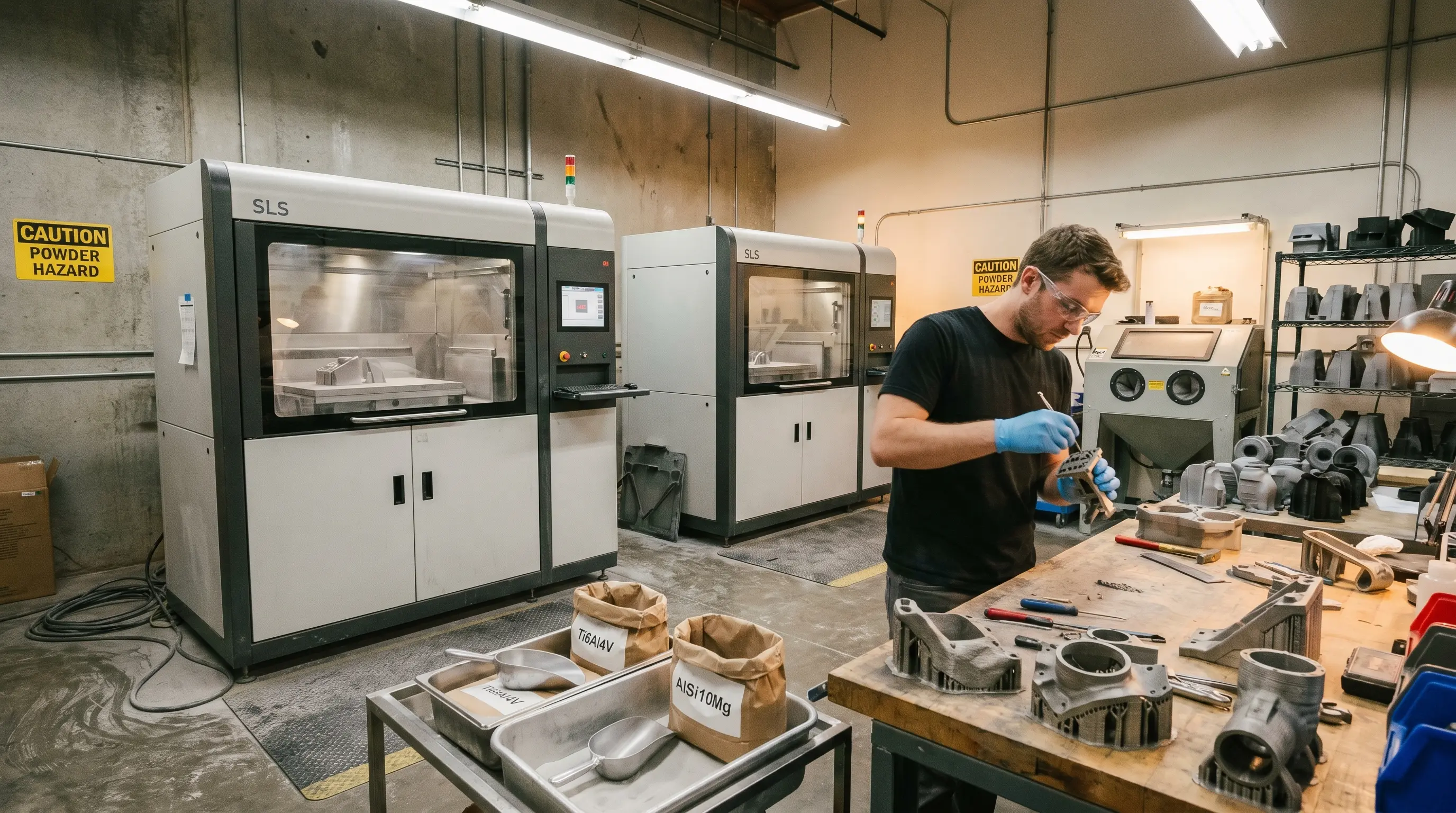
Laser Powder Bed Fusion has matured from aerospace-only prototyping to mainstream production. Companies like TRUMPF, AddUp, and EOS now ship multi-laser systems capable of producing thousands of metal parts per month with mechanical properties matching forged equivalents.
AI-Driven Quality Control
Multi-agent LLM systems monitor print quality in real time, identifying defects and adjusting parameters autonomously. This reduces material waste by 40%+ and eliminates the trial-and-error cycles that previously made metal AM prohibitively expensive for production runs.
Bridge Manufacturing Strategy
Startups use SLA, SLS, MJF, and FDM 3D printing to produce their first 100-1,000 units while injection mold tooling is being fabricated. This approach cuts time-to-market by 8-12 weeks without committing to hard tooling before design validation.
Sustainability Advantage
Additive manufacturing generates up to 90% less material waste than CNC machining for complex geometries. Recycled metal powder and closed-loop polymer systems are making AM increasingly attractive for ESG-conscious hardware companies.
No Tooling Investment
Start producing parts immediately without $5K-$50K+ mold costs
8-12 Week Head Start
Ship product while injection mold tooling is still being built
Design Freedom
Iterate on geometry between batches without mold modifications
Full Spectrum Technologies
SLA for smooth finishes, SLS for durability, MJF for speed, DMLS for metal
Risk Mitigation
Validate market demand before committing to mass production tooling
Material Efficiency
Up to 90% less waste than subtractive CNC machining methods
— Ethan Yip, CTO at Illuminious"The economics of additive manufacturing have fundamentally shifted. We are seeing hardware startups use 3D printing not as a prototyping step but as a legitimate production strategy for their first 1,000 units. Metal DMLS parts now match the mechanical properties of cast components, and AI-driven optimization has made polymer printing reliable enough for end-use products. This is no longer experimental — it is the smartest path to market for low-volume hardware."
From Prototype to Production Partner
The additive manufacturing market is projected to exceed $140 billion by 2035, driven by production applications rather than prototyping. For hardware startups, the implications are clear: 3D printing has become a strategic production tool that bridges the gap between concept and mass manufacturing. Companies that leverage AM for bridge production gain 8-12 weeks of market advantage while reducing upfront capital risk.
Explore how Illuminious can support your product launch with 3D printing, injection molding, and CNC machining under one roof.