Every shipped hardware product passes through the same five gates — and most startups that fail, fail because they skipped one. New product introduction, or NPI, is the structured process that takes a product from working prototype to a production line that can build thousands of units without engineering chaos. It is also where the global electronics industry is concentrating its growth: the electronic manufacturing services market is projected to reach $690.36 billion in 2026 and climb past $1.15 trillion by 2034, according to Fortune Business Insights. For hardware founders, understanding what NPI actually means — phase by phase, deliverable by deliverable — is the difference between a launch and a lesson.
Search interest tells the story of a knowledge gap. Queries like "npi manufacturing," "npi electronics manufacturing," and "new product introduction services" generate steady monthly demand from founders and engineers trying to decode the term that every contract manufacturer throws around. Yet many first-time hardware teams treat NPI as a black box: they finish a validated prototype, hand files to a factory, and expect production to simply begin. What follows instead is the most expensive education in hardware — revision spirals, tooling rework, and pilot builds that never converge.
This guide breaks down the five phases of NPI in manufacturing, what each gate demands, and how 2026 market conditions change the calculus for startups choosing where and with whom to introduce their product.
Key Details
- What NPI covers: Five phases — concept and feasibility, EVT, DVT, PVT, and mass production ramp — each with defined entry and exit criteria that turn engineering intent into repeatable factory output.
- Timeline reality: The EVT-DVT-PVT sequence alone typically spans 16-30 weeks for a moderately complex product, before adding concept work and the production ramp.
- Market context: The global EMS market reaches an estimated $690 billion in 2026, with the US segment growing from $185 billion toward $267 billion by 2031 on reshoring demand.
- Stakes: Industry estimates put hardware startup failure rates near 90%, and process discipline during NPI — not product vision — is the most cited operational cause.
NPI is not a document or a meeting. It is a gated process where each phase answers one question and one question only. Answer it, prove it with data, and move forward. Fail it, and the loop costs weeks. The five phases below reflect how experienced electronics contract manufacturers actually run programs in 2026.
Phase 1: Concept & Feasibility
The gate question: can this be built, at a target cost, with today's supply chain? Teams lock requirements, run cost models against BOM assumptions, and screen component availability before a single layout file exists. Skipping feasibility is how startups discover in PVT that their chosen PMIC has a 40-week lead time.
Phase 2: EVT — Engineering Validation
The gate question: does the engineering work? Hand-assembled or soft-tooled builds — often 5 to 50 units — prove the schematic, the stack-up, and the firmware under real conditions. DFM feedback from the PCB assembly floor flows back here, where changes still cost days, not months.
Phase 3: DVT — Design Validation
The gate question: does the design survive the real world? Production-intent parts, environmental and regulatory testing, reliability runs. DVT freezes the design: after this gate, every change triggers requalification, so finding a thermal problem here is expensive — finding it in MP is existential.
Phase 4: PVT — Production Validation
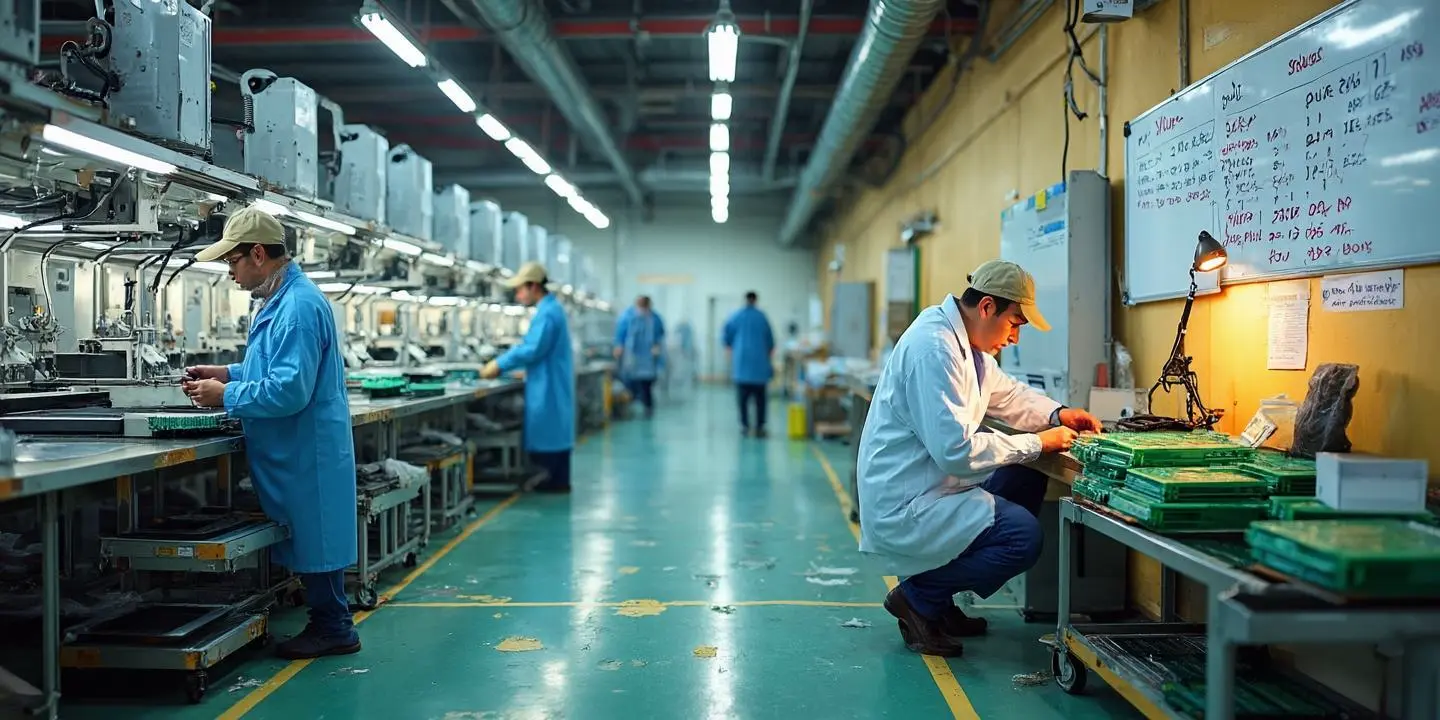
The gate question: can the line build it repeatably? Pilot runs on the actual SMT lines, with actual operators, test fixtures, and AOI programs. Yield data, cycle time, and first-pass test rates decide the go. PVT is where the factory, not the lab, becomes the arbiter of quality.
Phase 5: MP Ramp
The gate question: can volume scale without drift? Yield monitoring, ECO control, supplier scorecards, and capacity planning turn a validated pilot into a stable pipeline. Strong NPI programs carry golden samples, test limits, and process documentation straight into MP — weak ones rediscover problems at 10,000 units.
The 2026 market backdrop sharpens every one of these gates. The US electronics manufacturing services market is projected to grow from $185.30 billion in 2026 to $267.44 billion by 2031, driven by reshoring and advanced-electronics demand, according to a September GlobeNewswire market analysis. Global EMS growth toward $1.15 trillion by 2034 means capacity is abundant — but also that first-time founders are choosing among more partners, more geographies, and more quotes than ever, with less experience telling them what to check.
That experience gap shows up in the same places, program after program. The most expensive NPI failures are rarely exotic — and they map directly to the NPI engineering services a partner should be running from day one. They are predictable, and they cluster around decisions made in the first two phases:
Compressed Feasibility
Teams that skip BOM cost modeling and component screening meet those omissions in EVT as redesigns. A feasibility phase costs weeks; skipping it costs a board spin.
Premature Hard Tooling
Committing $50K-$200K injection tooling before DVT locks the wrong part forever. Bridge tooling and soft tooling exist precisely to defer this bet.
Late DFM Feedback
DFM review after layout freeze turns every suggestion into a revision. Assembly-floor feedback in EVT — 72-hour turnarounds are now table stakes — catches the same issues for free.
Test as an Afterthought
ICT and FCT fixture design that starts at PVT delays every gate before it. Test strategy belongs in EVT, alongside the first board.
Single-Shore Lock-In
Qualifying one factory in one country ties launch dates to one supply chain. Dual-shore NPI packages — qualified once, ramped where capacity and tariffs favor — hedge the risk.
Documentation Debt
Golden samples, workmanship standards, and revision-controlled BOMs feel bureaucratic at 50 units and indispensable at 5,000. Building them during NPI is the cheapest moment.
For startup teams, the practical takeaway is that NPI quality is mostly decided by what the manufacturing partner does before production starts — and how early they do it. A partner who treats NPI as a service rather than a phase delivers DFM feedback inside days of receiving CAD, runs feasibility screening against live component inventories, and staffs the program with an engineer who answers the founder directly. One who quotes only the build delivers the build, and leaves the gates to chance.
— Angela Lee, COO at Illuminious"The founders who ship are rarely the ones with the smoothest prototype demo. They are the ones whose NPI partner pushed DFM feedback in the first 72 hours and refused to let them skip a validation gate. Process discipline is invisible right up until the moment it is the only thing standing between you and a six-figure tooling mistake."
The demand signals bear this out. Google Search Console data for illuminious.com shows hundreds of monthly impressions across the NPI query cluster — "npi manufacturing," "npi electronics manufacturing," "new product introduction services" — from engineers actively researching the process, most landing on pages that explain the acronym without explaining the discipline. The gap between searching for NPI and executing it is where programs stall — and why the Series B hardware funding wave translates into NPI capacity demand rather than shipped product.
For teams entering 2027 planning cycles, the playbook is straightforward: gate every phase with written exit criteria, demand DFM and feasibility feedback in the first week of every board spin, keep hard tooling commitments until DVT data justifies them, and qualify the NPI package in a way that lets production ramp on whichever shore wins the capacity and tariff equation. Hardware startups that raise $2.3 billion in a quarter, as the AI hardware cohort did in early 2026, are not short of capital. They are short of manufacturing process — and NPI is the process.
From Acronym to Advantage
NPI in manufacturing is not paperwork — it is the operating system that converts a validated design into a factory that cannot build it wrong. The five phases exist because each one retires a specific risk at the cheapest possible moment, and the startups that respect the gates are the ones whose first production run is their second act, not their last stand.
Evaluating an NPI partner for your next build? Illuminious runs the full five-phase program in our own factory in Shenzhen with 72-hour DFM feedback, free engineering review, and US-based program management. Talk to our NPI engineering team or read the complete NPI engineering guide to pressure-test your launch plan.