Series B is the moment a hardware startup stops being a demo and becomes a product. The largest AI hardware rounds of 2026 are landing at companies that must now physically manufacture at volume: Positron AI closed an oversubscribed $230 million Series B in February at a valuation above $1 billion, MatX raised $500 million the same month, Neura Robotics secured up to $1.4 billion in August, and Apptronik, Walden Robotics, Skild AI, and AlpSemi all landed rounds that convert directly into tooling, NPI engineering, and production slots. Following our earlier coverage of the $2.3 billion AI hardware funding wave, the pattern through mid-2026 is unmistakable: capital has rotated from GPU infrastructure efficiency plays to product companies — edge AI devices, robotics, physical AI, and energy hardware — and every one of them needs a factory.
Key Details
- Positron AI — $230M Series B, February 4, 2026: Co-led by ARENA Private Wealth, Jump Trading, and Unless, with strategic investment from Qatar Investment Authority, Arm, and Helena. The Reno-based inference chip company reached unicorn status 34 months after founding and targets its next-generation Asimov chip for tape-out in late 2026 with production in early 2027.
- MatX — $500M Series B, February 24, 2026: Led by Jane Street and Situational Awareness, the fund formed by former OpenAI researcher Leopold Aschenbrenner. Founded by two ex-Google TPU engineers, MatX will produce its AI training chips with TSMC, with first shipments targeted for 2027.
- AlpSemi — €17M, June 2026: Grenoble-based wide-bandgap power semiconductor developer backed by Yotta Capital, SE Ventures, Navitas Semiconductor, and Cycle Group to industrialize solid-state circuit breakers for 800V DC AI data center power networks.
- Robotics mega-rounds, July–August 2026: Germany's Neura Robotics raised up to $1.4 billion in a Tether-led round; UK-based Walden Robotics landed $300 million from Menlo Ventures, NVIDIA, Boeing, and Toyota Ventures; Skild AI tripled its valuation to $14 billion in seven months on a $1.4 billion round.
- Record sector funding: Crunchbase reports 2026 venture funding into robotics hitting record levels as investors rotate from asset-light AI software into embodied AI and physical products — companies whose growth is measured in units shipped.
From Efficiency Plays to Product Companies
The 2025 funding cycle rewarded GPU infrastructure efficiency — interconnects, cooling, and cloud optimization. The 2026 cycle rewards companies that ship physical goods. Positron builds complete inference systems around its own silicon. Apptronik's $520 million Series A extension — backed by Google, Mercedes-Benz, and John Deere — funds production of the Apollo humanoid robot. Walden Robotics' two-armed mobile robots are headed for manufacturing and logistics floors. Even AlpSemi's data center components are physical power switches that must be packaged, qualified, and produced at scale. These are not software-margin businesses — they are bill-of-materials businesses where time-to-market is set by the factory, not the deployment pipeline.
Why Series B Is the Manufacturing Inflection Point
Series A buys proof: 25-100 hand-built units on development boards, 3D-printed enclosures, firmware that mostly works. Series B buys production: injection molds and custom tooling, test fixtures, certification runs, and first production volumes of 5,000-50,000 units across the full EVT-DVT-PVT-MP NPI cycle. This is precisely when a startup discovers its prototype was never designed for volume — non-panelizable board outlines, single-sourced components, no test points, hand-soldered connectors that a pick-and-place machine cannot replicate. Series B capital converts to revenue only if the design survives contact with an SMT line.
The NPI Capacity Crunch
Every newly funded hardware team now competes for the same scarce resources: NPI engineering bandwidth, SMT line slots for pilot builds, and component allocation in a market where PMIC lead times already run 35-52 weeks. Contract manufacturers that once quoted 8-week NPI starts are quoting 14 or more. Startups that lock manufacturing capacity within 90 days of closing their round consistently reach market 4-6 months earlier than those who treat production as a later-stage problem — a gap that often decides which company in a funded cohort survives to Series C.
The Prototype-to-Volume Trap
The most expensive surprise in hardware is a design that works at 50 units and fails at 5,000. The recurring failures are predictable: components that go on allocation mid-production, boards without panelization rails, enclosures that cannot be injection molded, assemblies that need manual rework because test coverage was an afterthought. A structured DFM review before tooling commitment costs days; discovering these issues at PVT costs months and burns the runway the Series B was supposed to protect.
Days 1-30: DFM Audit
Get the design reviewed for volume — panelization, fiducials, test point coverage, component orientation, single-pass reflow compatibility — before any tooling is cut
Lock Long-Lead Components
Place orders for 40+ week parts immediately after the round closes. PMICs, MCUs, and memory dominate delay risk. Negotiate buffer stock with your manufacturing partner
Define Golden Samples
Freeze reference units that define accept and reject criteria for every supplier and production stage. Ambiguous quality standards become expensive disputes at volume
Reserve Pilot Line Capacity
Book SMT line slots and NPI engineering bandwidth for EVT and PVT builds now. Line calendars at quality manufacturers are filling quarters ahead in 2026
Select Your Quality System
Match certification to market: ISO 9001 for general electronics, ISO 13485 for medical devices, IATF 16949 for automotive. Retrofitting quality systems mid-production stalls launches
Plan Dual-Shore From Day One
Run engineering-intensive NPI close to the design team and volume production where tariffs and labor favor it. Dual-shore strategies cut both cost and geopolitical risk
— Ethan Yip, CTO at Illuminious"We watched the 2026 funding calendar fill up and immediately saw the echo in our NPI pipeline. A Series B wire hits the startup's account, and six weeks later we get the call — and half the time the design was built for an investor demo, not for a pick-and-place machine. The teams that win are the ones that walk into their manufacturing partner's facility within a month of closing, with their BOM, their gerbers, and honest questions. The factory can solve almost anything except a customer who arrives late."
The funding-to-manufacturing pipeline now runs on a predictable clock. Positron's Series B explicitly funds the Asimov chip through tape-out in late 2026 and into production in early 2027 — an 18-month window in which board design, test development, and production ramp must all be sequenced. MatX's $500 million follows the same arc, with TSMC output targeted for 2027. Meanwhile the robotics cohort — Apptronik, Walden, Skild, and China's Galaxea and ROBOTERA — faces compressed consumer and enterprise demand curves that punish late manufacturing starts. Across every category, round size maps almost linearly to manufacturing ambition: this is capital earmarked for tooling, test development, and first article production.
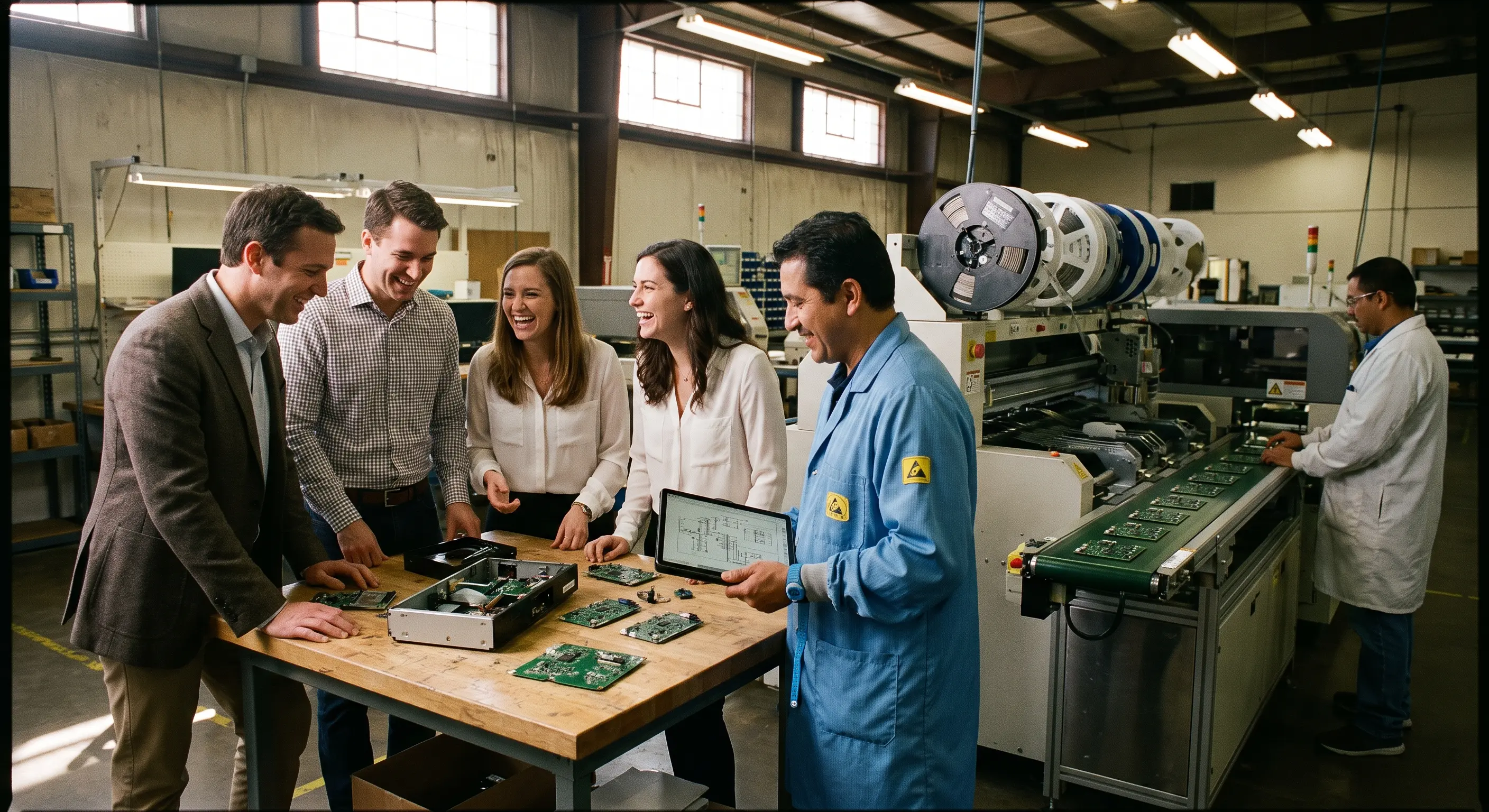
For contract manufacturers, the 2026 cycle changes the customer profile. Startup NPI demand is no longer a rounding error — it is a distinct workload class with its own requirements: no-MOQ entry points, fast DFM feedback loops, prototype quantities that arrive in days rather than weeks, and a documented path from 10 units to 10,000. Illuminious built its Startup Bridge Program for exactly this profile: no minimum order quantity, 72-hour DFM feedback on customer designs, and 72-hour PCBA prototype turnaround, backed by a dedicated US-based project manager who owns the account from first article through volume ramp.
Behind the program sits production infrastructure sized for the jump from prototype to volume: a five-phase NPI process that carries a product through engineering validation, design validation, and production validation to mass production; eight SMT lines with 01005 passive and BGA assembly capability; NPI and volume lines in our own factory in Shenzhen that separate rapid engineering builds from cost-optimized volume; and a US fulfillment center that keeps domestic delivery same-day. Quality systems including ISO 9001, ISO 13485 and IATF 16949 certificates in our own factory in Shenzhen mean funded startups can select the certification track their target market requires without changing manufacturing partners mid-ramp.
The historical pattern is instructive. In previous hardware cycles — wearables in 2014, IoT in 2017, drones in 2019 — the companies that dominated their categories were rarely those with the best demos. They were the ones that converted funding into production capacity fastest, locked component supply early, and shipped revision two while competitors were still debugging revision one at PVT. The 2026 AI hardware cohort is the largest ever funded, and the manufacturing math has not changed: capital does not ship product; factories do.
Series B Is a Manufacturing Decision
The 2026 hardware funding wave — Positron, MatX, Neura, Apptronik, Skild, AlpSemi, and dozens more — will be converted into market share on factory floors, not in pitch decks. Funded startups that execute a disciplined first 90 days — DFM audit, component lock, golden sample definition, pilot line reservation, quality system selection, and dual-shore production planning — enter 2027 with products in customers' hands. The rest spend 2027 explaining delays.
Just closed your round? Explore the Illuminious Startup Bridge Program — no MOQ, 72-hour DFM feedback, 72-hour PCBA prototypes, and a five-phase NPI path from EVT to mass production across eight SMT lines in our own factory in Shenzhen.