The global CNC machine market is projected to reach USD 108.58 billion in 2026, growing at an 11.1% CAGR through 2034, and the forces driving that growth are fundamentally different from what powered the previous decade. According to Dassault Systemes and multiple industry reports, five structural shifts are redefining precision manufacturing in 2026: 5-axis CNC machining has moved from competitive advantage to baseline expectation, AI-driven CAM automation is eliminating programming bottlenecks, and hybrid manufacturing combining additive and subtractive processes is gaining real production traction in aerospace and medical sectors.
Key Details
- Market size: The global CNC machine market reaches USD 108.58 billion in 2026, projected to hit USD 251.61 billion by 2034 at 11.1% CAGR, according to Fortune Business Insights. The machining centers segment alone grows from USD 41.43 billion to USD 67.75 billion in the same period.
- 5-axis adoption: The 5-axis CNC machining center market, valued at USD 7.35 billion in 2024, is projected to reach USD 11.99 billion by 2035. Once a specialized capability, 5-axis machining is now a baseline requirement for aerospace, medical, and complex prototype work.
- AI-driven CAM market: The CAM for CNC machining software market grows from USD 1.2 billion in 2024 to USD 2.5 billion by 2033 at 9.1% CAGR, driven by AI toolpath optimization, predictive tool wear monitoring, and automated fixture design.
- Precision machining growth: The broader precision machining market expands from USD 72.4 billion in 2025 to USD 121.8 billion by 2034 at 5.9% CAGR, with milling operations accounting for 43% of total demand and automotive representing 26% of market utilization.
5-Axis Becomes the New Standard
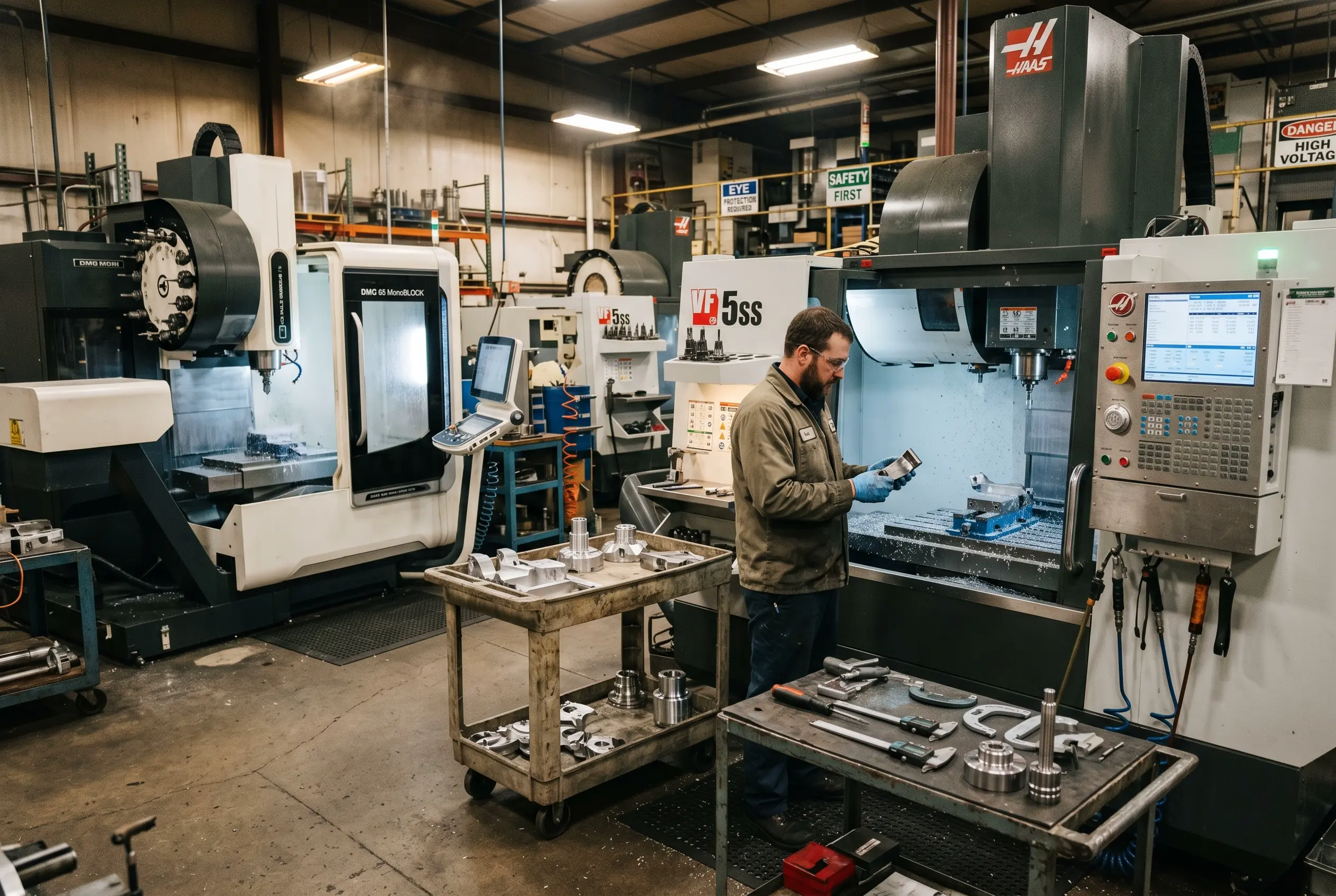
Five-axis CNC machining was once a premium capability reserved for aerospace contractors. In 2026, it has become the baseline expectation for precision parts across medical, automotive, robotics, and consumer hardware. The reason is straightforward: 5-axis reduces setups from 3-5 operations to a single fixturing, cutting lead times by 40-60% while holding tolerances as tight as ±0.01mm.
AI-Driven CAM Automation
AI-assisted CAM platforms from CloudNC, Productive Machines, and DELMIA Machining are eliminating the NC programming bottleneck. Tool path optimization, collision avoidance, and predictive tool wear monitoring now reduce setup time by over 50% while extending tool life through adaptive feed rates that respond to real-time cutting conditions.
Hybrid Manufacturing Goes Production
Hybrid platforms combining DMLS additive deposition with CNC subtractive finishing in a single setup are gaining adoption in aerospace and medical. This approach enables complex internal channels and conformal cooling features impossible with either process alone, reducing assembly steps for titanium and aluminum components.
Advanced Materials Mix
The 2026 material portfolio for precision machining centers on titanium Ti-6Al-4V for aerospace and medical implants, aluminum 7075 and 6061 for structural enclosures, stainless steel 316L and 17-4PH for surgical instruments, and PEEK for biocompatible medical components requiring both strength and radiolucency.
Fewer Setups
5-axis machining completes complex geometries in a single fixturing
Tighter Tolerances
±0.01mm precision achievable on multi-axis configurations
Faster Prototyping
AI-driven CAM cuts programming time from days to hours
Predictive Tool Life
Real-time monitoring prevents mid-run tool failure and scrap
Material Versatility
Titanium, aluminum, stainless, brass, PEEK all in one shop
Workforce Multiplier
CAM automation lets shops produce more with fewer skilled operators
— Ethan Yip, CTO at Illuminious"The machinist shortage is real, but AI-driven CAM is changing the math. Shops that once needed three senior programmers can now operate with one, because the software handles toolpath optimization and collision detection autonomously. The operator's role shifts from writing G-code to reviewing AI recommendations — and that is a fundamentally different workforce model."
For hardware startups evaluating manufacturing processes, the 2026 CNC landscape offers clear decision points. Prototyping stage: 3D printing delivers parts in days without tooling for design validation. Bridge production: CNC machining produces 10-500 units with production-grade materials and tolerances while die casting or injection mold tooling is being built. Volume production: die casting and injection molding take over once the design is frozen and demand exceeds 1,000+ units.
Illuminious supports this full spectrum with 3-axis, 4-axis, and 5-axis CNC milling, turning, Swiss lathe machining, and micro-machining capabilities. The facility handles aluminum, titanium, stainless steel, brass, copper, and engineering plastics including PEEK, with tolerances down to ±0.01mm. For hardware startups navigating NPI, integrated CNC, 3D printing, and die casting under one roof eliminates the coordination overhead of managing multiple suppliers across prototype, bridge, and volume stages.
The Bottom Line for Hardware Teams
The 2026 CNC machining industry report makes one thing clear: precision manufacturing is no longer bottlenecked by machine capability or operator skill — it is bottlenecked by how quickly teams can move from CAD to finished part. With 5-axis machining as the new baseline and AI-driven CAM compressing programming time from days to hours, the competitive advantage has shifted from shops with the best equipment to those with the most integrated workflow.
Ready to move from design to precision parts? Get a CNC machining quote within 24 hours on business days.