The component sourcing landscape in 2026 has fundamentally shifted. AI data center infrastructure demand is creating cascading shortages across the component categories that hardware startups and mid-stage companies depend on most: power management ICs, analog chips, industrial microcontrollers, and DRAM. PMIC lead times have stretched to 35-52 weeks, up from 12-18 weeks in early 2025. Analog IC allocation has tightened as Texas Instruments and Analog Devices prioritize automotive and AI infrastructure orders. Industrial MCU availability sits at 40-60% allocation for non-automotive customers. DRAM prices have surged 80-90% quarter over quarter as HBM production displaces conventional memory capacity. For hardware companies without enterprise allocation contracts, the impact is severe — and it requires a fundamental rethink of how products are designed and sourced.
Key Details
- PMIC lead times at 35-52 weeks: TrendForce reports PMIC lead times running 35-40 weeks, with some categories extending beyond 50 weeks. Samsung's planned 8-inch wafer fab closure in Korea further squeezes PMIC capacity built on mature process nodes from 90nm to 350nm.
- Analog IC allocation tightening: Texas Instruments extended power-management lead times and implemented price increases effective April 2026 — some specific power ICs up 85%. Analog Devices is advising customers to place orders six months in advance. Non-automotive buyers face 40-60% allocation cuts.
- DRAM prices surging 80-90%: HBM-to-DDR5 conversion runs at roughly 3-to-1 ratio. With HBM sold out through 2026, manufacturers diverted wafer capacity away from standard DDR4 and DDR5. DDR4 spot prices have surged over 1,360% since April 2025 in extreme cases.
- Counterfeit risk escalating: US Customs and Border Protection reported significant counterfeit electronics seizures in early 2026. Industry estimates suggest 5-10% of parts in distribution channels during shortage periods are counterfeit or remarked — costing the industry $7-10 billion annually.
PMIC Squeeze: Power Delivery Bottleneck
Every AI server rack demands sophisticated power delivery — voltage regulators, power converters, gate drivers, and current sensors managing hundreds of kilowatts flowing to GPU clusters. This demand cascades into the broader market because PMICs are manufactured on mature 90nm to 350nm process nodes shared across automotive, industrial, and consumer applications. The global PMIC market reaches $29.9 billion in 2026, growing at 8.22% CAGR through 2035, according to Business Research Insights. uPI Semi and other PMIC designers forecast supply shortages persisting throughout 2026.
Analog IC Allocation Reality
TI and ADI are prioritizing high-volume automotive and AI infrastructure contracts. Industrial and consumer buyers receive 40-60% allocation of their historical order volumes. Logic ICs and programmable logic reach 25-40 week lead times per Accuris data. A procurement professional quoted in Utmel's 2026 market report stated: "TI's recent 85% jump on our specific power IC forced us to redesign the board completely. Multi-sourcing is mandatory now." For hardware startups without allocation contracts, the situation means 3x longer lead times compared to enterprise customers.
DRAM Displacement by HBM
High-bandwidth memory production for AI accelerators consumes wafer capacity at roughly 3-to-1 ratio versus standard DDR5. AI data centers now consume approximately 70% of high-end DRAM output in 2026. DDR4 faces a peculiar price inversion — as manufacturers phase it out, per-GB pricing exceeds DDR5 in some spot markets. Industrial and medical device manufacturers locked into legacy DDR4 designs face panic buying scenarios. TrendForce reports Q4 2025 contract increases of 8-13%, with server DRAM up 40-50% and fulfilment rates falling to 70%.
Counterfeit Risk During Shortages
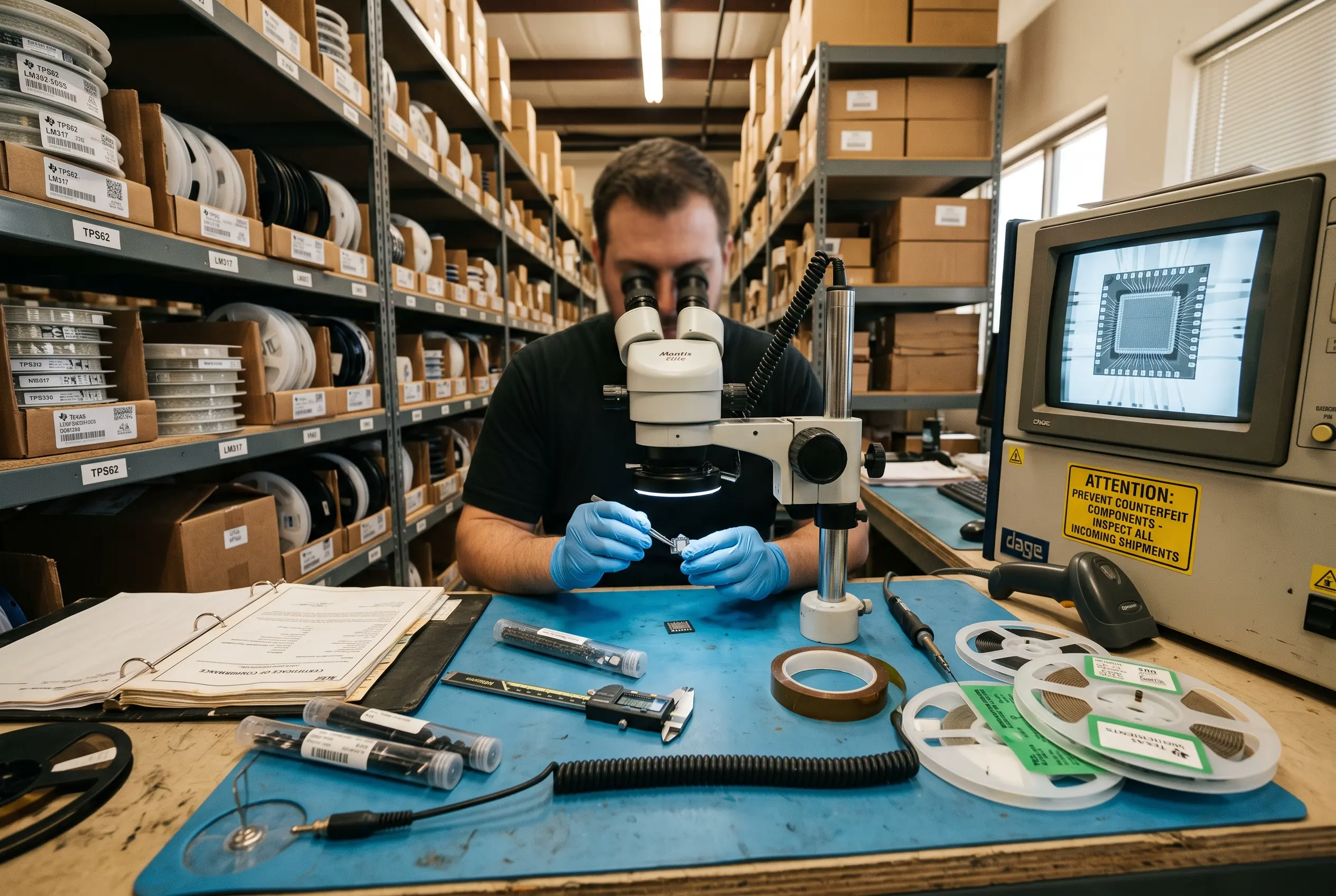
Counterfeiters follow margin. As component scarcity intensifies, gray market channels flood with remarked, reconditioned, and harvested components. 5-10% of parts in distribution channels during shortage periods are estimated counterfeit. SMT Corp reports that faster semiconductor iteration accelerates obsolescence, pushing procurement toward high-risk aftermarket channels. Industries with extended lifecycle requirements — industrial controls, aerospace, defense, medical — face the greatest exposure as they need parts long after commercial markets move on.
Multi-Source Design Strategy
Design circuits to accept 2-3 alternate PMICs and MCUs from different manufacturers. Specify pin-compatible alternatives for critical voltage regulators during NPI design phase
Buffer Stock Management
Maintain 8-12 week buffer for critical components, especially single-source parts. Work with a manufacturing partner who can hold consignment inventory at their facility
Lifecycle and EOL Monitoring
Check component end-of-life status before design-in. Avoid parts within 18 months of discontinuation. Implement EOL monitoring with 6-month advance alerts and last-time-buy recommendations
Authorized Distributor Only
Source exclusively from franchised distributors — DigiKey, Mouser, Arrow, Avnet — or directly from manufacturers. Avoid independent brokers during shortage periods when counterfeit risk peaks
Incoming Inspection Protocol
Require full traceability documentation. Implement visual inspection plus X-ray for die verification on critical components. Electrical testing on first article catches remarked parts
Regional Sourcing Diversification
Chinese semiconductor manufacturers like SMIC and GigaDevice offer alternatives for MCUs and analog chips. ASEAN sourcing through Indonesia provides tariff advantages and supply chain resilience
— Ethan Yip, CTO at Illuminious"The component shortage of 2026 is not a temporary disruption — it is a structural realignment. AI infrastructure demand has permanently reshaped how semiconductor capacity is allocated, and hardware companies that design for component resilience will be the ones shipping on time. At our Shenzhen facility, we have invested heavily in authorized supplier relationships, incoming inspection, and buffer stock management because our customers cannot afford a production line stoppage over a ten-cent component. The teams winning right now are the ones treating sourcing as a design problem, not a procurement problem."
The root cause of the 2026 shortage traces back to wafer capacity allocation. TSMC and Samsung are dedicating advanced node capacity to AI accelerators — GPUs and custom ASICs that command premium pricing. This cascades into mature node pressure because PMICs, analog ICs, and many MCU families are manufactured on 180nm to 350nm processes running on 8-inch wafer lines. When Samsung reportedly plans to shut down its 8-inch wafer fab in Korea, the ripple effect hits every product that uses a voltage regulator or power management chip. TrendForce, Kynix Semiconductor, and uPI Semi all converge on the same forecast: PMIC supply constraints persisting through 2026 with lead times of 35-40 weeks as the new baseline.
BOM cost inflation compounds the sourcing challenge. PMIC pricing is up 15-25% from 2025 baselines. Analog ICs have risen 10-20%. MCU pricing increased 8-15%. DRAM remains the most volatile category — contract prices projected to rise 58-63% in Q2 2026 alone according to ASC Global analysis. For hardware startups operating on thin margins during NPI, these cost increases can eliminate profitability on early production runs unless pricing strategies account for component inflation.
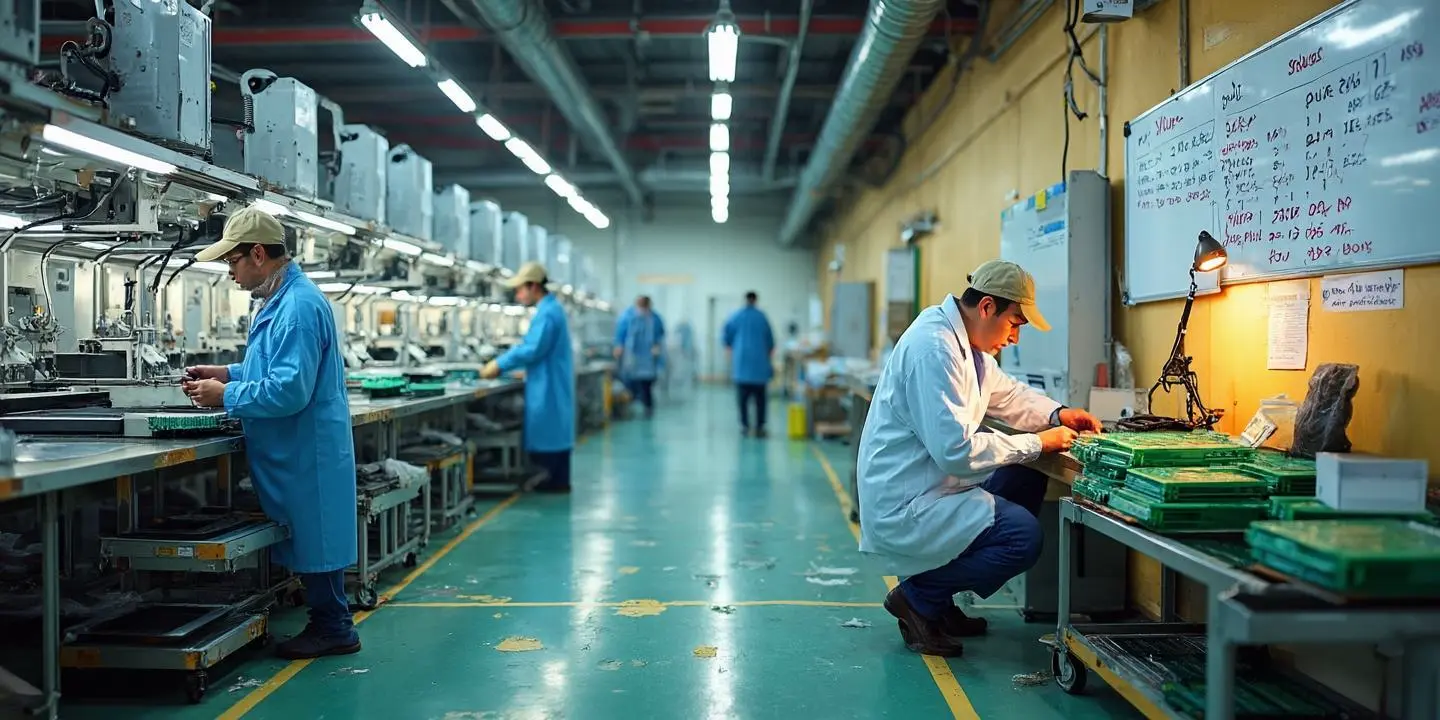
Illuminious manages component sourcing for customers through a structured approach built over years of navigating volatile semiconductor markets. The company maintains 1,200+ authorized supplier relationships across major franchised distributors and direct manufacturer channels. A dedicated sourcing team in Shenzhen monitors real-time allocation, lead time, and pricing data across all critical component categories. Incoming inspection covers 100% of critical components through a multi-stage counterfeit prevention program — visual inspection under microscope, X-ray imaging for die verification, and electrical testing on first article. Buffer stock management maintains 8-week safety inventory for recurring production orders. Component EOL monitoring provides customers with 6-month advance alerts and last-time-buy recommendations, preventing the scramble that occurs when a critical part receives discontinuation notice mid-production.
Regional sourcing dynamics offer additional resilience. Chinese semiconductor manufacturers — SMIC, GigaDevice, and兆易创新 — have matured significantly, offering viable alternatives for MCU and analog chip requirements. Our own factory in Shenzhen sits inside the world's densest component sourcing network, with authorized distributors close to the line. For high-reliability applications, Taiwan and US-based sourcing remains the preferred path. The combination of multi-region sourcing and authorized distributor relationships means Illuminious can present customers with options when a primary component becomes unavailable — rather than forcing a board redesign under time pressure.
Market outlook suggests component shortages will persist through Q2 2027. TSMC's new fab capacity in Arizona and Kumamoto may ease advanced node pressure by late 2027, but mature node capacity for PMICs and analog ICs will remain constrained longer. Hardware startups and mid-stage companies should treat the current environment as the new normal — not a temporary disruption. The companies that thrive will be those that design for component resilience from the start: multi-sourcing as a design principle, buffer stock as a financial strategy, and a manufacturing partner with the sourcing infrastructure to navigate allocation periods without missing production deadlines.
Component Resilience Is Now a Competitive Advantage
The 2026 component shortage reshapes how hardware companies must approach design, sourcing, and production planning. AI data center demand will continue consuming PMIC, analog IC, and MCU capacity through 2027. Companies that adopt multi-source design principles, maintain buffer stock, work exclusively with authorized distributors, and partner with a manufacturing expert equipped for counterfeit prevention will navigate this period successfully.
Ready to strengthen your component sourcing strategy? Explore Illuminious PCBA services or learn how we support hardware startups through shortage periods with authorized sourcing, buffer stock, and incoming inspection on every critical component.