Shenzhen tour · Dec 6–11

Apply
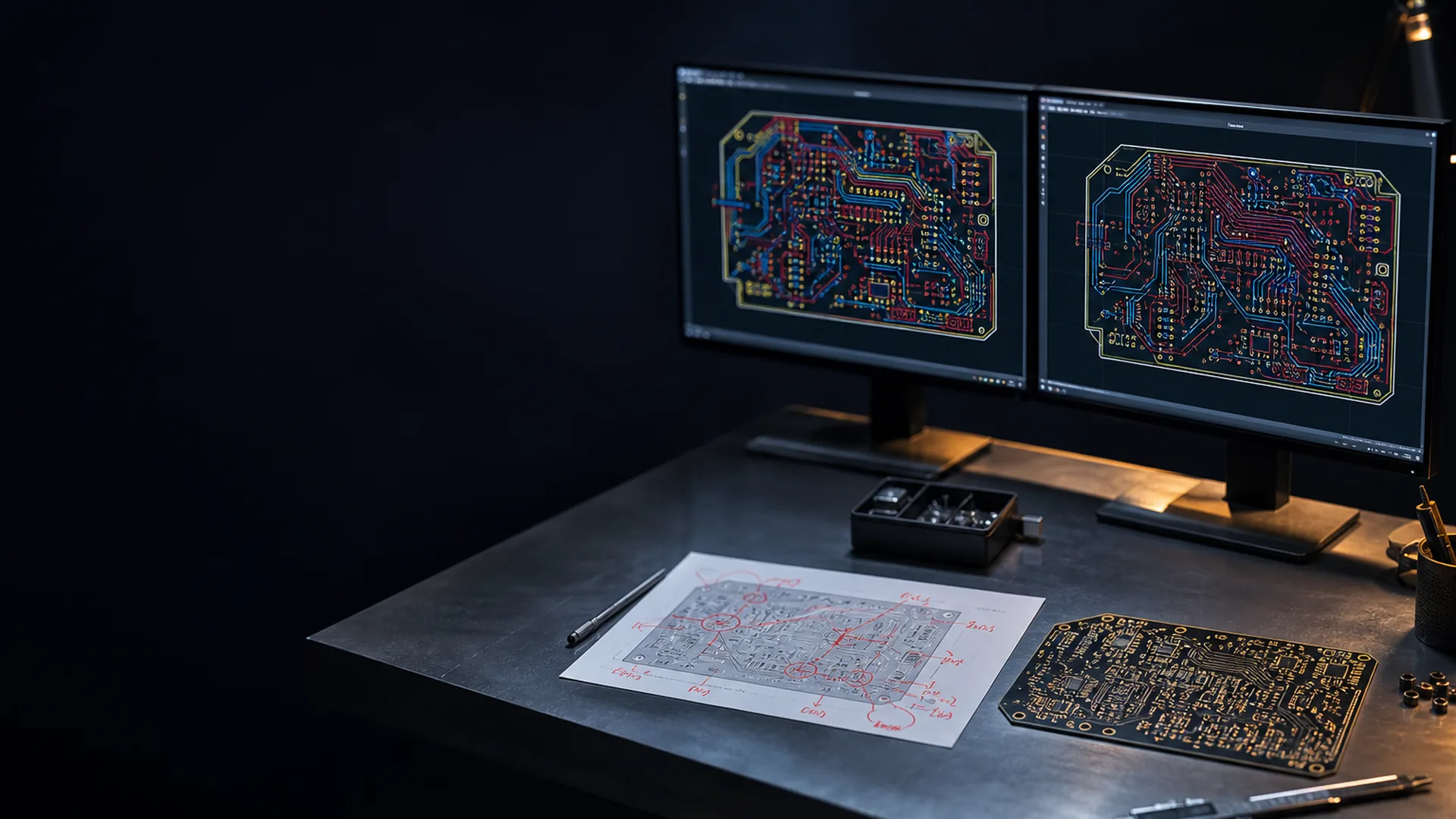
Dual monitors showing two routing revisions of the same PCB layout beside a marked-up board plot

Layout modification, scoped against what the change actually touches.

Illuminious is a U.S. NPI engineering company. Layout modification changes an existing board rather than starting one, and it is scoped against what the change actually touches instead of against the whole board. Engineered in San Francisco. Prototype builds, DFM and mass production in our own factory in Shenzhen. Upload your files, get a free engineering review, and pay only the official quote that review publishes.

Changing an existing board is its own kind of job. The work is set by what the change disturbs: which nets move, which areas re-route, and what must stay exactly where it is. An engineer reads the board to judge that, instead of counting pads.

Configure it online, or send the job to an engineer. Online, you get a live supplier price, a published tier, or an official quote prepared by a specialist within 24 hours on business days, depending on the service. Engineering review is free either way and comes before you pay.

Payment
Official price after free review
Review target
Within two business days after you submit

The configurator opens with this configuration preselected. An engineer reviews every order. Account required; engineering review is free and comes before payment.

Is your change a modification, or effectively a new layout?

  • Component changes and end-of-life replacements
  • Board outline, connector, or mounting changes
  • Correcting a specific area without redesigning the board
  • Adding a circuit block to a proven design
Typical orders
One modification scope per project, delivered through the same approval milestones as a new layout.
Accepted files
The existing layout source and schematic, plus a written description of the change. Marked-up plots, mechanical DXF, updated BOM, and datasheets for new parts upload to the same project.
Payment basis
Official price after free review
Preparation workbook
Download the intake workbook

The choices that decide the part.

Each of these is a real configuration decision with a cost and a consequence, not a feature list. Where one of them constrains another, engineering review is the step that resolves it.

Component change

A part changed, replaced, or gone end-of-life. The footprint may differ, the routing around it may need to move, and the surrounding placement may or may not survive, which is exactly what review determines.

Mechanical change

A new outline, a moved connector, a changed mounting pattern. These ripple outward further than expected, so the mechanical DXF matters as much as the schematic.

Targeted re-route

One area corrected while the rest of the board stays untouched. The value here is precisely that the rest stays untouched, which review confirms explicitly.

Added circuitry

A new block on a proven board. Scoped by where it fits and what it displaces rather than by its own size.

What the configurator prices, and where review takes over.

Layout modification capability bounds
ParameterSupported range
ServiceLayout modification: change to an existing board layout.
Source requirementUsable EDA source is needed. Without it, review says whether the work is a modification or a re-layout before you commit.
Board classRigid, flex, HDI, RF/high-speed, or power. All but rigid route to engineering review.
Layers2, 4, 6, 8, 10, 12, or 16 layers.
Board size and complexity5–600 mm per side, 1–100,000 estimated pads, components on one or two sides.
EDA toolsAltium Designer, KiCad, EasyEDA, Cadence, or another tool we convert. Conversion routes to review.
Approval milestonesPlacement approval and routing approval, applied to the changed region.
DeliverablesEDA source, Gerbers, BOM and CPL, DXF, assembly and fabrication PDFs, 3D model, production instructions.

The bounded thing here is the change, not the board. Review's job is to state in writing what is inside the scope and what is not, so that neither side discovers the boundary halfway through.

Boundaries

  • A modification whose scope grows past the reviewed change is re-scoped and re-quoted rather than absorbed
  • Without usable source files, a modification can become a re-layout; review says so before you pay, not after
  • Reverse engineering a board from Gerbers alone is out of scope
  • Schematic changes are a separate scope from the layout work they imply

How is a layout modification scoped and priced?

Fixed tiers. Engineering review is free and happens before payment, so nothing is charged to reach this figure. Priced from our three published PCB Layout tiers — Starter, Standard, and Premium — confirmed by a specialist during review. Scope is confirmed during review, and the official quote is what you are asked to pay.
  • The extent of the change and how much of the board it disturbs
  • Whether usable source files exist in the original EDA tool
  • Footprint work for new or substituted components
  • Board class, layer count, and declared constraints in the affected area
  • Requested output set, approval milestones, and delivery time

What engineering reviews

Customer approvals may include

  • The written scope boundary — what is being changed and what is deliberately not
  • Placement of any moved or added components, before re-routing
  • Routing of the changed region, before final files
  • Any itemized price or lead-time revision
  • Whether the supplied source is complete and opens cleanly in the stated tool
  • What the change actually disturbs, beyond what the description says
  • New or substituted footprints against their datasheets
  • Whether constraints in the affected area still hold after the change
  • Whether the honest answer is a modification or a re-layout
  • Which outputs need regenerating and which stay valid

Free review first. Keep every later decision explicit.

The same milestone sequence as a new layout applies, scoped to the changed region: requirements received, scope and price reviewed, payment settled, placement ready and approved, routing ready and approved, final package delivered. Scope growth creates a new price revision rather than silent extra work.

  1. Create your account

    Verify your email before the persistent quote workspace opens. Every file, estimate, message, and payment stays attached to that account.

  2. Configure and upload

    Provide service-specific inputs and place technical files in private project storage. Saved drafts remain available across sessions.

  3. Free engineering review

    Submit the configured cart at no charge. A reviewer checks the exact file and specification revision, then prices it or opens a documented question or correction request.

  4. Official quote

    Review publishes an itemized quote with lead time and a validity window. That is the binding figure; anything shown earlier was a preliminary estimate.

  5. Accept and pay

    Accepting opens payment rather than charging you. Lead time is counted from settled payment, and any later itemized revision needs your approval first.

  6. Produce and deliver

    After all commercial, technical, and customer gates are complete, the project moves through the service-specific production or design milestones.

Commitments the order system actually enforces.

Price, then engineering review

The online figure prices the change you described. A designer then opens the actual board and confirms what the change touches — the step that turns a rough description into a scope both sides can hold to.

Source files stay private

Schematics, source archives, and every deliverable revision live in per-project storage reached through short-lived authenticated links, tied to your account.

Review target

Layout projects are targeted for scope review two business days after you submit them. Review is free and precedes the official price.

Answers before you upload anything.

I only have Gerbers, not the source files. Can you still modify it?

Usually not as a modification. Gerbers describe the finished artwork, not the design intent, so changing them is closer to redrawing the board. Upload what you have and review tells you plainly whether it is a modification, a re-layout, or not worth doing either way.

How do you stop a small change from growing?

By writing the boundary down. Review states what is in scope and what is deliberately untouched, and you approve that before work starts. If the work genuinely needs to grow, that is a new price revision you approve — never silent extra work or a surprise on the invoice.

Why does a modification sometimes cost as much as a new layout?

Because the constraint of not disturbing the rest of the board can be harder than a clean sheet. When that is the case, review says so before you pay, and you can decide which is the better value.

Is the amount at checkout final?

The free engineering review comes first. Depending on the service you see a live supplier price, a published fixed price, or a price from a specialist within 24 hours on business days, and nothing is charged when you submit. After the review we publish an official quote with an itemized total, lead time and a validity window, and that is the amount you are asked to pay. Accepting the official quote opens payment rather than charging you. If a later correction changes scope or price, you see an itemized revision and can approve, question or decline it. We never silently charge an increase.

How is my design source protected?

Your technical files are stored in private project storage and accessed through short-lived authenticated links. Files, prices, replacements and approvals stay tied to your account and keep their revision history.

Start a modification project with the service already selected.

Upload the existing source and describe the change. A designer confirms what it touches, and the scope boundary is agreed in writing before the official price.

Three lead-time tiers, each with its trade on the line: Economy lengthens the quoted target range and takes a discount line; Standard is the quoted target range at the quoted price; Express shortens it and adds an expedite line. You see the line before you commit, and every range is a target, not a promise.

  1. An engineer runs a free engineering review of your files, and nothing is charged when you submit.
  2. You see the findings first.
  3. We publish the official quote with an itemized total, lead time and validity window.
  4. You accept the official quote, and only then does payment open.